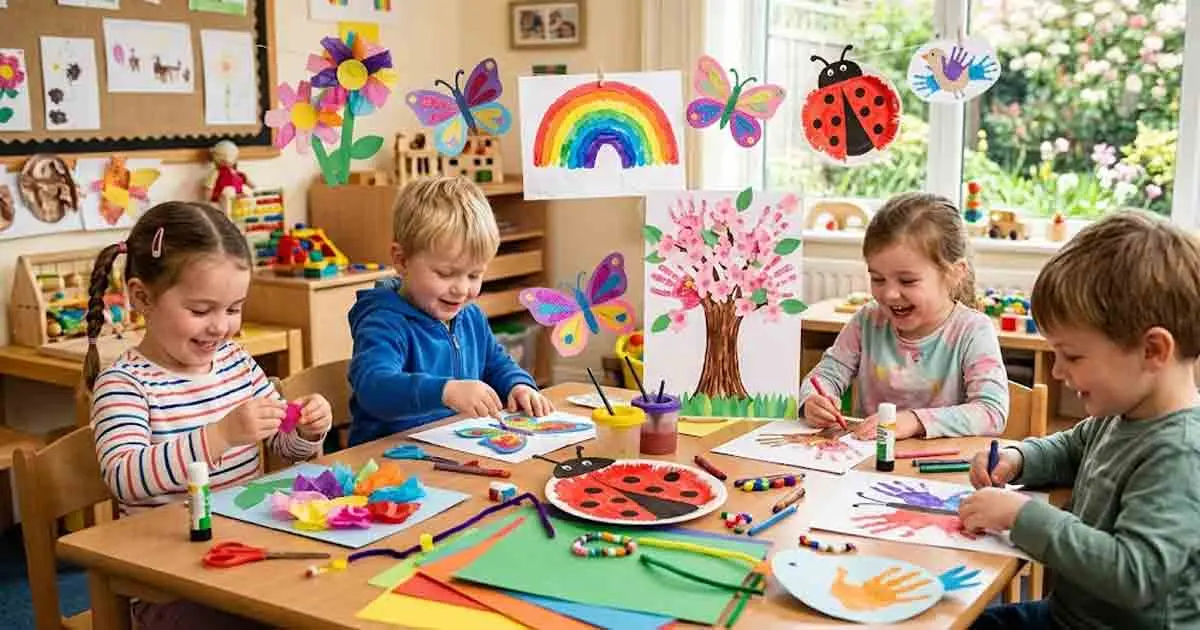
Springtime crafts are the most resourceful time of year for preschool! Flowers, butterflies, rain, rainbows, birds, seeds, and bugs are just some of the endless themes that tie directly to children’s observations in the outside world. The crafts in this guide are grouped by theme and material type, have a developmental skill focus for each and utilize materials that are commonly available in most preschool classrooms or craft drawers. Each activity is suitable for children ages 3-5, and has suggested adaptations for younger and older children in this age group.
Key Takeaways
- Crafts for the spring season are found with common materials such as coffee filters, egg cartons, paper plates, tissue paper and pipe cleaners.
- The arts and crafts develop fine motor skills, promote self-expression and stimulate mental development, laying the groundwork for problem solving and early writing, says mybrightwheel.com.
- Spring crafts are related to science (plant life cycles, weather), math (counting petals, sorting colors), and literacy (tells a story about completed pieces).
- Multi-step crafts with cutting, gluing, painting and assembling are the best developmentally rich spring crafts for preschoolers.
- mccaedu.org lists the following benefits of seasonal spring craft ideas for children: fine motor control, creativity, language and sensory processing.
- Leaf printing, planting seeds and making mobiles with sticks are some of the most effective nature-based crafts that involve an outdoor observation and an indoor crafting.
- Most of the crafts listed here can be completed in 20-45 minutes, and all you need is a simple preschool supply cabinet.
The reasons why spring crafts are important for preschoolers
Mybrightwheel.com says craft activities tend to be small activities, like scissors and paintbrushes, and glue, which requires fine motor skills. Preschoolers develop fine motor skills such as hand-eye coordination, finger dexterity and grip strength through the manipulation of these materials. Skills such as writing, tying shoe laces, buttoning clothes are essential for these skills.
The mccaedu.org website states that children’s seasonal spring craft ideas offer more than just fun. They assist children in learning valuable early learning skills and link classroom to the outside world.
The spring season is an ideal theme for young children as many of the symbols, butterflies, flowers, birds and rain can be seen and felt during the season. A child who has seen a caterpillar crawling on the playground and has created an egg carton caterpillar at the craft table is linking lived experiences with creative production. That’s the link that makes seasonal crafts different from random art projects.
This Spring, create Butterfly Crafts for Preschool
1. Coffee Filter Butterfly
Materials: White coffee filters, washable markers, spray bottle of water, pipe cleaner.
Method: ABCmouse says to lay a coffee filter on a protected surface. Create patterns and designs using washable markers with different colors and shapes. Lightly spray with water from a spray bottle. The colors mix together in the water forming a tie-dye effect. Allow to dry completely. Crush the middle section of the dried filter and collect it to form wings. Twist a pipe cleaner around the middle and secure. With the pipe cleaner ends up, bend to create antennae.
Focus on skill: Observation and understanding of water absorption, fine motor control (twisting and gathering).
Science extension: Discuss how butterflies start off as caterpillars, then make a chrysalis, and then emerge with wings. The concept of metamorphosis is visually represented in the plain white filter, which has been transformed into a colorful butterfly, in a tactile manner.
2. Sponge Painted Butterfly
Materials: Butterfly wing template, small pieces of sponges, paint in spring colors, black construction paper for the body.
Step 1: Crease a butterfly wing template in half. Use sponge pieces to apply paint to one half. Fold the paper in half to print the other half with the same pattern in the form of a symmetrical wing. Open and allow to dry. Glue black paper down the middle crease.
Skill focus: Understanding symmetry, controlled sponge pressure, color selection.
The young child’s love of stamping is extended into making sponge-painted butterflies, according to teaching2and3yearolds.com.
3. Butterfly in a Bottle
Materials: Toilet paper roll, paint, spring colored tissue paper, pipe cleaners, googly eyes.
Method: Use a paint brush to paint the toilet paper roll and let it dry. Fold two pieces of paper in the middle to create wings. Pass the scrunched center of the toilet paper through the toilet paper roll. Thread pipe cleaners for antennae into the top hole. Take one end of the roll and stick on googly eyes.
The three-dimensional construction and assembly sequencing, along with fine motor control skills involving scrunching and threading, are the focus of the skill.
Once children have created their butterfly they may be encouraged to tell a story about the butterfly’s flight, according to mccaedu.org. This is a blend of practical creativity and language learning, enabling children to communicate and articulate their ideas.
Flower Crafts for Preschool Spring
4. Paper Plate Sunflower
Materials: Paper plate, yellow paint, brown paint/brown paper, sunflower seeds (optional), green paper strip for stem.
Method: Classpop.com says to paint the edge of a paper plate yellow to form petals and brown paint the center to form the stem. Allow to dry. Glue in sunflower seeds in the brown centre if desired. Put a green paper strip as a stem.
Materials: glue, scissors, colored pencils, and a sunflower.Learning goals: applying color, gluing accurately and learning the structure of the sunflower.
Science extension: This activity can help preschool children learn about symmetry and nature while practicing their gluing and painting abilities, according to classpop.com.
5. Egg Carton Flower
Materials: Egg carton, scissors, paint, pipe cleaners (for stems), green construction paper leaves.
Materials: Egg carton.Activity: Cut out individual cups from an egg carton. Colour in each cup with a spring colour and let dry. Make a stem by pushing a pipe cleaner through the bottom of the cup. Attach a green paper leaf by wrapping it around the stem.
Skill focus: Cutting with scissors (adult assisted or child led depending on ability), 3 dimensional structure of the flower, combining parts to make a whole.
Classpop.com says this eco-friendly craft helps children learn about recycling and enhance their cutting and gluing skills. The cups can be put together into a bouquet which can then be taken home, with a social purpose other than classroom display.
6. Yarn-Wrapped Flower
Materials required: Cardboard flower shape, coloured yarn in spring colours, glue.
Method: Make a simple flower shape from a large piece of cardboard. Squeeze a thin bead of glue around the perimeter. Start wrapping yarn continuously over the surface of the cardboard flower. Use various colors in sections to create a petal effect. Tuck in the end.
Skill focus: Bilateral hand coordination (wrapping), sustained attention, color pattern decision making.
Cardboard flowers with wrapped yarns help improve hand-eye coordination and give young crafters a taste of layering, classpop.com says. The wrapping movement is repetitive and is appropriate for children who need sensory regulating activities.
Rainbow and Weather Crafts for Preschool Spring
7. Make a tissue paper rainbow collage
Materials: rainbow outline printed or drawn on white paper or card, tissue paper (red, orange, yellow, green, blue and purple), glue stick.
Method: Cut up coloured tissue paper into small pieces. Glue first rainbow arc and press red tissue pieces on. Fill in colors, arc by arc until all colors are used. Allow to dry.
Skill Focus: Color sequencing (order of the rainbow colors), fine motor skills (tearing), working within a shape.
Classpop.com says this spring craft is great for toddlers’ hand eye coordination, for introducing them to basic color recognition, and for giving them some fine motor practice tearing and gluing.
8. 3D Fine Motor Rainbow
Materials: White paper, strips of construction paper in rainbow colours and glue.
Method: Give strips of coloured paper that have been cut in a rainbow order. Children attach each strip in an arc to the white paper, slightly curving it to form a rainbow shape. All the arcs are placed just above the previous arc.
Skill focus: Color ordering, curved line placement, spatial arrangement.
This is one of the best fine motor rainbow activities for preschoolers and creates a wonderful three dimensional rainbow in the context of a spring weather unit according to teaching2and3yearolds.com.
9. Create a rain drop suncatcher with a coffee filter
Materials: Coffee filter, blue marker, purple marker, washable markers, spray bottle of water, tape, blue string or ribbon.
Materials: Coffee filter, blue and purple markers.The Method: Use blue and purple markers to color a coffee filter in patches, overlapping them. Lightly water and bleed colors. Allow to dry fully. Shape into a raindrop. Attach to a window or hang on a string close to a window.
Skill focus: Colour blending observation, understanding of light through translucent materials, delayed result (patience through a two stage process).
Cutting out paper or filter paper raindrops enables children to represent the beauty of spring rain, while also exploring patterns and colour combinations, according to classpop.com.
Nature Based Spring Crafts for Preschoolers
10. Leaf and Flower Print Collage
Materials: Spring leaves, grass, and small flowers gathered, white paper or canvas, paint in spring colors.
Activity: Go for a short walk outdoors with children to pick up leaves and flowers. Return to the table and paint the bottom of each leaf or flower. Press down on paper and pull up to see print. Repeat activity to create a garden composition using other leaves and plants of different colors.
Skill focus: Nature observation, knowledge of the process of print, spatial organization of print on paper.
Leaf printing is a craft that uses leaves and paint to create collages, inspired by nature, which mybrightwheel.com says is a great activity for kids. Allowing children to choose their arrangement means they have ownership of the outcome.
11. Art and Craft for Seed Planting
Materials: Small plastic or paper cup, soil, seeds (sunflower, bean or radish are good options), paint or stickers to decorate the cup.
Method: Children decorate their cup with paint, stickers or markers before planting. Fill with soil. Plant 2-3 seeds 1/4″-1/2″ deep according to the seed species. Water gently and place in sunlight.
Skill focus: Sequencing (decorate, fill, plant, water), responsibility (ongoing care), science (observation over days and weeks).
Little Scholars NYC says that for young children, planting seeds and watching them grow into flowers or vegetables can be a magical experience, and an introduction to the basics of science and biology.
12. Nature Mobile using sticks and found materials
Materials: Sticks, string, natural materials gathered (leaves, seed pods, small stones, feathers), glue or tape.
Materials: Outdoor stick with lengths of string tied along its length. Children glue or tape their collected natural objects to the ends of the string. Hang the completed mobile from a ceiling hook or window frame.
Focus of skills: Balance and spatial arrangement, linking art with a nature walk, fine motor skills of tying and attaching.
This craft is great to do at the start of spring when children can observe new growth and see what’s emerging. The mobile is not just a decoration, it is a record of a moment outside.
Bug and Bird Crafts for Preschool Spring
13. Egg Carton Caterpillar
Materials: Egg carton row (6 cups), green paint, pipe cleaners, googly eyes, small pom poms.
Method: Fill egg carton row with green paint and let dry. Put googly eyes on one end cup. Hold the cup upside down and poke the pipe cleaner antennae through the top of the cup. Decorate with small pompoms or drawn spots.
Learning objectives: Sequential assembly, painting on a 3-D surface, understanding caterpillar body structure.
The egg carton caterpillar is a great springtime activity to do with a butterfly life cycle theme, according to teaching2and3yearolds.com. The caterpillar and coffee filter butterfly can be given as a two-session paired project.
14. Handprint Bird in a Nest
Materials: Brown paint, green paint, orange paper (beak), googly eyes, construction paper (background).
Method: Use a brown paint to print on a background paper a child’s palm and fingers to make the body of the bird; let dry. Rip off brown strips of paper and stick them down underneath the bird to make a nest. Place a small orange paper triangle beak, googly eyes and green grass around the base of the nest.
Focus of skills: Paint, paper, brushes, scissors, glue.Skill focus: Handprint printing technique, combined media (painting and paper tearing), spatial arrangement.
15. Doily Butterfly
Materials: Paper doily, pipe cleaner, markers/paint.
Care.com says that creating butterflies with doiles is a simple process that yields a cute end product. Lightly paint the doily with markers. Fold in the middle and tie with a pipe cleaner to make the body. Make antennae by bending pipe cleaner ends upwards.
Focus skill: Minimal steps, appropriate for the youngest preschoolers, decorating a pre-cut form.
This is a springtime garden and growing crafts for preschool.This is a springtime garden and growing crafts for preschool.
16. Paper Garden in a Box
Materials: Shoebox or shallow cardboard tray, green crinkle paper or painted green tissue for ground, construction paper flowers on stick stems, tissue paper butterflies.
Procedure: Line box with green paper to provide ground cover. Children cut and make paper flowers on craft stick/pine cone stems. Stick stems into a strip of foam or clay in the bottom of the box. Attach tissue paper butterflies and other spring items.
Learner focus: To focus on 3D construction, planning a composition, cutting and assembling a number of parts.
This craft can be used as a small group activity with each child creating a different flower, butterfly, bird, etc. to be put together by the group to make the garden. This collaborative aspect brings a social learning component to the work of the craftsmen.
17. Garden Suncatcher
Materials: Contact paper (sticky on one side), gathered pressed flowers, frame of craft sticks or cardboard.
Method: According to teaching2and3yearolds.com, after noticing new growth in a flower garden, children can make suncatchers. Adhere a sheet of contact paper sticky-side down on the table. Children stamp small flowers, leaves and grass on the sticky surface. Cover with another piece of contact paper or seal with clear tape. Use craft sticks to frame. Place in a sunny window.
Content: Controlled pressure, light through materials, arranging elements on a flat surface.
Classpop.com says that suncatchers made with contact paper and pressed flowers will encourage creativity and fine motor skills.
Spring Crafts has been extended to Curriculum Areas
Crafts for spring can be tied to curriculum topics outside of art, as mccaedu.org states that seasonal crafts are a great way for children to practice important early learning skills, such as creativity, language and sensory processing.
Literacy extension: Children dictate or write a sentence to describe a spring craft they have made. Early writing is integrated with the visual art experience with prompts like “My butterfly has wings the color of…”
Science extension: Look at pictures of the butterfly life cycle before creating butterfly crafts. Look at real flowers, and name their parts before making flower crafts. Discuss what happens when water falls on various surfaces before making rain crafts.
Math extension: Count petals on paper plate flower. When collecting leaves for printing, separate them into different categories by size or shape. Count the parts of an egg carton caterpillar. Integrations can be made in less than 5 minutes and link the craft to numeracy without disrupting the creative flow.
The idea that seasonal craft activities have the most developmental impact when they are deliberately related to what children see in the world around them is the same concept that underlies the most successful seasonal activities throughout the year. In the Preschool Pumpkin Crafting guide, the idea is further developed and a pumpkin craft is used as a way to teach multiple developmental skills in a single activity, such as fine motor skills, early science, and literacy.
Materials List for Preschool Spring Crafts
| Material | Used In |
| Coffee filters | Butterfly, raindrop suncatcher |
| Egg cartons | Flower, caterpillar |
| Paper plates | Sunflower, butterfly wings |
| Tissue paper | Rainbow collage, butterfly wings |
| Pipe cleaners | Butterfly body, caterpillar antennae, yarn flower stem |
| Washable markers | Coffee filter dyeing, doily decoration |
| Spray bottle | Coffee filter color blending |
| Construction paper | Flowers, leaves, nest components |
| Googly eyes | Caterpillar, handprint bird, toilet roll butterfly |
| Green paint | Caterpillar, leaf prints, bird nest |
| Contact paper | Suncatcher, pressed flower projects |
| Collected leaves and flowers | Leaf prints, nature mobile, suncatcher |
| Yarn | Yarn-wrapped flower |
| Cardboard / shoebox | Garden in a box, yarn flower base |
Here are a few suggestions for helping to manage spring crafts in a preschool classroom
Rotate by center. Create 2 or 3 craft stations and have small groups visit each station at different times. This decreases the wait time and increases adult attention per child.
Pre-cut where needed. Pre-cut sections of egg carton, flower shapes, and strips of paper for younger preschoolers so they can concentrate on the assembly and decoration of the pieces without problems with scissors.
Have materials ready for nature walk. For any craft that uses collected natural materials, make the walk outside just before the craft time so the kids are interested in what they collected and the materials are fresh.
DOCUMENT PROCESS NOT PRODUCT. Take a picture of children at every stage of the craft and not just the final product. Process documentation offers more developmental assessment information and enables families to get a fuller picture of the session.
Allow variation. A purple and orange caterpillar is as developmentally useful to a child as a green caterpillar. The learning is not about finding a model to match, it is about the process of creating the learning.
If a craft session is successful in the preschool classroom, the materials are prepared, each step is known in advance, and time is allowed for each step to be completed correctly, then the same applies to any well-executed project. It’s the same concept as the seasonal craft planning guides explored in the guide to free printable 2026 New Year’s crafts, where the preparation steps are eliminated to ensure children can jump right into the crafting.
Conclusion
Preschool crafts ideas for spring are best used when they relate what children see in nature with what they create at the craft table. Each of the twenty crafts in this guide is chosen for the developmental skill practiced, as well as for its seasonal connection.
The best spring craft sessions are a celebration of the natural world as both material and inspiration. In one learning sequence, a child observes leaves on a morning walk, collects them, and prints them into a collage the afternoon. The direct experience and hands-on production is what makes seasonal crafts more than decoration and what makes the season of spring, with its many changes that can be seen and felt, the most fruitful season of the year for preschool art.
To read more guides on seasonal crafts, creative activities and early childhood learning, check out the full range of content at Shani Levni.
Frequently Asked Questions
Which spring preschool crafts ideas are the best?
Coffee Filter Butterflies, Tissue Paper Rainbow Collages, Egg Carton Caterpillars, Paper Plate Sunflower, Leaf Print Collage, Garden Suncatcher, Doily Butterfly, and Handprint Bird in a Nest are the best spring crafts for preschoolers. They are all linked to a spring theme and focus on a particular fine motor or developmental skill.
What materials will I need to make crafts for preschool spring?
Coffee filters, egg cartons, paper plates, tissue paper, pipe cleaners, washable markers, spray bottles, construction paper, googly eyes, paint and contact paper are the most common items needed for preschool spring crafts. Other arts and crafts include those made from leaves, small flowers, and sticks gathered from the wild. Most of the items can be found in the basic classroom supply cabinets or dollar stores.
What are the benefits of spring crafts for children?
From mybrightwheel.com, craft activities help develop fine motor skills (cutting, gluing, painting, assembling); promote self-expression and support cognitive development. Spring crafts also link to science by observing plant life cycles and weather and to math by counting and sorting, and to literacy by telling stories about completed crafts.
How long do Preschool Spring Crafts take?
Most simple spring crafts for preschool take about 20-30 minutes, not including drying time. Multi-stage crafts like the coffee filter butterfly or garden suncatcher need to be dried between stages, and are more successful for two-session projects. Most activities will require a 45-minute block with set up and clean up time.
Is there a way to create springtime preschool crafts without special equipment?
Yes. This guide includes crafts that all can make with household or basic craft supplies. For the butterfly and raindrop suncatcher activities, all you need is a coffee filter, markers and a spray bottle. The caterpillar and flower crafts are covered with egg cartons, paint and pipe cleaners. You do not require any specialist equipment for any of the activities in this guide.
Do there exist spring crafts for the youngest preschoolers (2-3 years old)?
Yes. The doily butterfly, tissue paper rainbow collage, sponge painted butterfly and handprint bird are suitable for ages 2-3 with adult help. These activities are not scissor work and can be used by children who are not yet able to use scissors.
What are some ways to tie spring crafts to curriculum standards?
Fine motor development (writing readiness), science (plant life cycles, weather, butterfly metamorphosis), math (counting petals, sorting by color or size), and literacy (storytelling about completed pieces, labeling parts of a flower or butterfly) are all connections to early learning standards that spring crafts can make. A suggested curriculum extension is provided for each craft in this guide.