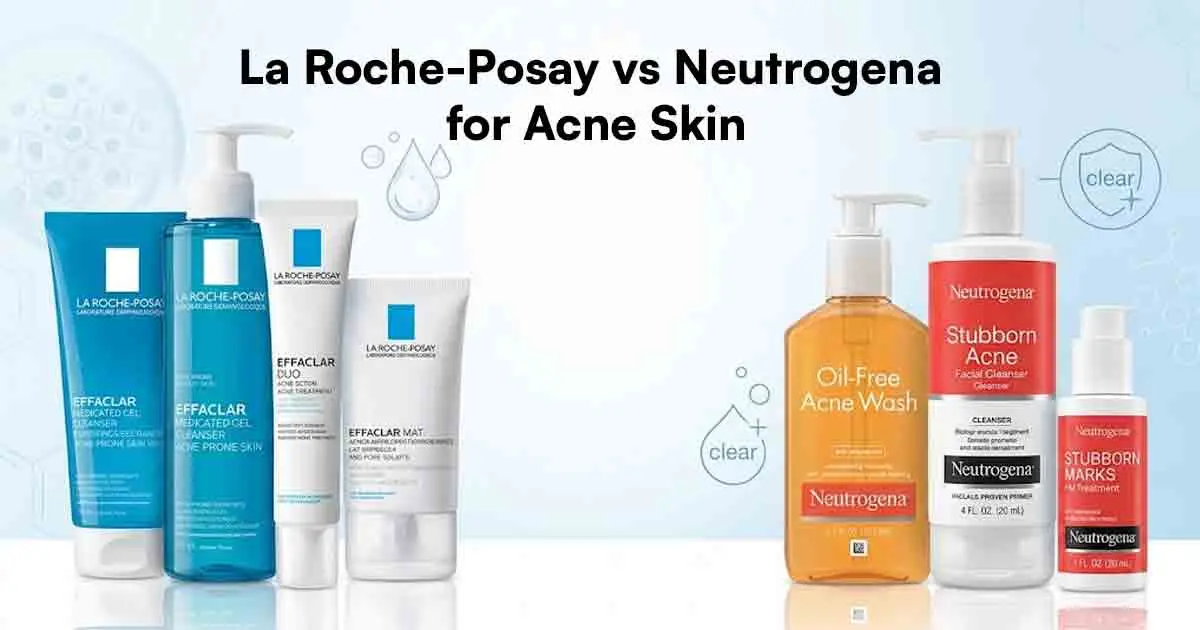
The truthful answer to this question is: it depends on the skin type of a college student suffering from acne. Generally, La Roche-Posay is better for sensitive, easily irritated skin that requires gentle, barrier supporting formulas. Neutrogena is suitable for oily or moderate acne which requires quick and inexpensive treatment. Both brands are dermatologist recommended and both work. The difference is in the manner, the recipients, and the cost. This guide explains the comparison in detail that a real purchasing decision needs.
Key Takeaways
- The range is ideal for sensitive, barrier deficient and reactive types of acne-prone skin thanks to its minimal and fragrance-free formulas and barrier repair with ceramides.
- Neutrogena is ideal for oily, moderate and budget conscious students who require fast action, clinically proven ingredients such as benzoyl peroxide and salicylic acid.
- Achieve Your Best Skin says this about it: La Roche-Posay is the “clinic shelf” while Neutrogena is the “bathroom counter.
- The main active ingredients in acne treatments are salicylic acid, benzoyl peroxide, adapalene, niacinamide and ceramides, some of which are used by both brands, but in various amounts and formulations.
- There is a price difference: La Roche-Posay products average $15-$35. The average price of a Neutrogena product is $7-$18.
- Most dermatologists suggest you use both brands instead of one, with La Roche-Posay for cleansing and moisturizing, and Neutrogena for acne-specific treatments.
- Brand loyalty is not as important as consistency. The best product is one that a student will use every day without fail.
Why College Students Get More Acne
It’s best to know the reasons for why acne tends to get worse in college before comparing brands. howinsights.org states that acne occurs when pores get clogged with oil, dead skin cells, and bacteria. College life further speeds up all of these triggers.
As per dostishayare.com a dermatologist explained that stress in college leads to rise in cortisol levels, which causes an increase in sebum production, leading to blockage of pores and acne. The following factors of college life are known to aggravate acne:
- High cortisol due to school stress: Cortisol directly stimulates the production of oil and inflammatory response in the skin.
- Irregular sleep patterns: Sleep loss affects the repair cycle of the skin during the night, and increases inflammatory markers.
- High-glycemic diets, dairy, and processed snacks are associated with worsening acne in several studies, and should be avoided.
- Inconsistent routines: Skipping cleanser applications or applying any available cleanser adds to the existing stress on the skin.
- Environmental factors: Shared bathrooms, pollution, and regular mask usage (in exam settings) all can play a role.
Knowing these triggers makes it easier to see why a product that takes one or two steps and irritates a little will be more successful at the college student than one that takes a lot of steps and irritates a lot.
La Roche-Posay is what?
La Roche-Posay is a French pharmaceutical skin care line of products, owned by L’Oréal. Achieve Your Best Skin says all products begin with a sensitive-skin attitude: little or no fragrance, a controlled pH and ingredients that help repair the skin, such as ceramides and niacinamide. The brand’s recommendation by dermatologists all over the world is backed by the company’s investment in clinical trials. The same source states that La Roche-Posay is the market leader in clinical documentation, as its formulas have been published in scientific studies of atopic dermatitis, acne and barrier repair.
The brand’s thermal spring water, from La Roche-Posay, western France, is used in a number of formulations as a base, and it also contains selenium, a trace element with proven antioxidant and anti-inflammatory properties.
La Roche-Posay Key Acne Products
| Product | Key Ingredients | Best For |
| Effaclar Medicated Gel Cleanser | Salicylic acid 2% | Daily cleansing, oily and acne-prone skin |
| Effaclar Duo Dual Action Acne Treatment | Benzoyl peroxide 5.5%, Lipo-Hydroxy Acid | Active breakouts, post-acne marks |
| Toleriane Hydrating Gentle Cleanser | Ceramides, niacinamide | Sensitive acne-prone skin, dry/combination |
| Toleriane Double Repair Moisturizer | Ceramides, niacinamide, prebiotic thermal water | Barrier repair, post-treatment moisturizing |
| Effaclar Adapalene Gel 0.1% | Adapalene (retinoid) | Persistent acne, comedones, anti-aging |
What Is Neutrogena?
Neutrogena is a Johnson and Johnson owned American brand of drugstore skincare products. Beauty Secret By Samira says Neutrogena wins in terms of consumer adherence figures – people are more likely to repurchase based on sensory appeal and availability. It is available in all pharmacies, supermarkets and online, so it is the go-to brand for students who need something readily available.
Neutrogena’s products are often more concentrated with active ingredients that fight acne, leading to quicker results, but also resulting in greater irritation to sensitive skin.
Neutrogena Key Acne Products
| Product | Key Ingredients | Best For |
| Oil-Free Acne Wash | Salicylic acid 2% | Daily cleansing, oily and combo skin |
| Rapid Clear Stubborn Acne Spot Gel | Benzoyl peroxide 10% | Spot treatment, fast active breakout clearing |
| Hydro Boost Gel-Cream | Hyaluronic acid, dimethicone | Oily acne-prone skin needing hydration |
| On-The-Spot Acne Treatment | Benzoyl peroxide 2.5% | Mild spot treatment, sensitive-oily skin |
| Stubborn Acne AM Treatment | Benzoyl peroxide 2.5%, niacinamide | Daily treatment layer for persistent acne |
Key Ingredients Compared
Usually, it’s more about what ingredients are in the product than the brand name, as the active ingredients make the difference in the results of acne treatment, according to nadiahameed.com. Both brands feature the same key active ingredients that combat acne, but in varying strengths and formulations.
Salicylic Acid
Both brands have products containing 2% salicylic acid, the highest concentration allowed on the market in the U.S. Salicylic acid is a beta-hydroxy acid (BHA) that works by penetrating oil-filled pores, exfoliating the lining of the pores and reducing blackheads and whiteheads. howinsights.org says salicylic acid unclogs pores and helps to cut down excess oil.
Verdict: Equal. Both brands contain 2% salicylic acid and it is effective in both.
Benzoyl Peroxide
Neutrogena has a range of benzoyl peroxide concentrations from 2.5% to 10%. La Roche-Posay’s Effaclar Duo combines 5.5% with a milder exfoliating derivative called Lipo-Hydroxy Acid (LHA), which lessens the irritation that is often caused by pure benzoyl peroxide. howinsights.org states that benzoyl peroxide is a bactericidal and pore-clearing agent.
Winner: Verdict: 10% spot gel is faster acting from Verdige. The 5.5% with LHA formulation is more gentle and less irritating to sensitive skin than La Roche-Posay’s other formulations.
Adapalene (Retinoid)
Today, both brands have OTC adapalene available in 0.1%. Skinsort.com states that adapalene belongs to the class of retinoids which visibly decrease acne and indications of aging. The active ingredient concentration and efficacy of these two products, La Roche-Posay’s Effaclar Adapalene Gel and Neutrogena’s Adapalene Gel, are the same, meaning they work in the same way.
Verdict: Equal. Select according to feel and price.
Use of ceramides and barrier repair
The moisturizers at La Roche-Posay contain ceramides, niacinamide and prebiotic thermal water. As per skinsort.com, ceramides help retain moisture and maintain the barrier of the skin. Neutrogena’s Hydro Boost does not contain ceramides, but it contains hyaluronic acid, which is very hydrating but not as effective at repairing the barrier.
Verdict: La Roche-Posay is the winner for barrier repair. This is particularly important if the skin is acne-prone and has been severely treated with active ingredients, a common occurrence in college students who use them too much.
Niacinamide
Both brands feature niacinamide in some of their products. Skinsort.com states that niacinamide fortifies, smoothens and brightens skin. Unlike Toleriane Double Repair Moisturizer, which is more of a barrier-support formula, the latter also includes niacinamide. Stubborn Acne AM Treatment also contains niacinamide from Neutrogena.
Verdict: It’s similar, but La Roche-Posay consistently combines niacinamide with barrier ingredients.
The sensitivity and skin tolerance of the plant
For many college students, the biggest distinction between the two brands lies at this point.
If you have skin that is prone to flushing or unpredictable, then Achieve Your Best Skin says La Roche-Posay’s simplicity is the winner. For sensitive skin, La Roche-Posay products are fragrance-free, non-comedogenic and dermatologist-recommended, says Beauty Secret By Samira.
Overuse and application to damaged skin of Neutrogena’s higher concentrations, especially the 10% benzoyl peroxide spot gel and salicylic acid washes, have been known to cause dryness, peeling and irritation. This is not a bad thing; good actives are supposed to be strong, but it means that Neutrogena’s full strength products must be used in conjunction with them, and moisturization is a must.
Achieve Your Best Skin states that the Toleriane line from La Roche-Posay has the advantage for dry or barrier-impaired skin as it contains less volatile alcohol and has more ceramide in its formulas.
Price comparison for college students
Money is a serious issue for most college students. There is a huge difference in price between the two brands.
| Product Type | La Roche-Posay (avg.) | Neutrogena (avg.) |
| Cleanser (6 to 7 oz) | $15 to $22 | $7 to $10 |
| Spot treatment | $18 to $25 | $8 to $12 |
| Moisturizer (1.7 oz) | $20 to $35 | $10 to $18 |
| Adapalene gel | $25 to $30 | $12 to $16 |
| Monthly routine (est.) | $50 to $80 | $20 to $40 |
A student on a budget will find that Neutrogena offers a complete effective acne treatment for about half the price of the same treatment from La Roche-Posay. The price gap is greatest with moisturizers and cleansers, with La Roche-Posay’s thermal spring water base and clinical formulation process commanding a high price.
It is important to note, however, that La Roche-Posay items are frequently on sale in the Target Circle, with Amazon Subscribe and Save, and campus health center partnerships. If a student is eligible for student health insurance or flexible spending accounts, they may also use these funds to purchase skincare products that have been recommended for their skin by a dermatologist.
Which brand is better, the verdict by skin type
The key is to know your skin type, observe reactions, and have a routine, says howinsights.org. The truthful comparison gives varying responses, depending on the student who is asking.
| Skin Profile | Better Choice | Reason |
| Sensitive, reactive, easily irritated | La Roche-Posay | Minimal formulation, barrier-friendly, fragrance-free |
| Oily, moderate-to-severe acne | Neutrogena | Higher active concentrations, faster visible results |
| Dry with acne | La Roche-Posay | Ceramide moisturizers protect barrier while treating acne |
| Combination skin | Either or both | Use LRP moisturizer with Neutrogena spot treatment |
| Very tight budget | Neutrogena | Comparable active ingredients at significantly lower cost |
| Post-treatment recovery | La Roche-Posay | Toleriane line specifically designed for irritated skin |
| First-time acne treatment | La Roche-Posay | Lower risk of over-stripping or irritation reaction |
Use Both is the Dermatologist-recommended strategy
Dermatologists frequently recommend using both brands together, says Achieve Your Best Skin. The two pillars of compliance are scientific rigor and user enjoyment and the synergy is both of these. A combination of the two might be this:
Morning:
- The gentle, barrier-safe La Roche-Posay Toleriane Hydrating Gentle Cleanser removes impurities and exfoliates without harming the skin.
- Neutrogena Hydro Boost Gel-Cream (HYDRATION, OIL FREE)
- SPF 30 or higher (either brand, or a dedicated SPF product)
Evening:
- La Roche-Posay Effaclar Medicated Gel Cleanser (salicylic acid cleansing)
- Neutrogena Spot Gel (benzoyl peroxide)
- The La Roche-Posay Toleriane Double Repair Moisturizer (barrier repair overnight) is a good choice for overnight barrier repair.For overnight barrier repair, the La Roche-Posay Toleriane Double Repair Moisturizer is a good choice.
The cleanser and moisturizer are both formulated with the gentlest ingredients and provide barrier support, which is why they are both used by this routine on the skin, while the active ingredients in the treatment are most important, the Neutrogena is used.
The following are some things that are undesirable for a college student
There are some common errors that decrease the effectiveness of both brands and can worsen acne.
Over-cleansing: Washing more than twice a day will remove the skin barrier and cause the skin to produce extra oil to compensate. Limit to morning and evening.
Immediate use of maximum strength products: If you use a 10% benzoyl peroxide or a daily retinoid without a gradual introduction, the acne will become worse due to skin peeling, redness and barrier damage.
No moisturizer: Both brands need to be moisturized when using the active ingredients. Drying off with no moisturizer will make the skin more irritated and won’t make it more effective.
Frequent product changes: nadiahameed.com says it’s more important to stick with a product than to change it too often. It takes 6 to 8 weeks of regular treatment to see any real change in acne. Students often don’t see improvement because they change brands or products every 2-3 weeks.
The same spot treatment for all types of acne: Benzoyl peroxide is effective for inflammatory acne (red, swollen pimples). Salicylic acid is more effective on clogged pores, blackheads, and whiteheads. If you use the wrong type of active on the wrong type of acne, it won’t work.
When do you need to see a dermatologist?
Both La Roche-Posay and Neutrogena are OTC brands. They’re suitable for mild to moderate acne. The effective products address one or more of the causes of acne: oil, dead cells, and bacteria, according to howinsights.org. However, they don’t cover every cause.
A dermatologist visit is appropriate if the acne is severe, cystic, and causes significant scarring or if the acne does not improve after 8 weeks of consistent OTC treatment. Prescription products such as tretinoin, clindamycin, doxycycline and hormonal products work in ways that OTC products can’t. Students enrolled at many campus health centers can get dermatology referrals from the health center for free.
Conclusion
Both La Roche-Posay and Neutrogena are not necessarily better for college students suffering from acne-prone skin. For sensitive, reactive and barrier-compromised skin, or for students who are new to acne treatment and want to reduce the risk of irritation, the alternative is better: La Roche-Posay. Neutrogena is a better option for oily skin and for students who are on a budget and require quick and easy results.
The best way, according to dermatologist opinion, is to combine the best of both worlds: The gentle cleansers and the ceramide moisturizers from La Roche-Posay and the targeted spot treatments from Neutrogena. This pair is the perfect barrier protection and active acne treatment without the price tag of having an all La Roche-Posay line.
First and foremost, consistency is more important than brand. The neutrogena routine will be more effective than the La Roche-Posay routine if it is used daily for eight weeks. The simplest skin care regimen that a college student will follow is the best.
To find out more about health, skin care, and everyday life, go through the entire collection of content on Shani Levni.
Frequently Asked Questions
So if you have acne-prone skin, are the La Roche-Posay products better than the Neutrogena?
It is dependent on the type of skin that you have. La Roche-Posay is generally good for sensitive, barrier impaired, or reactive skin prone to acne. Neutrogena tends to work better for those with oily or moderate acne who require quick results. The dermatologists recommend La Roche-Posay for the “clinic shelf” (clinical documentation and sensitivity) and Neutrogena for the “bathroom counter” (accessibility and compliance), according to the website Achieve Your Best Skin.
Which brand is more affordable for college students?
Neutrogena is much cheaper. The total price of a Neutrogena acne treatment is about $20 to $40 per month. The La Roche-Posay equivalent costs $50-$80. There are other options, though, that can help reduce the cost gap: La Roche-Posay can be found at Target Circle, Amazon, or student health programs.
Which active ingredients should I seek out in an acne product?
The active ingredients in OTC acne treatments include pore-clearing salicylic acid (2%), bacteria-killing benzoyl peroxide (2.5%-10%), cell turnover salicylic retinoid adapalene (0.1%), anti-inflammatory niacinamide, and barrier-supporting ceramides. Products with these ingredients are available from both brands.
Is it safe to use La Roche-Posay and Neutrogena together?
Yes. The majority of dermatologists will suggest that you use both brands together. One strategy is to use La Roche-Posay for cleansing and moisturizing (where gentle formulation is most important) and Neutrogena for spot treatment (where the concentration of the active ingredient is most important).
How long does it take to see results from either brand?
Most treatments take 6 to 8 weeks of regular use, every day, to see results. nadiahameed.com states that consistency is more important than changing products frequently. One of the most frequent reasons why OTC acne treatment is not effective is that they switch brands or products before eight weeks.
Does the additional expense of La Roche-Posay make sense for a college student?
It will depend on the skin you have. The milder formulas of La Roche-Posay are less likely to cause over stripping and damage to the skin barrier, which can exacerbate acne for those with sensitive or reactive skin. Neutrogena’s lower price and identical active ingredients offer the same benefits for students who have resilient oily skin. When money is the main concern, Neutrogena’s main products offer clinically proven ingredients for half the cost.
What is the best brand to use for acne scars and post acne marks?
The Effaclar Duo with LHA from La Roche-Posay treats acne and post-acne marks. Over time, both brands’ niacinamide products lighten hyperpigmentation. The most well-supported OTC retinoid is adapalene (from either brand) for significant scarring.