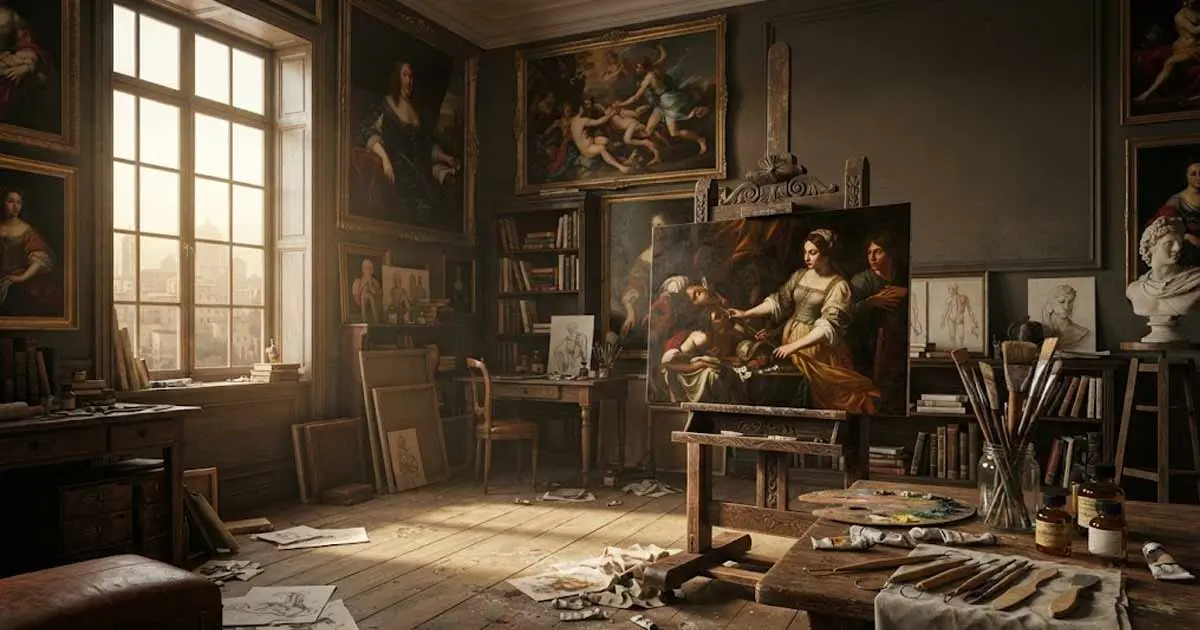
There is no one answer to the question of who is the best traditional artist in the world, and any serious consideration of the subject should start with that admission. Art criticism is not a game of points with a score to be tallied. What constitutes the “best” artist will vary based on the criteria used: critical consensus, auction price, institutional recognition, influence on later artists, technical skill, or emotional and intellectual response of the viewer. This book looks at the artists most often voted the best on each of those lists, discusses what they have accomplished and why they are considered great artists, and provides a straightforward overview of where the professional opinion is now.
Key Takeaways
- While there is no consensus on any one artist being the “best” of the traditional school, the most frequently mentioned top living artist by critics, auction prices, and institutional awards is Gerhard Richter, who has been called by Lux Magazine “the world’s greatest living artist.
- With a career spanning more than 60 years, David Hockney is the most commercially successful living British artist and the most expensive living artist ever, with a record of $90.3 million for Portrait of an Artist, set at an auction.
- Ibrahim Mahama was placed No. 1 on ArtReview’s 2025 Power 100 list, the most comprehensive and influential ranking of living artists by institutions and critics.
- Traditional artists are people who paint, sculpt and print using historical technique and media (oil, watercolor, stone, bronze) rather than digital, NFT and installation.
- The best traditional artists of history are Leonardo da Vinci, Michelangelo, Rembrandt, Caravaggio, Vermeer, Velázquez, Goya, Rubens and Turner, who are all at their best in their respective art forms.
- The most critically acclaimed living traditional painters are: Gerhard Richter, David Hockney, Jenny Saville, Anselm Kiefer, Lucian Freud (deceased in 2011 but recent enough to be included in the current discussion), and Sean Scully.
- Auction price is not a perfect, but well documented measure of market consensus: Richter’s most expensive painting was sold for $46.3 million, Hockney’s for $90.3 million, and Lucian Freud’s for $56.2 million.
What is a Traditional Artist?The meaning of the term ‘Traditional Artist’
In this guide, the term “traditional artist” is used in a variety of ways, and the meaning of this term is important for organizing this guide.
A traditional artist is a person who uses physical means (canvas, paper, stone, bronze, wood, etc.) and techniques that have been used in the past to create art. This is different from digital art, NFT-based art, or installation art that is mostly technologically driven, light, or found objects.
In the art market and critical discourse, “traditional” is used to specifically refer to painting, printmaking, drawing, and figurative or representational sculpture. In this sense, a traditional artist is a painter working with oil or acrylic on canvas, whether they paint representational or abstract pictures, or whether their subject matter or conceptual approach is very modern.
This guide includes both the greatest living artists in traditional media and the greatest historical traditional artists, as the question “best in the world” is sometimes asked without a time frame limitation.
The Greatest Living Traditional Artists: Critical and Market Consensus
Gerhard Richter: The Most Cited Greatest Living Painter
Gerhard Richter is the artist most often cited as the greatest living traditional artist in critical publications, auction sales and institutional awards. Lux Magazine dubs Richter the world’s greatest living artist, noting his capacity to reinvent himself, pioneer new genres and combine social commentary with the purity of fine art.
Richter is regarded by many as the “Master of Modern Painting” by Superprof. He was born in Dresden, Germany in 1932 and is now 93 years old and retired from active production. According to contemporary art sources, the most expensive painting he ever sold was at auction for $46.3 million.
Richter’s reputation is based on his wide and scholarly range of work. Throughout his career he shifted from photorealism to abstraction, and his signature method was the “Richter blur” where he dragged a squeegee across wet oil paint to produce images that were between photography and painting. Richter is a master of photorealism and abstract art, frequently hopping between the two styles, Artsology reports. His art is in the realm between control and unpredictability.
The contemporary art blog on Sotheby’s Realty states that Richter’s entire career was dedicated to challenging what painting could be, with a clear shift in commitment to different stylistic direction, and defiance against the limits of traditional fine art painting.
His works are in major museums around the world, such as Tate Modern, MoMA and the Städel Museum. His work, in the form of stained glass windows of exceptional size, is permanently installed in Cologne Cathedral, where his practice is placed in one of the most historic architectural contexts in Europe.
David Hockney is the most commercially successful living British painter
David Hockney (1937- ) is one of the world’s most famous painters and the most valuable living artist in the auction market. Born in Bradford, he was one of the most significant 20th century British figurative painters according to Sotheby’s Realty.
Portrait of an Artist (Pool with Two Figures) was sold at Christie’s in 2018 for $90.3 million, the highest price ever paid for a work by a living artist. That record has since been broken by Jeff Koons, but it is one of the most important auction results in art history.
According to Artsology, Hockney is a master of color and clarity. He is a British painter, printmaker and photographer and one of the most influential and significant artists of his time. His renowned swimming pool series, Yorkshire landscape series and his more recent iPad drawings have all garnered huge critical and popular acclaim.
Today, Hockney is going on his painting journey through digital art on the iPad, a creation of his life in Normandy during the pandemic, according to Superprof. Today, at the age of 88, he has embraced digital art while remaining one of the world’s most prolific contemporary artists.
This is the year of Ibrahim Mahama, the Most Institutionally Influential Artist of 2025
Born in 1987 in Ghana, Ibrahim Mahama is named No. 1 in ArtReview’s 2025 Power 100 ranking, the most comprehensive art list of living artists by institutional and critical influence. Mahama’s work fuses artistic practice with cultural infrastructure, creating installations that speak to social history and community engagement across the globe, according to the World Cultural Capital Index Art Division’s 2026 ranking.
Mahama’s monumental installations, comprised of recycled textiles, notably jute sacks, are large-scale works that reflect on Ghana’s economic past, colonial history, and social present. In 2019 he was presented at the Venice Biennale and in 2024 he was presented at Art Basel.
Mahama’s work is more installation-based than painterly, but his materials and methods are physical, tactile, and craft-based, not digital, and he is thus part of the vast category of the traditional practice of art at its most ambitious contemporary extension.
This is the greatest living German painter after Anselm Kiefer
Anselm Kiefer (1945-) is one of the most important German painters of the late 20th and early 21st centuries, whose large-scale paintings are concerned with German history, mythology and the Holocaust. His use of materials such as lead, straw, ash and shellac, combined with paint, results in surfaces of extraordinary textural complexity.
Kiefer features in the top 20 list of the most cited names of today’s greatest living painters in Contemporary Art Issue’s ranking. His works are collected by major museums around the world such as the Centre Pompidou, Tate Modern and the Museum of Contemporary Art Los Angeles.
His paintings are large, ambitious in material, and deal with some of the most challenging subjects of modern European history, earning him a critical reputation for being both aesthetically accomplished and intellectually serious.
Jenny Saville: The Most Significant Living British Figurative Painter
Born in 1970, Jenny Saville is always referred to as one of the most important British painters of her time, and is noted for her large-scale figurative paintings, which portray the human body at an unusual scale, intensity and technical richness.
Saville’s paintings, according to the contemporary portrait artist’s guide by Zarastro Art, are known for their raw and honest depiction of the human body, sometimes questioning beauty norms and body image, offering her subjects extreme figures. She is both provocative and engaging in her approach to portraiture.
Her large oil on canvas painting Propped was first exhibited in 1992 and has since been one of the most talked about British paintings of the past three decades. Saville produces oil paintings on linen in a style which is directly linked to Lucian Freud, who has been a significant influence on her studies from afar, but not her formal teacher.
Lucian Freud (1922-2011) was the greatest British painter of the 20th century
Lucian Freud died in 2011, but his legacy is alive and well in the world’s greatest traditional artists as his death was recent enough to continue to shape the terms of modern figurative painting. The Lucian Freud Painting People monograph cited by art book sources considers Freud to be one of the world’s greatest realist painters.
He is one of the most commercially successful traditional painters in auction history, having sold his most expensive painting, Benefits Supervisor Resting, at Christie’s for $56.2 million in 2015. As for Freud’s portrait of Hockney, “It is hard to think of two greater British artists who are as critically and commercially acclaimed as Lucian Freud and David Hockney,” says Sotheby’s director Tom Eddison.
Freud’s method was to sit with his patients for extremely long periods, sometimes years, and to apply thick, directional brushstrokes to his canvases which encompassed the psychological significance and the physical particulars of his patients. His 1991 painting of the performance artist Leigh Bowery, and his series of paintings of his own mother, are some of the most psychologically intense paintings in contemporary figurative painting.
The greatest artists of all time
No one can answer the question of who is the best traditional artist in the world without realizing that the greatest traditional artists are not in the world in 2026. All traditional artists are judged in the context of the historical canon of Western art.
Leonardo da Vinci (1452 to 1519)
The most famous names in traditional art are Leonardo da Vinci, the painter, sculptor, architect, scientist, and engineer, who created the Mona Lisa, The Last Supper, and Vitruvian Man, all of which have shaped the way Western art has understood human proportion, sfumato technique, and narrative composition. His notebooks reveal a variety of mental activity with painting as a field of study that is unparalleled in its scope.
Michelangelo (1475 to 1564)
Michelangelo’s Sistine Chapel ceiling fresco (1508-1512) and his sculptures such as the David and the Pietà were the culmination of Italian Renaissance excellence in two traditional media. His technical command of the human figure, both in painting and marble sculpture, was such that all European artists and sculptors of the next four hundred years were influenced by him.
Rembrandt van Rijn (1606 to 1669)
Rembrandt is generally regarded as the most important oil painter of the Dutch Golden Age, and as the most important portrait painter in Western art history. His mastery of chiaroscuro (the play of light and shadow) and his ability to capture the psychological life of his figures through paint on canvas established a body of work that includes some 90 self-portraits over 40 years of his career that continues to be the fundamental reference point for figurative oil painting.
Johannes Vermeer (1632 to 1675)
Only 34-36 paintings by Vermeer remain and they are of exceptional compositional and luminosity perfection. His representation of the quality of light that enters a domestic interior, achieved through careful observation and precise technical execution, has made him one of the most studied artists in art history. His Girl with a Pearl Earring (c. 1665) is one of the most famous pictures in Western art.
Caravaggio (1571 to 1610)
Caravaggio’s dramatic realism and his use of tenebrism, extreme contrast between light and dark areas, revolutionized European painting in the early 17th century, and directly set the visual language for Rembrandt and the whole Baroque movement. His paintings of religious subjects, in the visual language of the contemporary street, with working-class models and naturalistic lighting, are among the most viscerally powerful in western art.
How “Best” is Defined: The various criteria
The answer to the question of who is the best traditional artist is highly dependent on the criterion used and varies with the criterion.
| Criterion | Answer |
| Auction price record (living artists) | David Hockney ($90.3 million) |
| Critical consensus (living painters) | Gerhard Richter |
| Institutional influence ranking 2025 | Ibrahim Mahama (ArtReview Power 100 No. 1) |
| Most studied in art history | Leonardo da Vinci |
| Greatest portrait painter (historical) | Rembrandt |
| Greatest colorist (20th century) | Matisse |
| Greatest living British painter | David Hockney or Jenny Saville |
| Greatest figurative painter (recent) | Lucian Freud (1922 to 2011) |
| Most intellectually rigorous (living) | Gerhard Richter |
No one artist can win all of the awards at once, so there is no easy answer for “the best”. The most accurate statement is that Gerhard Richter is the best-known, most widely regarded, most commercially successful living painter in traditional media, and that Leonardo da Vinci and Rembrandt are the two most important painters of the centuries-long history of Western painting.
Traditional Art vs. Contemporary Art: The Critical Divide
The difficulty in answering this question lies in the difference between what the art critics consider to be art and what the public does. For decades, the contemporary art world, which focuses on the big auction houses, galleries, and art fairs, has preferred conceptual and installation-based work over painting and sculpture. Artists such as Jeff Koons, Damien Hirst and Yayoi Kusama are highly sought after and market valued, yet they produce work that directly challenges what is considered to be craft and technique.
In the circle of critics who hold a special regard for technical excellence in traditional media, the discussion is more focused on the painters such as Richter, Kiefer, Saville and Hockney, and on the direct continuation of the historical European painting tradition, which is still in evidence in figurative and abstract painting.
This division is evident in the difference between the Power 100 list of ArtReview, which is based on institutional influence and critical discourse, and the type of critical writing that is produced by the specialist painting historians and curators who assess artists based on the quality of their work in terms of composition, color, surface and technique.
The question of how an artist’s reputation is built and measured over time, and what is historically significant, is one that is directly linked to the processes of the art market and documentation’s role in creating the value of a work over time. The guide to certificate of authenticity for artwork explores the principles of the formal establishment of authenticity and the documentation practices that safeguard the work’s market value and historical record, in practical terms for artists and collectors.
Non-Western Traditional Artists: Expanding the Frame
But any full response to the question of who is the best traditional artist in the world must include the fact that the critical and commercial discussions that give rise to the names most commonly mentioned in response to the question have been dominated by the European and American canon. The most prominent traditional artists outside that context are:
Katsushika Hokusai (1760-1849): The Japanese ukiyo-e master whose series of woodblock prints, Thirty-Six Views of Mount Fuji, is one of the most famous images in world art history, including The Great Wave off Kanagawa. The skill of line and composition and the expressive possibilities of the simple color in the highly restricted print medium are unparalleled in Hokusai’s tradition.
Zhang Daqian (1899-1983): The Chinese painter regarded as one of the most talented traditional painters of the 20th century, who not only mastered the classical Chinese painting styles but also invented a new type of abstract splashing with ink, which directly inspired Western Abstract Expressionism.
Frida Kahlo (1907-1954): The Mexican painter, whose work was highly personal, autobiographical, and a synthesis of Mexican folk art and European Surrealism. Her work is now one of the most commercially profitable in Latin American art history and her impact on culture has been far greater than what is reflected in the art world.
Whether traditional mastery in non-Western media (ink, woodblock, textile, mosaic) is the same as traditional mastery in Western oil painting is a question that has been debated for decades in the contemporary art world, and the strongest position is that great traditional art exists in all these forms, and that the preponderance of European names in standard lists is due to the historical distribution of art market power, not an objective assessment of quality.
The role of art as a vehicle for transmitting a community’s values and need for shared meaning over time is a common thread in art studies in many settings. It is linked directly to the analysis of compositional tradition, in the guide to the composition of the Maestà painting by Simone Martini, in which a single early 14th-century fresco is made to bear the weight of the community’s religious and political values in its visual structure, as the best traditional art is always technically accomplished and culturally embedded.
Who Will Be the Next Great Traditional Artist?
There are a few names that regularly turn up in the most esteemed critical publications among artists under 50 who are getting serious critical attention for their work in traditional painting and sculpture.
Artnet News’ 2025 list of 25 artists pushing the boundaries of contemporary painting includes painters such as Pol Taburet (France), Maja Ruznic (Bosnia/USA) and Antonio Obá (Brazil). These artists combine traditional painting methods with modern themes and content, incorporating oil paint, canvas, and figurative forms to explore cultural, historical, and personal themes relevant to the present moment.
These artists’ early reputations are being built in the institutions and publications that have traditionally formed the critical consensus that defines a reputation over decades, such as Gagosian, Hauser and Wirth, ArtReview, Artforum, and the large biennials.
Conclusion
Who is the best traditional artist in the world? Well, that’s a question that can only be answered honestly, depending on the criteria used and the time frame in question. Gerhard Richter is the most widely praised living artist in traditional media and among living artists, David Hockney is the most successful and popular. By the measure of global cultural influence the 2025 institutional Power Rankings, produced by ArtReview, Ibrahim Mahama is ranked first, ahead of the likes of Leonardo DiCaprio, which is impressive. The next generation of living traditional painters are represented by Anselm Kiefer and Jenny Saville.
The names of Leonardo da Vinci and Rembrandt van Rijn are most frequently linked to the best traditional Western painting. In traditional Japanese printmaking, Hokusai occupies the same role. The question who is best is not so important as the answers that reveal the importance of each of these artists: technical skill, intellectuality, and ability to yield work that continues to reward continued attention long after it has been created.
Visit Shani Levni for a full repertoire of art history, contemporary artists and the visual traditions that link them.
Frequently Asked Questions
Who is the world’s greatest traditional artist?
There is no answer which is universally accepted. Of the living artists, by critical consensus, Gerhard Richter is the greatest painter in traditional media. David Hockney has the highest auction record of any living artist and is best known to the public. The greatest traditional artists in Western art history have been traditionally said to be Leonardo da Vinci and Rembrandt van Rijn.
In 2026, who is the greatest living painter?
According to critics, Gerhard Richter (b. 1932) is the greatest living painter. Lux Magazine calls him “the world’s greatest living artist. David Hockney (b. 1937) is the most successful living artist by auction record, with a Portrait of an Artist that sold for $90.3 million.
What is it that makes an artist “traditional”?
A traditional artist is normally defined as a person who is working with a physical medium that has a historical precedent, such as oil paint, watercolor, pencil, stone, bronze, or ink. It is contrasted to digital art, NFT-based art, and installation art, which is more technologically or found-object based. Traditional is a term that can be applied to both representational and abstract painters who use physical media and craft-like methods.
Who is the highest bidder at auction for a traditional artist?
In 2018, Portrait of an Artist (Pool with Two Figures) by David Hockney was sold at Christie’s for $90.3 million, the highest price ever paid for a living artist at the time. The recently deceased artists that sold the most include Lucian Freud’s Benefits Supervisor Resting, which sold for $56.2 million at Christie’s in 2015. The most expensive painting by Gerhard Richter was sold for $46.3 million.
Who was the most famous artist in the history of art?
Leonardo da Vinci is undoubtedly the most famous name in Western art history, and is known for his skill in painting, drawing, and scientific observation across several fields. He is often compared to Michelangelo and Rembrandt as the three greatest traditional artists in Western art history.
Is David Hockney a traditional artist?
It is important to remember that the majority of David Hockney’s career has been spent working in traditional media such as oil and acrylic painting, printmaking, drawing and photography, all of which have a historical tradition. His latest experiments with drawing on the iPad are not a break from the tradition of his work but an extension of it, and he still works in traditional drawing media as well.
Who is the world’s best traditional artist that isn’t Western?
The most internationally known non-Western traditional artist was Katsushika Hokusai (1760-1849) whose Thirty Six Views of Mount Fuji woodblock series is well known. Zhang Daqian (1899-1983) is regarded as the greatest traditional painter in the 20th century in China. Frida Kahlo (1907-1954) is the most commercially successful traditional Latin American painter in auction history.