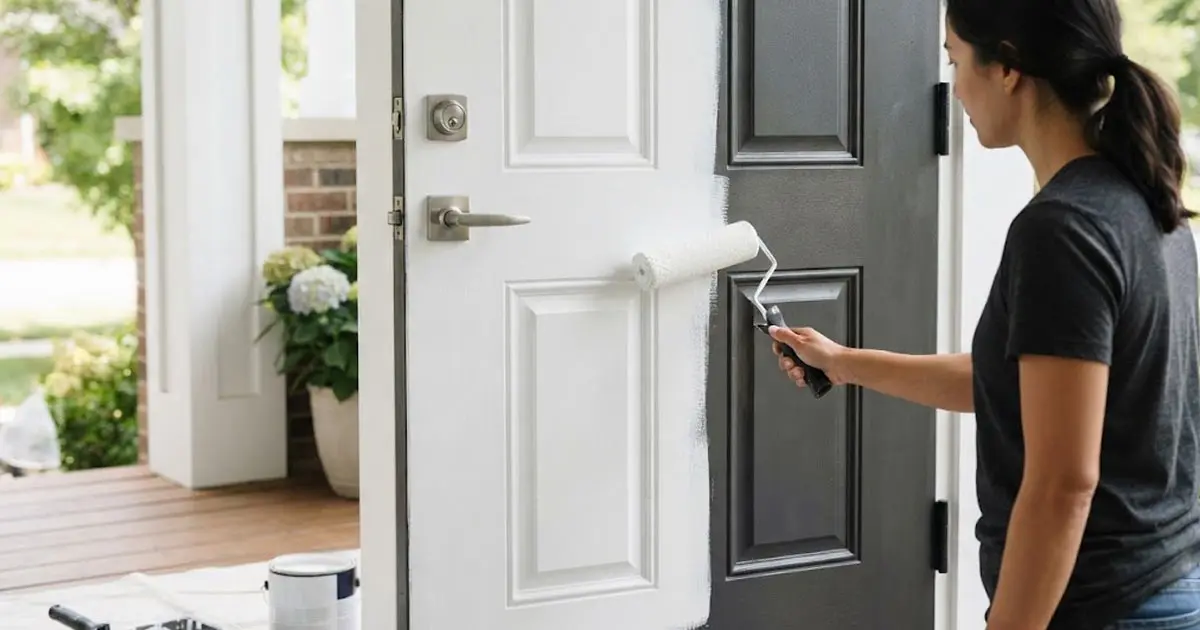
When the metal door surface is cleaned, degreased, and then primed with a rust-inhibiting metal paint before the topcoat is applied, a 100% acrylic latex paint will adhere and hold up well. Latex paint is the most practical option for most homeowners, as it dries fast, is waterproof, emits low VOCs, and holds color well when exposed to UV rays. If you’re installing a metal door inside, then a medium-grade latex will do the job and you don’t need to use a primer. Exterior doors exposed to weather, temperature fluctuations and direct sunlight should be specified to be premium exterior acrylic latex with semi-gloss or gloss finish.
Key Takeaways
- Latex paint can be used to paint a metal door. A 100% acrylic latex paint applied over a rust-inhibiting metal primer will adhere properly and will last under normal use.
- Surface preparation is the most important step. It’s all in the preparation: if the paint is cleaned, degreased, light sanded and primed properly, it will last 2 years or 10 years.
- Apply a rust-inhibiting metal primer, not a drywall primer. This is the most common mistake that leads to early peeling.
- If the metal exterior door is going to be in an exposed location where it will be exposed to the elements, a high-quality exterior acrylic latex in a semi-gloss or glossy finish will provide the most durable and easy-to-clean door.
- Apply two thin coats and not one thick coat. Thin coats level better, dry faster and are less likely to sag or brush mark.
- Paint should not be applied in direct sunlight or when the surface temperature is above 90°F, because the latex dries out too rapidly causing adhesion problems and lap marks.
What You Will Need Before You Start
The most frequent source of mistakes in a painting job is to stop in the middle of the job and have to run out and buy a missing item, and then run back to the painting surface, which has already dried or oxidized.
Cleaning and prep materials:
- Trisodium phosphate (TSP) cleaner or a commercial degreaser
- Wipe with clean rags or microfibre cloths
- Fine-grit sandpaper (120 to 220 grit for previously painted surfaces; 80 to 100 grit if removing rust)
- Wire brush (rust spots only)
- Painter’s tape
- Drop cloth
Primer and paint:
- Rust-inhibiting metal primer (such as Rust-inhibiting metal primer (Zinsser Bulls Eye 1-2-3, Rust-Oleum Clean Metal Primer, or Benjamin Moore Fresh Start Multi-Purpose Latex Primer are recommended)
- 100% acrylic latex paint semi or gloss grade exterior use.
Application tools:
- HD foam roller (4-inch) for flat panels
- Angular sash brush (2″ to 2.5″) for recessed panels, edges and trim details
- Paint tray
Step 1: Take the Door out of the way or Paint it in Place
When the door is removed from the hinges, you can reach all surfaces, particularly the edges and top and bottom rails that are hard to reach when painting on the door. It also lets you paint on a horizontal surface to minimize paint run or paint sag. Place the door on two sawhorses or supports at a convenient working height.
Wedge the door open while painting in place and use painter’s tape around the hinges and threshold; painting in place is safe and practical, and is often done with heavy exterior steel doors.
Remove the door and/or all the hardware from the handle, lockset, kickplate and any door knockers or numbers before you start. Painting around hardware creates an uneven surface and makes it more difficult to replace hardware in the future.
Step 2 is to thoroughly clean and degrease the surface
This is the one thing that most people miss out on. Oils from hands and road grime, as well as from previous waxes or polishes, will settle on a metal door. No matter how well the primer, latex paint will not adhere to any of these contaminants.
Use warm water and mild detergent to clean the surface of the door from dirt, grease and grime. If the door has been in industrial use or subjected to heavy use, a degreaser might be needed.
A TSP solution or a specially formulated degreaser using a cloth and rinsing with water will work for most residential doors. Complete in sections from top to bottom. Let the door dry thoroughly (at least 30 minutes in warm, dry air) before proceeding to the next step. Moisture that gets underneath the primer or paint will result in poor adhesion.
Step 3: Sand the Surface
The sanding roughens the surface for the primer to adhere. If the metal door is in good condition and has been painted before, the sanding can be done with a fine grit sandpaper, 120 to 220 grit. It’s not about removing the old paint, it’s about scuffing the surface evenly so the primer will have something to adhere to.
Sand gently and lightly using fine sand paper. Make sure you give the surface a quick wipe with a damp cloth to remove any dust left over from sanding before proceeding.
Rust spots on the door should be taken care of before sanding the rest of the door. Scrape with a wire brush or rust remover and sand back to bare metal. Prime these spots before full priming of the door.
When peeling and bubbling paint is extensive, remove the old paint. No matter how well the new product performs, it will fail in a short time if paint is applied over an adhesion failure.
Step 4: Use Painter’s Tape
Cover the glass surfaces, hinges (if painting in place), door frame and any surface that is not to be primed or painted. Make sure to use a high quality painter’s tape and push the edges to the ground. If the tape edge is not applied well, a ragged paint line will form that will be hard to fix after the paint has dried.
For panels that have raised or moulded features, tape around the outside edge of the panels, not freehand. The angular sash covers the panel reveals, and the tape covers the flat areas around the panel.
Step 5: Prime with a Rust-Inhibiting Metal Primer
Use a metal primer that is designed to protect the metal from rust, particularly exterior steel doors that are subject to humidity and temperature changes. They are not designed to adhere to metal surfaces or to prevent oxidation, which starts as soon as the surface of bare metal is exposed to moisture.
Use a rust-inhibiting primer for bare metal or rust removed areas. If the surface has been painted before, and is in good condition, an all-purpose metal and previously painted surface primer will do.
Application method:
Use the primer to apply on flat surfaces with a foam roller and on recessed panels with an angular sash brush. Use a thin, even coat of primer and let it dry completely (usually 1-3 hours, depending on the product) before applying paint (see manufacturer’s data sheet for specific recoat window on the primer used).
A standard application of primer is one coat. A second spot coat on areas where bare metal is found, before the prime coat, gives additional protection.
Step 6: Apply the Latex Paint
After the primer is completely dry, paint with two thin coats of latex paint instead of one thick coat. One heavy coat will dry longer, sag on vertical surfaces and will exhibit brush or roller texture more clearly.
Sequence for panelled doors
To avoid contamination of wet paint and to keep the wet edge throughout, work in this order:
- Recessed panels (use angular sash brush, working into corners)
- Rails running from left to right (brush)
- Vertical stiles on either side (brush, top to bottom)
- The sides of the door are flat.
Afterwards, repeat the process on the flat surfaces to remove any brush marks and to level out the texture with the foam roller.
Application tips
For best results on metal surfaces, use a high-quality brush or foam roller. A foam roller will create fewer texture marks and is ideal for a smooth surface like a steel door.
Fill the brush with an appropriate amount of paint not so much that it drips, not so little that it has to be dragged. Blend with long even strokes and keep the edge wet by working fast enough that you are always blending into paint that hasn’t started to skin over.
Wait for the paint to dry between coats (as specified by the manufacturer). This is usually two to four hours for most exterior acrylic latex products. Be careful not to apply the second coat too soon; if the surface is dry to the touch, it might not be firm enough to take another coat without causing damage to the film.
Once the second coat, check the surface in raking light (angled light that reveals surface flaws). A light third coat will remedy any areas that are not covered or have a visible texture from the roller.
Step 7: Wait for Full Cure before heavy use
In humid or cool conditions, do not slam the door or hang anything on it for at least 72 hours after the final coat for exterior doors.
If you paint the door by removing the door, hang it back up after painting it is touch dry, but the painting is carefully done by the edge. Avoid pressing on painted surface until paint has cured.
Latex vs. Oil-Based Paint for Metal Doors: Which Is Better?
It’s a fair question, as both products are popular and both have their merits. This is going to depend on the place of the door and the amount of maintenance that you’re willing to put into it over the course of time.
| Factor | Latex (Acrylic) | Oil-Based |
| Adhesion to metal | Good with proper metal primer | Excellent without primer on bare metal |
| Rust resistance | Moderate (water content can promote rust if primer fails) | High (no water content) |
| Flexibility | High — expands and contracts with temperature changes | Low — becomes brittle over time |
| Drying time | 1 to 4 hours per coat | 24 hours or more per coat |
| Finish smoothness | Very good with foam roller | Excellent — self-levels during drying |
| Fading in sunlight | Low — retains color well | Moderate — can yellow over time |
| VOC emissions | Low | High |
| Cleanup | Water | Mineral spirits or paint thinner |
| Long-term durability | Very good with premium product | Excellent initially; may crack after several years |
The exterior latex paint typically performs better in the long run than an oil paint, since latex expands and contracts in concert with the door material, whereas oil paint may become brittle and crack over time.
Oil-based paints will stick to bare metal better than latex paints and won’t cause rust to form on the metal surface due to the oil content of the paint.
The best advice for most homeowners who are painting a steel exterior door is to apply a high-quality 100% acrylic latex paint to a rust-inhibiting metal primer. This mix provides a good balance of adhesion, weather resistance, quick recoat and clean-up. Oil based enamel or direct to metal (DTM) acrylic is a level up in protection if the door is located in a particularly harsh climate, such as heavy snow, salt air or extreme heat.
The difference between oil-based and water-based paint is not confined to door painting but is applicable to fine art and decorative work; oil paint’s properties of slow drying, self-levelling and rich colour depth were once its raison d’être for use on architectural surfaces. In oil painting classes, students learn the characteristics of oil paint as a medium, and how it will perform on various surfaces, a knowledge that is useful in the real world beyond the easel.
Common Errors and Solutions for Avoiding Them
The use of an inappropriate primer
The most frequent reason for latex paint peeling from a metal door within 1-2 years is using a wrong primer for metal. A general purpose interior or exterior primer for drywall or wood will not provide enough bonding to keep latex paint from peeling from a steel surface when exposed to weather. Use a product which clearly indicates suitability for metal and rust protection.
Skipping the degreaser
The degreasing step is a five minute and small product investment that will result in an uneven paint and peel in a few months if it is not performed. It is not optional.
Painting in the sun or hot weather
Avoid direct sun when you are painting and do it in the early morning or late afternoon. If the surface is hot, or if the drying process takes place in humid conditions, the latex paint will prematurely dry out and not level and adhere to the surface. The outcome is satisfactory at first but starts to flake sooner than paint that was painted correctly.
Using thick single applications
One deep coat appears to be effective but creates a coat that is saggy, brush-marked, and takes a long time to dry. Two thin coats are quicker, better and last longer.
Not allowing enough drying time between coats
If a second coat is applied before the first coat has dried properly, it will disrupt the film, streak and can lift the entire coating. Don’t rely on your sense of dryness, follow the manufacturer’s recoat time.
Best Latex Paint Products for Metal Doors
The following are products that are widely recommended by painting professionals and follow the advice given in this article. They can be found at all paint stores and home improvement centers.
For priming:
- Rust-Oleum Clean Metal Primer — Rust-inhibiting, bonds to bare and previously painted metal
- Zinsser Bulls Eye 1-2-3 is a multipurpose product that is used on metal surfaces under latex.
- Benjamin Moore Fresh Start Multi-Purpose Latex Primer — excellent adhesion and smooth base for topcoats.
For topcoat (latex):
- Sherwin-Williams Pro Industrial DTM Acrylic — direct-to-metal formula, is now as durable as oil-based finishes.
- Benjamin Moore Aura Grand Entrance is premium exterior door paint with premium rich finish and premium weather resistance.
- Rust-Oleum Protective Enamel — readily available and specially formulated for metal surfaces.
Exterior doors: Semi-gloss or gloss. Both are easier to clean and have greater scuff and water resistance. Satin can be used for interior metal doors where appearance is more important than durability.
Finishing Touches After the Paint Dries
After the door is completely cured, carefully reinstall the hardware. Use a hand driver to drive screws for the initial few turns, and then use a power driver for the remainder. If the power driver strips the thread, the coating around the screw head may crack or chip.
If the door is a front entry door, think about how the new paint looks with the frame, door and sidelights. If the trim is painted and in good shape, a freshly painted door will show weathered and faded trim that was not noticed before. To get a professional look, paint the trim and door frame in matching or complementary colors.
Natural materials, such as a wreath or seasonal decorations, are great options for homeowners who love to add decorative touches to their freshly painted door when it’s time to decorate the entryway. Using natural craft materials, as detailed in the bulk natural grapevine for crafts guide, is a great way to come up with easy decorating ideas to add to an entryway without competing with a new paint color.
Surface preparation is a principle that is used in many home improvement situations. If you’re tackling several projects around the house, you’ll also want to check out the guide on how to hang artwork on plaster walls, especially if you are working with older walls, picking the right hangers and protecting finished walls during installation.
Conclusion
When the preparation is correct, it is easy to paint a metal door with latex paint. Clean and degrease the surface, sand lightly with sanding sponge, prime with rust-inhibiting metal primer, and paint with two thin coats of a good quality exterior acrylic latex in a semi-gloss or gloss finish. When applied in the order above, the result is a clean and durable finish that is resistant to weather, traffic and everyday use.
The outcome is determined in the preparation steps. A clean, degreased and properly primed door will look good for 5 years or more after painting. Less than 2 years a painted over or improperly primed door will start to peel. The material and method are important but the preparation is more important.
Check out the entire library of art, craft, home decorating and creative projects at Shani Levni.
Frequently Asked Questions
Is it possible to paint a metal door with latex paint?
Yes. A 100% acrylic latex paint that is applied over a rust-inhibiting metal primer will adhere to metal surfaces and will perform well in normal residential environments. Use a high-quality exterior grade acrylic latex in semi-gloss or gloss finish for exterior doors. A normal or medium grade latex can be applied to interior metal doors, which require the same level of primer preparation.
Do you have to prime metal doors before painting with latex?
Yes. It’s not an option to paint a metal door without using a primer. A metal surface primer that prevents rust will ensure that the latex topcoat adheres properly and will act as a barrier against oxidation. The most common cause of latex paint failing to adhere to steel doors is the use of a general purpose primer that isn’t rated for metal.
Which sandpaper should be applied to a metal door before painting?
If the metal door is painted and has been painted well, then 120 to 220 grit sandpaper is suitable. The purpose is to roughen the surface to hold paint, not to strip the paint. If there is rust, start with 80-100 grit to remove the rust and then move to finer grit and then prime.
A metal door requires how many coats of latex paint?
A metal door is typically two coated. Use thin coats and dry thoroughly between applications. If the second coat is not even, a third thin coat can be added. Do not use single heavy applications as they tend to droop, dry slowly and show application trails.
Which type of paint should I choose for my metal door semi-gloss or gloss?
Metal doors can be either semi-gloss or gloss. Gloss creates a more reflective and harder surface that is slightly more resistant to scuffs and moisture. A semi-gloss finish is easier to install to avoid showing imperfections and it is the most popular finish for residential entry doors. For interior metal doors, a lower-sheen is acceptable, so satin is a viable option.
What is the curing time for latex paint on a metal door?
Latex paint dries to a touch dry in about 1-2 hours. The coating is completely cured (hardness and adhesion) in 24 to 72 hours depending on the product, temperature and humidity. Do not use heavily until paint is completely cured, such as slamming, hanging objects, or pressure washing.
Does latex paint rust metal door?
Latex paint contains water and may cause surface rust on bare metal if the primer is not applied properly or is missing. That is why a metal primer coating beneath the latex topcoat is a must, not an option. Under normal conditions, a properly primed and painted door will not rust out for many years.