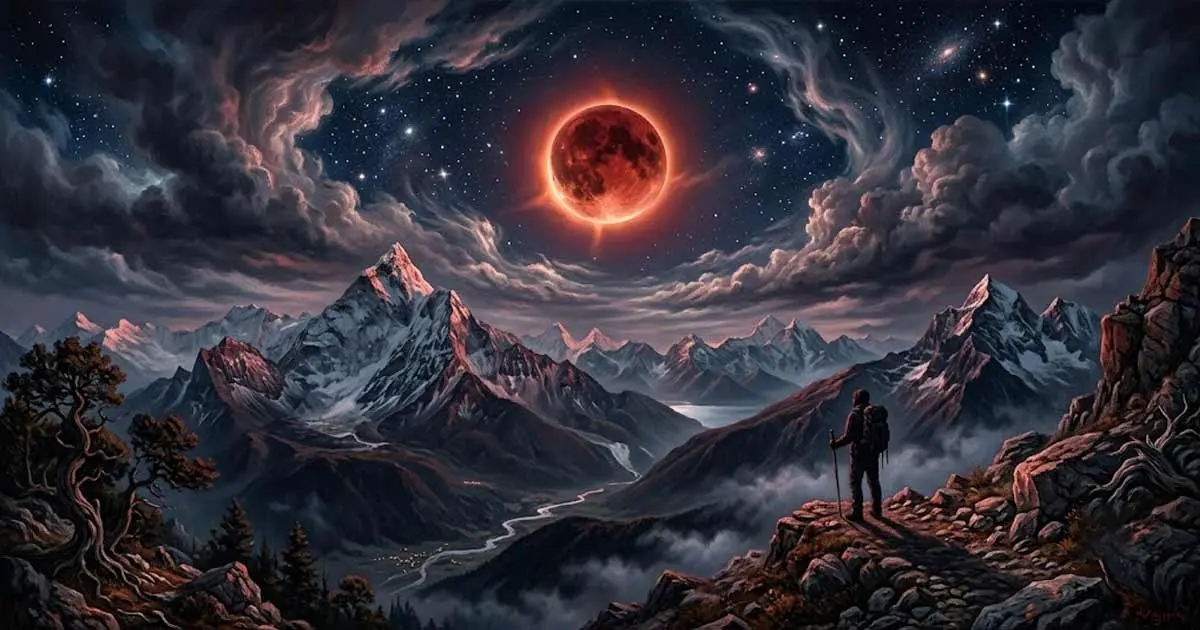
A painting of a full lunar eclipse is a painting that portrays the astronomical phenomenon known as a full lunar eclipse, in which the Earth moves between the Sun and the Moon, casting the umbra (total shadow) over the entire surface of the Moon. The Moon is not completely dark during totality. Rather, it shines in deep red, burnt orange and copper brown colors. This effect is because the sun’s rays bend and pass through the Earth’s atmosphere and scatter the blue light, leaving the red light behind, hence the name Blood Moon.
This astronomical or nocturne painting is one of the most challenging subjects for artists. The difficulty is not just darkness but the reddish light within the darkness, a light that does not match the light of regular daylight.
Key Takeaways
- The full lunar eclipse is depicted in this painting, where the Earth’s shadow completely obscures the Moon, creating a deep red, orange and copper colour due to the refraction of light in the atmosphere.
- The phenomenon is known as a “Blood Moon” because the Moon appears a reddish color during totality.
- The full lunar eclipse is depicted by the artists in the use of layered glazing, wet-on-wet oil techniques and controlled watercolor washes.
- The lunar eclipse has been a symbol of transformation, death and rebirth, spiritual revelation, and other meanings across many cultures throughout thousands of years.
- In order to make a successful painting of a lunar eclipse, one must have a good understanding of the two types of shadows that the Moon traverses, the umbra and penumbra.
The Science Behind the Colors: What Artists Need to Know
A painter who is painting a full lunar eclipse must know what colours are created in nature before he or she can begin mixing.
During a total lunar eclipse, the Moon sits inside Earth’s umbra the darkest, most central part of the shadow. The light that reaches the Moon at this time has traveled through the edge of the outer atmosphere of the earth. The atmosphere absorbs the shorter wavelengths (blue, violet) and lets the longer wavelengths (red, orange) go on. The same effect that causes a red sunset. This filtered light gives the Moon a warm, dark, earthy color, rather than its cold, silver appearance as it is when fully lit.
The exact color will be determined by the conditions of the atmosphere at the time of the eclipse. The eclipse appears darker and more brown in Earth’s atmosphere if there is a lot of dust, volcanic ash, or wildfire smoke. The clear air results in a brighter, more orange-red Moon.
| Phase of Lunar Eclipse | Visible Color | Cause |
| Penumbral phase | Subtle darkening, grey-silver | Partial atmospheric shadow |
| Partial umbral phase | One side darkening to orange | Entering deep shadow zone |
| Totality (Blood Moon) | Deep red, copper, orange-brown | Full atmospheric refraction |
| Emerging partial phase | Orange fading back to silver | Leaving umbra progressively |
| Return to full moon | Standard silver-white | No shadow interference |
Lunar Eclipse Art is done with historical and symbolic meaning
Lunar eclipses have been depicted in art since ancient times, and they have multiple symbolic meanings in various cultures.
For Mesoamericans, a lunar eclipse was considered to be the Moon being eaten, and thus a rite had to be performed, such as a loud noise to scare off the force eating the Moon. This imagery was reflected in visual art, ranging from pre-Columbian murals to contemporary Mexican-American art. The warm skull symbolism of Día de los Muertos face painting with its focus on cycles of death and return, and its ample use of deep reds, purples, and warm blacks, shares a visual language with the astronomical painting of a Blood Moon. Both traditions see transition and darkness not as an end, but a transformation.
Lunar eclipses were recorded in illuminated manuscripts and were used as omens in narrative paintings in medieval European art. The changing of the color of the Moon from normal to red was interpreted as a sign of war, of plague or of a divine warning and signified that the normal order had been disturbed.
The eclipse was observed systematically in scientific and artistic form in the East Asian astronomical tradition. The Chinese imperial courts also had astronomers who recorded celestial phenomena in accurate visual observations and these observations affected the style of landscape and sky painting in the region.
In the present day, the complete lunar eclipse is regarded as an optical phenomenon, a purely technical and aesthetic problem of light in darkness, and it becomes the theme of a painting.
Color Palette for Painting a Full Lunar Eclipse
The most important preparatory step is choosing the right palette. The range of colors in a lunar eclipse painting is limited but delicate. Wrong selections result in a Moon that resembles an orange or a lantern, not a glowing astronomical object in space.
For oil or acrylic paints, the recommended palette is:
- Ivory Black or Mars Black — dark space and dark shadow areas.
- Burnt Sienna is the mid-tone in the middle of the warm range for the umbra.
- Cadmium Orange or Transparent Orange — for brighter edge areas
- Alizarin Crimson — to give the deeper red areas in totality
- Raw Umber (dark brown shadow transitions on the moon)
- Titanium White (small quantities for lightening the penumbral halo)
- Ultramarine Blue or Prussian Blue — for the night sky surrounding the Moon
The background of the Blood Moon is not usually black. When a combination of Ivory Black and Ultramarine Blue is used, it gives a richer, truer night sky. The Moon itself should be constructed in warm tones, each one of which should be visible through the others.
How to Take a Complete Lunar Eclipse Photo, by Painting Techniques
Oil Glazing Method
Oil glazing is the most historically appropriate technique for this subject. Start with an underpainting using neutral grey or warm umber colours, creating the overall outline of the Moon and the surrounding darkness. Let this layer dry completely.
Add additional layers as thin, transparent glazes of Burnt Sienna, Alizarin Crimson and Transparent Orange. Each glaze is deeper and more luminous. What you get is a glowing Moon, not a painted surface. This is the method that rules fine layered application in many fine art disciplines, the same method that is found in the disciplined minimalism of Ad Reinhardt’s abstract painting of 1957, where the surface layers are different depending on the depth of the pigment.
Watercolor Wet-on-Wet
When painting watercolor, paint on wet paper and add warm colors as the paper is still wet. Burnt Sienna and Quinacridone Red blend naturally on the damp surface, producing soft, atmospheric edges which are impossible to achieve with dry brush. The watercolor lunar eclipse needs to be quick and confident, otherwise the translucency is lost, which is the whole point of the watercolor eclipse.
Keep the brightest areas of the Moon for last. Masking fluid around the edge of the penumbra lets warm colors be placed over the cool gray of the partial shadow zone.
Digital Painting Approach
If you are a digital artist using Photoshop or Procreate, create the lunar eclipse in layers, using Multiply (shadow) and Screen or Add (luminosity). The warm orange-white color of the soft glow around the Moon during totality is best rendered using a large, low opacity brush to paint over the dark background in circular strokes centered on the Moon’s disc.
The composition and background will be taken into account
A full lunar eclipse painting doesn’t need to be strictly a celestial event. Some of the most amazing lunar eclipse artworks feature the Blood Moon in a landscape, cityscape, or water reflection.
Water is used as a foreground feature, doubling the impact. The reflection of the reddened Moon in a river, lake or ocean provides a compositional anchor and enables the artist to employ a wet, fluid approach in the foreground while applying a dry, layered technique to the sky.
The eclipse is set in a scene that includes silhouetted trees or architecture, offering a sense of scale and earthly context. If there were no sign of the land, the image may lose its meaning. The ideas underlying painting a swimming pool with epoxy paint have conceptual similarities with the larger discipline of painting on any large, challenging surface where the quality of the preparation is key to the quality of the finished surface.
What a Full Lunar Eclipse Painting Says:
In the field of visual arts, the total eclipse of the moon is a more than scientific record. It has a symbolic significance for which it is suitable as a compositional and narrative element.
The Blood Moon’s transformation from cold silver to warm red enacts a visual metaphor of change the familiar becoming unfamiliar, the ordinary becoming charged with significance. Lunar eclipse images are often depicted in paintings that represent turning points, loss, spiritual renewal and transition between states of being, which is why they are so common.
The total lunar eclipse is one of the most striking subjects to use for contemporary artists working in the fields of cycles, death and the interplay between human experience and nature.
Also See: Shani Levni
Conclusion
One of the most challenging and evocative themes in nocturne painting is the full moon eclipse. The artist needs to understand the optical science that creates the colors of the Blood Moon, learn layered techniques that can convey warm luminosity in deep darkness, and make compositional choices that can evoke a sense of scale and meaning for the astronomical event.
The total lunar eclipse is a bridge between visual art and astronomy, between the symbolism of the moon and the long history of artists who have gazed at the heavens and attempted to capture not only what they saw, but what they felt and thought in the face of a rare and extraordinary phenomenon.
Frequently Asked Questions
What colors would you use to paint a full lunar eclipse?
The primary colours used for the Moon itself are deep red, burnt orange, copper brown and warm umber, with a dark blue-black sky. The most popular palette options for oil or acrylic painting are Burnt Sienna, Alizarin Crimson, Transparent Orange, and Ivory Black with Ultramarine Blue.
During a full lunar eclipse, the Moon appears red.Why is the Moon red during a full lunar eclipse?
In totality, the Moon is inside Earth’s umbra and gets only light that has been refracted (bent) by the Earth’s atmosphere. The atmosphere absorbs the blue wavelengths, and the red and orange wavelengths continue to pass through, resulting in the Blood Moon’s color. The same effect causes red sunsets on earth.
Which painting technique would you choose for a lunar eclipse?
The most popular method is oil glazing, which enables a warm, glowing effect of the Blood Moon to be developed in layers of transparency. Watercolor wet-on-wet works well for more atmospheric results. The glow effect can be accurately replicated with digital painting with the Screen and Add blending modes.
What does it mean to have a lunar eclipse in art?
The moon’s eclipse has been used in many cultures as a symbol of change, death and rebirth, divine warning, and a disruption of the mundane. In the field of visual art, it serves as a symbol for significant changes, spiritual shifts, and turning points. Its visual language is similar to that of traditions that combine darkness and warmth to signify loss and continuity.
What is the difference between full lunar eclipse and partial lunar eclipse, in terms of painting?
During a partial eclipse, only a portion of the Moon passes into the shadowed part of the umbra, resulting in a two-toned lunar surface with one silver-white and another warm shadowed region. During totality, the entire disc assumes the warm red-brown colour of totality. The artist must have a uniformly warm, dark palette for painting a full eclipse, and must carefully balance the contrast between the illuminated half and the shadowed half when painting a partial eclipse.