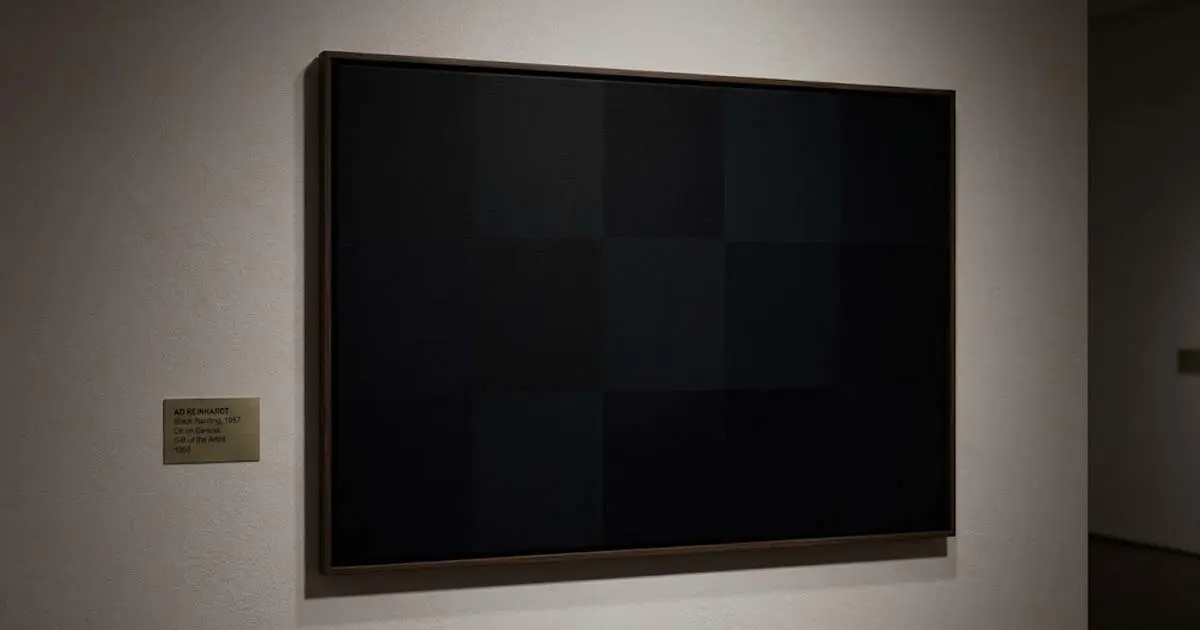
Abstract Painting, created by Ad Reinhardt in 1957, is an oil on canvas 9 feet by 40 inches (274.3 x 101.5 cm) that is in the permanent collection of MoMA in New York City. The first impression of the painting is that of a uniform field of color. After prolonged viewing, a grid of slightly distinct tone levels becomes apparent, with each rectangle differing slightly from its neighbours in colour and brightness, but not so much as to be easily described. This is exactly what Reinhardt wanted. The painting does not depict, refer to or evoke anything more than what it makes up. It is one of the most strenuous and most cogently thought out works of the peak of American abstract art.
Key Takeaways
- Abstract Painting 1957 is an oil painting on canvas by Ad Reinhardt, 274.3 x 101.5 cm (9 ft x 40 in), in the permanent collection of the Museum of Modern Art (MoMA) in New York City.
- This piece is part of Reinhardt’s Color Field Painting period, where the color variations form a recognizable grid, but do not represent anything or have a symbolic meaning.
- It was before his famous Black Paintings series (1953-1967) and marks a transitional period in which his use of color was being streamlined to its end.
- Reinhardt’s guiding philosophy, known as Art-as-Art, was that the only legitimate subject matter of a painting was painting itself.
- He said that he was painting the “last paintings” that anybody could paint, and that his work was the “last painting” of the reductive logic of the western painting.
- It was acquired by MoMA in 1969, two years after Reinhardt’s death, accession number 246.1969.
What Is Ad Reinhardt Abstract Painting 1957
In Abstract Painting 1957, the slight differences in colour produce a recognisable grid, but this is not meant to be symbolic or referential but optical. Reinhardt preached the gospel of abstraction in art.
The canvas is tall and narrow, almost nine feet high and just over three feet wide, which accentuates the sense of verticality and a kind of monumental stillness. Surface is meticulously worked in oil. The changes of color are so subtle that the grid-like pattern only becomes apparent after careful examination, and the overall composition of the painting is not easily grasped in a single viewing. This is deliberate.
The work is part of a larger oeuvre of his single-color series from the 1950s, which came before the Black Paintings. In this time he created a series of paintings that played with nuances in a single color: all red canvases, all blue canvases, and a series of paintings that showed the color being compressed over a period of time toward a single tone. Abstract Painting 1957 is part of this transitional period.
Ad Reinhardt: Who Was He
Adolph Friedrich Reinhardt was born 24 Dec. 1913 and died 30 Aug. 1967. An American abstract painter and art theorist, who lived and worked in New York City for over 30 years. As a theorist he wrote extensively and lectured on art, and was a key figure in the development of conceptual art, minimal art and monochrome painting. His estate is represented by David Zwirner Gallery, which states that Ad Reinhardt is one of the most important 20th-century American artists, a link between geometric abstraction and minimal and conceptual art, and a force that carries on to the present day.
He attended Columbia University, graduating in Art History in 1935. He then attended the American Artists School and the National Academy of Design to learn painting. His work with the WPA Federal Art Project in the 1930s was an important source of support and exposure, giving him the opportunity to continue to develop his skills and to work on public art projects.
He became a member of the American Abstract Artists and was part of the movement centered on the Betty Parsons Gallery that became known as Abstract Expressionism. Nevertheless, Reinhardt opposed the basic concepts of Abstract Expressionism. Reinhardt’s contemporaries such as Jackson Pollock and Willem de Kooninging focused on gesture, emotion, and the physical act of painting, but he was a believer in the principle of elimination. In hindsight, he was a transitional figure between Abstract Expressionism and the Minimalism that came after it.
He was a professor of many institutions such as Brooklyn College, Yale University, and Hunter College, where he passed on his rigorous intellectual approach to aspiring artists.
The Philosophy Behind Abstract Painting 1957
Art-as-Art
Reinhardt was a proponent of the abstract art movement and was adamant that abstract art should be pure, that is, it should show art itself and nothing else, and be non-objective, non-representational, non-figurative, non-imagist, non-expressionist and non-subjective. As he proclaimed, in David Zwirner Gallery’s own words: “Art is art. Everything else is everything else.”
In Reinhardt’s view, any painting that looked beyond itself, toward a story, a feeling, a political stance, or a personal life had failed to capture the essence of painting.
The Removal of Emotions
“In a painting,” Reinhardt said, “I don’t know what love is, I don’t know the love of anything except the love of painting itself.”
This is the whole idea behind Abstract Painting 1957. This painting is not about anything else but the painting itself. There is no representation of image, no expression of gesture, no personal narrative, no legible symbol. It only requests that the viewer pay attention to the actual content: subtle relationships between colors, organized within a grid, painted with oil on a tall canvas.
This decrease does not create a vacuum. It generates a very targeted form of attention. It is essential to be aware of the nature of perception itself when viewing Abstract Painting 1957, of the eye’s ability to see a very fine difference in hue and luminosity, and of the alteration of what is seen in the painted surface when sustained attention is given to it.
Exhibit of Abstract Painting 1957, in the context of the Black Paintings
Abstract Painting 1957 stands in a certain position in Reinhardt’s career. It is part of the period before he became a full-time artist in the Black Paintings series, the five-by-five-foot square canvases in black-on-black he made from 1953 until his death in 1967.
Starting in 1956 he used only five-by-five-foot square canvases with dark, matte, hand-painted surfaces, according to the Whitney Museum of American Art. The nine abstract paintings, all extraordinarily subtle black-on-black squares, are only apparent through prolonged viewing and vanish in reproduction; their somber variations are only perceptible through sustained viewing. The only possible experience was to think about the picture itself, Reinhardt felt.
The work of 1957 is earlier than the totality of that last position. Although it’s been toned down to almost monochromatic, there’s still a range of color. The grid is discernible. The differences between the zones are readable to the careful viewer, but do not need that extreme adaptation that is required for the later black canvases. TheArtStory claims that Reinhardt felt his Black Paintings were the “zero point of art” and linked this idea in his theories to ideas such as Negation Theology, Neo-Platonism and Zen Buddhism.
The 1957 painting is a logical step in the direction of reduction, but not its end.
The painting’s physical characteristics are analyzed.Analyzing the physical characteristics of the painting
Dimensions and Format
Abstract Painting 1957 is an oil on canvas measuring 9 feet by 40 inches (274.3 x 101.5 cm). The tall narrow format doesn’t match any traditional picture ratio. It’s too small to be used as a landscape and too tall to be used as a conventional portrait. It is a format that is vertical and self-contained, and it has a quality between that of a column and that of a door.
Medium and Surface
The painting is painted in oil on canvas. Reinhardt’s method was to apply paint in thin layers, carefully, so that there would be no brushwork, drip, or incident in the painting. If there was an actual surface that exhibited the marks of its creation, the viewer would be drawn to the body and hand of the painter. Reinhardt wanted to get rid of that evidence. The surface should show only the colour and the grid.
Location and Provenance
Abstract Painting 1957 is part of the permanent collection of the Museum of Modern Art (MoMA) in New York City. It was purchased by MoMA under acquisition number 246.1969. The copyright belongs to the Estate of Ad Reinhardt, administered by Artists Rights Society (ARS), New York.
In 1957, Reinhardt’s Place was a staple in the New York art scene
Reinhardt by 1957 was a battle-tested and established name. By 1957, at the latest, Willem de Kooning and Robert Motherwell were avoiding him, by 1963, art critics such as Clement Greenberg insulted him, and the Museum of Modern Art never let him into any significant group show before 1963.
His exclusion from the mainstream of Abstract Expressionism was no coincidence. He was a constant target because of his notions of purity, his satirical attacks on artists who commercialized their work and his uncompromising theoretical positions.
But his impact was greater than the antagonism he engendered. TheArtStory states that Reinhardt’s work is a significant milestone on the way from Abstract Expressionism of the 1950s to Minimal and Conceptual Art of the next decade. He was a figure of ridicule to his expressionist contemporaries but a priest and prophet to the next generation to which he served as a link to Constructivism.
Reinhardt’s practice is connected to the experiences of many creative people in various disciplines because of the principle that a sustained, uncompromising creative position yields more enduring results than does a compromise with the market in place. In the piece on the American Crafts album Grape Soda, the durability of a well-made material is presented as an example of the kind of principled commitment to craft over convenience that is demonstrated by it.
This is the reason why Abstract Painting 1957 Matters Today
Abstract Painting 1957 is important in a number of ways, beyond its historical context.
First, it shows that intellectual seriousness and visual complexity are not necessarily the same as visual busyness. The painting is not as immediately impactful as some other paintings.
Secondly, IdeelArt says that Reinhardt’s work provided an alternative to prevailing trends of the day, thus ensuring the continuation of art history. The Black Paintings of Ad Reinhardt did not stop painting, but advanced the continuum as did the Black Square of Kazimir Malevich. He was dogmatic and thus he gave a gift to the next generation—a foe to fight, a purist to beat back, an ideology to defy.
Third, the painting poses questions of relation between experiencing art and reproducing it. But its exquisite subtleties are mostly lost in reproduction, as Reinhardt knew they would be, as the Whitney Museum states. The only possible experience was thinking about the painting itself, he felt, so to speak. It is more relevant in an age where most art consumption is done through screens than ever before, that the physical object cannot be reduced.
In art, the notion that a work can only be created once is shared by other creative fields. It relates to the traditions discussed in the guide to Day of the Dead artwork, in which the most important forms of art are those of sugar skulls, ofrenda altars, and tapetes de aserrín, which are made specifically for encounter, not for reproduction, with the meaning of these art forms being tied to physical presence in a community context.
Reinhardt’s legacy and influence
Reinhardt’s legacy is well documented and far-reaching to subsequent art. His “black” paintings are now seen as pivotal works in minimalist and monochrome painting and have been interpreted as an assault on representational art and an exploration of visual perception. His Art-as-Art writings are still read by artists and critics.
His influence was directly felt by the Minimalists of the 1960s, such as Frank Stella, Donald Judd and Robert Morris. In his Art-as-Art philosophy, conceptual artists saw a precedent in his work, which emphasized ideas over objects. He was a teacher at Brooklyn College from 1947 until his death in 1967, and his influence was felt by generations of students at the college.
What is the relationship between a clear and principled creative position of one person and the practices of the artists who follow them is one of the central questions of art history. It mirrors the dynamic explored in the article about who classifies, who has the power to define categories and who gets to be included or excluded from them, and who, then, will have a deep and lasting impact on all who operate within the system. Reinhardt’s Art-as-Art was similar: it precisely determined what painting was, and what it was not, and thus set the frame for later generations to situate their own work in.
Abstract Painting 1957: Quick Reference
| Detail | Information |
| Artist | Ad Reinhardt (1913 to 1967) |
| Title | Abstract Painting |
| Date | 1957 |
| Medium | Oil on canvas |
| Dimensions | 274.3 x 101.5 cm (9 ft x 40 in) |
| Style | Color Field Painting |
| Genre | Abstract |
| Location | Museum of Modern Art (MoMA), New York |
| Acquisition | Purchase, 1969 (246.1969) |
| Copyright | Estate of Ad Reinhardt / ARS, New York |
| Related Series | Black Paintings (1953 to 1967) |
Conclusion
Ad Reinhardt’s Abstract Painting 1957 is a work that demands a lot from the viewer and will give back a lot in return, if the viewer is willing to look patiently and without expectations. Its delicate colour grid, tall narrow format, and matte oil surface are not simple but the result of sustained, rigorous elimination. The fact that everything in the painting is included is due to the fact that Reinhardt could find no reason to exclude it. Everything not in the painting was taken off, as it did not make sense to have it there.
It occupies a particular moment in the history of abstract American art between the Color Field work of the early 1950s and the Black Paintings in which Reinhardt’s final decade of work was focused. It reflects a philosophy he consistently and at length argued in his writings and teaching: Painting is painting and it is only painting.
The painting is a foundational work for anyone studying postwar American art and one of the most coherent and demanding positions of the postwar period. One of the most difficult things an artist can try and one of the most rewarding things a viewer can witness is the elimination of the unnecessary, and that is what it shows.
To read more about art history, visual culture and creative practice, check out the complete Shani Levni content.
Frequently Asked Questions
What is Abstract Painting 1957 by Ad Reinhardt?
Abstract Painting 1957 is an oil on canvas painting by American artist Ad Reinhardt, 274.3 x 101.5 cm (9 ft x 40 in). It is on view in the Museum of Modern Art’s (MoMA) permanent collection in New York City. The work is composed of subtle differences in hue that are organized in a grid pattern, and not meant to be symbolic or referential.
In which museum is Ad Reinhardt’s Abstract Painting 1957 hanging?
The painting is in the permanent collection of the Museum of Modern Art (MoMA) in New York City. It was acquired by MoMA in 1969 (246.1969) two years after Reinhardt’s death.
Which of the following is the style of Abstract Painting 1957 by Ad Reinhardt?
It is categorized as Color Field Painting. It was created in the transitional phase between his early 1950s monochromatic work and the Black Paintings that he worked on from 1953 until his death in 1967.
What is the meaning of Ad Reinhardt’s Abstract Painting 1957?
Reinhardt’s own philosophy is that the meaning of the painting is the painting itself. He argued that art should present art-as-art and as nothing else. The delicate colour grid has been designed to provide an optical experience for the viewer rather than to suggest a story, feeling or symbolism.
What does Art-as-Art mean to Ad Reinhardt?
Art-as-Art was the doctrine that art could not be anything other than art, and that was the belief of Reinhardt. He believed that abstract art must be non-objective, non-representational, non-figurative, non-expressionist and non-subjective. This approach led him to gradually remove color, gesture and story from his paintings in the 1950s and 1960s.
What connections can be made between Abstract Painting 1957 and the Black Paintings of Reinhardt?
Abstract Painting 1957 is a work from the time just before Reinhardt began to work exclusively in the Black Paintings. It’s his reductive logic, but in a more sophisticated form, not yet fatal. The visible color grid and near-monochrome palette suggest the black-on-black canvases, where tonal difference is condensed to such an extent that the grid can only be discerned in optimal viewing circumstances.
Why were the paintings so important to Ad Reinhardt that he insisted they be viewed in person?
Reinhardt felt that the subtlety of his paintings had been rendered in reproduction to a large extent. The gradation of tones that make up the grid used in Abstract Painting 1957 is not fine enough to be captured accurately on photographic paper. He argued that the only real experience was in thinking about the actual painting, and this has become more important as art becomes more common in the digital and print media.