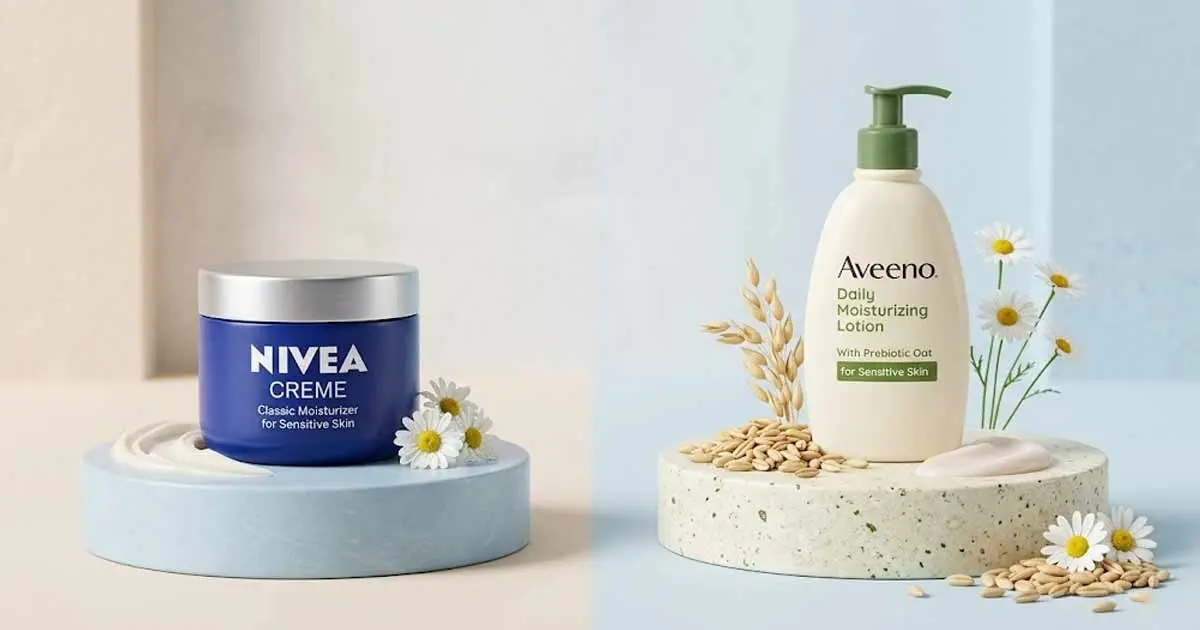
For sensitive skin, Aveeno is the easier of the two brands to use, in part because the products are formulated with ingredients that are especially soothing to irritation, rather than just trapping moisture in. Nivea is not always rough on the skin, but its classic creams focus on rich, occlusive hydration, and often contain added fragrance, which is the #1 most common irritating factor in reactive skin. The correct answer for your skin will depend on whether you have dry skin or actual sensitivity, as these are different skin conditions but related, and will require different ingredient strategies.
Key Takeaways
- Generally Aveeno is less harsh on sensitive, reactive, and eczema prone skin because they use a fragrance free formula with colloidal oatmeal, which the FDA has classified as a skin protectant.
- Nivea is typically used for plain dryness, not sensitivity, and most of the formulas contain petrolatum and lanolin, which provide more occlusive hydration, but many classic products have added fragrance.
- Fragrance, not moisturizing ingredients, is the primary cause of irritation in sensitive skin, according to dermatology-related sources.
- The signature ingredient of Aveeno, colloidal oatmeal, is FDA-approved as a skin protectant, and it has been shown to have anti-inflammatory and barrier-supporting properties.
- Nivea Creme is free of ceramides, and contains lanolin, which is a known allergen for some eczema sufferers, whereas Aveeno’s Eczema Therapy line contains ceramide-3 and has been given the National Eczema Association Seal of Acceptance.
- It will depend on whether your skin is in need of soothing or sealing moisture (Aveeno or Nivea, respectively sensitive skin is a barrier problem, not a dryness problem).
- Brand loyalty is not that important as both brands have fragrance free product lines, and you should just look at the ingredient list of the product you are interested in.
Sensitive skin isn’t a dryness problem, it’s a barrier problem
You might think that sensitive skin is synonymous with dry skin, but this isn’t entirely correct. A barrier problem is a frequent cause of sensitive skin. Your skin barrier is the barrier on the outside that is meant to keep moisture in and irritants out. If that barrier is broken, it can cause ingredients that would not normally cause issues to create problems.
Sensitive skin is more prone to sensitivity to a number of common triggers:
- Fragrance
- Alcohol-based products
- Harsh cleansers
- Weather changes
- Strong active ingredients
Signs of reaction are redness, burning or stinging, dry patches, tightness, itching. This is important because a product that provides superb hydration is not necessarily gentle. A heavy, well moisturizing cream that also contains fragrance can moisturize dry skin well, and at the same time, induce inflammation in a damaged barrier. This is the crux of the Nivea vs Aveeno debate.
Nivea’s Approach to Sensitive Skin
Nivea has been known for its moisturizing and nourishing formula. The familiar blue Nivea tin is one of the world’s most widely acknowledged skin care products and its most appealing feature has always been its simplicity: a thick, protective layer of moisture that keeps in the hydration.
Nivea’s Strengths
Nivea creams are good for retaining moisture. Their thick, protective texture forms a barrier to retain moisture in the skin, and the products are readily available and affordable. One of the most important occlusive ingredients in numerous Nivea products, petrolatum is one of the most effective occlusives dermatologists know. When used properly, petrolatum can help decrease more than 98 percent of transepidermal water loss, according to the American Academy of Dermatology. Glycerin and panthenol (vitamin B5) are also common ingredients in Nivea’s formulas; they are humectants that attract water to the skin.
The limitations of Nivea’s Sensitive Skin
The worry for those with sensitive skin is related with 2 ingredients that are frequently used in standard Nivea products. Nivea Creme is hydrating, but it doesn’t contain ceramides and it does contain lanolin, which is an allergen for some eczema sufferers. Additionally, many of the classic Nivea products have additional fragrance added that can cause contact dermatitis or aggravate existing inflammation in those with highly sensitive skin.
The petrolatum and lanolin in Nivea Creme are non-comedogenic on paper, but users report that it causes microcomedones when applied to the face every day. For acne-prone people, dermatologists recommend that they avoid heavy occlusives on the T-zone.
However, it is important to note that Nivea is not a single uniform product line. In some product lines, Nivea also offers products specifically formulated for sensitive users, and many people who have normal dry skin (not really sensitive skin) can use the classic formulas without any problem, and find that they provide deep hydration.
Aveeno’s strategy to sensitive skin
The formulation approach of Aveeno is quite different. Rather than targeting the moisture barrier with occlusives, Aveeno’s attention is given to calming the skin directly with its signature ingredient, colloidal oatmeal, in most of its sensitive skin product line.
This is the role of colloidal oatmeal
Colloidal oatmeal is finely milled oat that is processed into an effective form that the skin absorbs. The FDA has approved it as a skin protectant, making it more medically credible than some of the trendy ingredients in skin care products. The oat’s ability to reduce itching and promote barrier repair is used in dermatology and is so effective that Aveeno is recommended for eczema-prone skin or individuals who are sensitive to a lot of moisturizers.
One skin care expert’s take on the ingredient: Colloidal oatmeal is a special ingredient that helps to soothe irritated skin right away and promote long-term skin barrier health.
The Key Product Lines for Sensitive Skin are Aveeno’s
Aveeno Skin Relief Moisturizing Lotion combines the skin-softening benefits of glycerin with a Triple Oat Complex of colloidal oatmeal, oat flour and oat extract. Shea butter offers skin barrier-strengthening fatty acids without pore-clogging.
In addition to colloidal oatmeal, Aveeno Eczema Therapy also contains ceramide-3, which helps to restore the skin’s lipid barrier, which is essential for preventing moisture loss and pathogen entry. This product has received the National Eczema Association’s Seal of Acceptance, which is awarded to products that satisfy specific clinical requirements to be used on compromised skin.
The formula for Aveeno Calm + Restore is a blend of colloidal oatmeal and prebiotic oat extract (and some formulations include feverfew) to help nourish the skin’s microbiome and barrier function. It is sold as fragrance-free and is tested for sensitive skin.
Aveeno’s Limitations
Not all Aveeno products are scent-free. Although the brand name suggests that Aveeno products should be fragrance free, it is important to always check individual formulas, as some do contain fragrance.
Side-by-Side Ingredient Comparison
| Factor | Nivea | Aveeno |
| Primary moisturizing strategy | Occlusive sealing (petrolatum, glycerin, panthenol) | Barrier support and calming (colloidal oatmeal) |
| Signature ingredient | Petrolatum, lanolin | Colloidal oatmeal, ceramide-3 (select lines) |
| Fragrance | Present in many classic formulas | Fragrance-free in most sensitive-skin lines |
| Ceramides | Generally absent (Nivea Creme) | Present in Eczema Therapy line |
| FDA/clinical recognition | Petrolatum as established occlusive | Colloidal oatmeal as FDA-recognized skin protectant |
| Eczema-specific certification | None widely cited | National Eczema Association Seal of Acceptance |
| Texture | Thick, rich, occlusive | Lighter, less greasy |
| Best for | Plain dryness, harsh weather, cold climates | Reactive, eczema-prone, fragrance-sensitive skin |
| Price point | Budget-friendly, widely available | Comparable drugstore pricing |
When it comes to choosing a cream for a particular skin problem, which one will you select?
For Eczema and Psoriasis
Clinically proven to help reduce flare-ups of eczema with Aveeno Eczema Therapy. The line contains a combination of ceramide-3 and colloidal oatmeal to restore the lipid barrier of the skin, which helps prevent moisture loss and pathogen infiltration, and has been awarded the Seal of Acceptance by the National Eczema Association. The Nivea Creme is not sold for eczema, and can irritate sensitive skin because of the fragrance and thicker base that can retain heat.
For Acne-Prone Skin
The non-comedogenic formulas of Aveeno are generally safe for acne-prone skin, particularly the Daily Moisturizer with SPF. Although the formulas are technically labelled non-comedogenic, some users have reported that the heavier occlusive ingredients are responsible for microcomedones when used on the face daily.
If you have plain dry skin (without sensitivity):
Even if you don’t have the main problem of sensitivity, Nivea can still work well for you if you have the problem of dryness. The classic formulas work well for many people with normal dry skin and provide good hydration, especially in the winter or in climates with very cold weather, where heavier occlusion can actually be helpful.
Specifically for Facial Skin
The fragrance-free, lighter formula of Aveeno Skin Relief makes it a better option for sensitive facial skin. Nivea Creme contains fragrance and is rather thick, which can clog pores or cause redness and breakouts in the face.
What a skincare professional says
Christina Korouchtsidi, a skin care expert with more than 10 years experience says, “Aveeno works well for reactive/inflamed skin, Nivea works well for very dry or broken skin barriers there’s no one ‘better’ it depends on your skin’s current condition and environmental triggers.
This is the main point of the comparison that is well expressed in this assessment. The two brands do not compete directly against each other. Nivea is moisture-proof optimized by occlusion. The Aveeno is formulated with active calming ingredients to help repair and soothe. If someone has a dry skin without any active sensitivity or inflammatory reaction, they can actually benefit from the heavier formulations of the Nivea products. The calming approach that Aveeno’s formulation philosophy provides is what a person whose skin reacts, flares or becomes inflamed requires.
Nivea vs Aveeno: What is the Difference?
If You Experience: Choose Aveeno:
- Redness or sight of irritation following the application of most moisturizers
- Any diagnosed skin condition (eczema, rosacea, atopic dermatitis)
- Reactions that are only to fragranced products
- Acne alongside dryness
- Need for a lighter daily moisturizer, which does not feel heavy under makeup or sunscreen.
Choose Nivea If You Experience:
- Absence of any redness, itching or burning sensation.
- Exposure to cold weather or low humidity that removes moisture rapidly.
- Thick, long-lasting hydration, especially on the body, not face.
- No history of reaction to any fragranced skin care product
Always Check the Specific Product
Many believe that the terms “sensitive skin formula” and “fragrance free” are synonymous. They do not. A common error people make is considering Nivea to be one product, but it is actually a variety of products, some of which are formulated for sensitive users. The same applies to Aveeno: not all Aveeno products are fragrance free, and reading the actual ingredient list on the specific product you wish to purchase is more reliable than relying on the reputation of the brand.
The Broader Principle: Ingredients Over Brand Names
Gentleness is more about ingredients than marketing. This is the main principle that should be kept in mind when choosing Nivea, Aveeno or any other moisturizer brand. Both petrolatum and mineral oil are confused. Although there is some controversy about their safety and efficacy on the internet, they are generally safe and effective moisturizers, according to dermatologists. The problem with sensitive skin typically lies in the fragrance added to the moisturizer, not with the moisturizing agents.
The best advice for a sensitive skin person is not to be loyal to a brand, but to know what ingredients are likely to irritate and what ones are beneficial to the skin type.
The same rule is true of all products and categories where consumers are required to judge content over brand: the content of a product is more important than its name. This is explored in another way in the comparison of La Roche-Posay vs Neutrogena for acne-prone skin, and the same conclusion is reached: the real-world effectiveness of a product, not just the brand or price, is much more reliably predicted by the concentration of the active ingredient(s) and the philosophy of the product formulation.
The Step Most People Skip: Patch Testing
A small patch of product is tested before applying the whole product to avoid unwanted flare-ups. This is an easy step to overlook, especially when trying to change moisturizers when you’re in an active flare-up, and you want to put a new product on all of the affected area.
Correctly patch testing: Apply a small quantity of the new product to an inconspicuous area (inner forearm) once a day for 3-5 days. Keep an eye out for redness, itching or bumps. If there is no reaction, the product can be reasonably considered as safe to be used in more sensitive areas, like the face. Most of the unnecessary reactions that lead people to dismiss a brand for a single bad experience with a formula can be avoided with this one habit.
Also See: Olay vs L’Oréal
Conclusion
There isn’t really an honest answer to the question of how gentle Nivea is compared to Aveeno, except that Aveeno is typically gentler for truly sensitive, reactive or eczema-prone skin, and Nivea is a good option for simple dryness without an active inflammatory or allergic component. The key difference is in formulation philosophy: Nivea locks moisture in with the addition of luxurious occlusive ingredients, while Aveeno comforts and restores the skin barrier with colloidal oatmeal and, in some lines, ceramides.
Both brands have their advantages and disadvantages. The key is to make sure you know exactly what it is your skin requires, soothing or sealing, and then to look at the specific product’s list of ingredients and not the general brand reputation. No matter the brand of the product, patch testing is the most reliable method for avoiding an unwanted reaction before applying to the face or body.
To read more skin care, ingredient comparisons, and evidence-based beauty product decisions, check out the extensive library of content at Shani Levni.
Frequently Asked Questions
Which is more suitable for sensitive skin, Aveeno or Nivea?
Generally, yes. Aveeno is typically a better choice for very sensitive or eczema-prone skin as its formulations are based on ingredients that are made with colloidal oatmeal and are fragrance free, helping to soothe irritation. If you are experiencing dryness rather than actual sensitivity, Nivea can still be very effective as it is in its ability to provide rich, occlusive hydration, not barrier calming.
Which moisturiser is best for eczema skin?
For sensitive skin that is prone to eczema, it’s best to use fragrance-free moisturizers containing colloidal oatmeal, ceramides and glycerin. The National Eczema Association’s Seal of Acceptance has been given to Aveeno Eczema Therapy, which is one of the more clinically validated products in the drugstore category and is a combination of ceramide-3 and colloidal oatmeal.
Is a fragrance added to Nivea?
Some of the most popular Nivea products, such as the original Nivea Creme and some of the body lotions, contain added fragrance that can cause contact dermatitis or exacerbate inflammation in very reactive skin. But not all Nivea products are perfumed, as Nivea also provides certain product lines to be used specifically on sensitive skin. Please always read the list of ingredients on the individual product.
What is the benefit of colloidal oatmeal to the skin?
Colloidal oatmeal is finely milled oat that the skin can absorb. The FDA recognizes it as a skin protectant and it has been shown to have anti-inflammatory properties that can help to alleviate itching and promote skin barrier repair. That’s why it’s the main component in Aveeno’s products for sensitive skin and eczema.
Does Nivea make acne or clog pores?
Although Nivea Creme is not comedogenic, some users have reported that it leads to microcomedones when applied on the face on a daily basis, especially in the T-zone. However, Aveeno’s non-comedogenic formulas are safer for acne-prone skin, especially the Daily Moisturizer with SPF.
If I have sensitive skin, should I use Aveeno instead of Nivea?
This will depend on the specific cause of your skin. If a particular Nivea product causes redness, itching or burning, it is a good idea to try switching to a fragrance-free Aveeno product, like Skin Relief or Calm + Restore. In the case of dry skin without active irritation, you may not need to change anything, as Nivea’s rich hydration can be beneficial for dry skin.
Does Aveeno have any products with perfume or fragrance in them?
No. Not all Aveeno products are fragrance-free, but most of the sensitive-skin and eczema products contain no fragrance. Do not assume that the entire brand is the same, always read the ingredient list of the product you are purchasing.