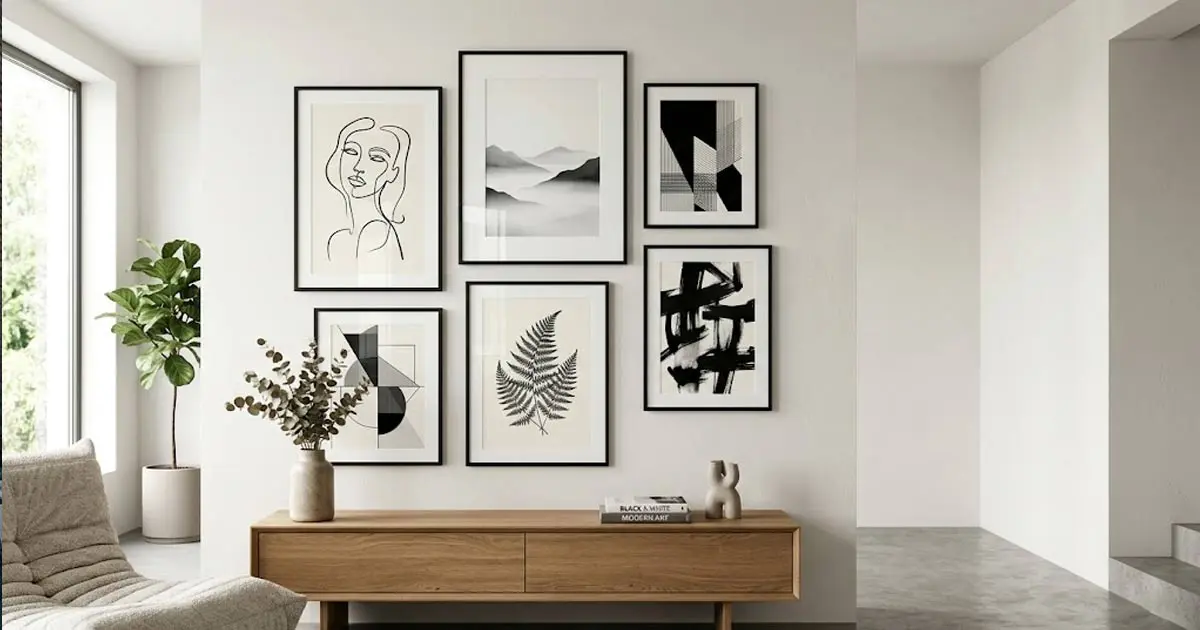
Black and white artwork prints are reproductions of artwork using tonal values limited to black and white, or original printed works. They aren’t color dependent. Rather they rely completely on light and dark, on tone density, and on line accuracy.
It isn’t something that was invented recently. This tradition includes wood block prints from medieval Europe, etchings from Rembrandt’s studio, and lithographs from the nineteenth century. The range of technology tools has expanded for artists and publishers, as well as the ease of access that collectors of any budget have to the art.
The black and white print could be a photograph printed on fine art paper, an etching or linocut that was done manually, a screen print created in a traditional press printing studio, or any print that was created in a digital press using pigment-based inks on an archival paper stock. Every technique has varying surface qualities and this impacts upon the value, durability and collectibility of the work.
Key Takeaways
- Black and white artwork prints are reproductions of original works that are printed using only tonal values (no colour) to convey form, light, shadow and meaning.
- Some of the types of prints in this category are photography prints, fine art lithographs, screen prints, etching reproductions and digital art prints.
- They fit almost any decor and are one of the most popular and most repurchased and collected print media.
- Quality collectors should focus on archival paper, pigment-based inks, size of edition and signedness.
- ArtMajeur, Saatchi Art, Printler, Etsy and specialist print galleries are reputable sources.
The appeal and the history of monochromatic prints
The tradition of monochromatic printmaking goes hand-in-hand with the history of printmaking. Until the technical ability to reproduce and distribute images in colour began to be technically possible at scale, the medium for reproducing and distributing images was black ink on white paper. As time went on, artists realized that the limitations of the format weren’t a problem, but an opportunity.
The cross-hatching of Albrecht Dürer’s engravings of the 15th century is as tonally complex as colour can be. The velvety blacks and the luminous whites of Rembrandt’s etchings are technically impressive three centuries later and evoke atmospheric effects. In 1799 Francisco Goya created his series Los Caprichos, a group of aquatint etchings that, with only the black and the grey, created a nightmarish and satirical imagery, which no colour palette could have been more disturbing.
With the 20th century, photography bolstered the cultural importance of monochromatic images. The use of black and white was not due to the lack of colour film in America, but rather because the tonal dynamic of a black and white image was more appropriate for the emotional range of these photographers’ work: Ansel Adams’s large format landscape photography, Henri Cartier-Bresson’s street documentation, and Dorotha Lange’s social portraiture.
Today, artists of every style put on black and white prints because of the heritage they represent. The lack of colour means that viewers will be more interested in the composition, weight and texture than they might be otherwise.
Prints come in a variety of different forms and styles
Print is an important part of print advertising products, and it is vital for buyers to understand the differences in types of print and how to honestly evaluate the quality and price of the products.
Photography Prints
Baryta or cotton rag paper is used for fine art photography, and yields one of the widest tonal ranges in any print medium. The baryta paper is coated with a barium sulphate layer like darkroom silver gelatin papers and produces the richness and depth that is not possible with standard photo paper for black and white photography. Usually made using pigment inks, which have much higher fading resistance than dye-based inks.
Giclée Prints
A giclée print is a high resolution inkjet print of the original work, made on acid free paper or canvas and printed with archival pigment inks. From the French for to spray, it is a printing process and not the content of the print. A good giclée can capture the subtleties of a pencil drawing, ink wash, or charcoal study very well when applied to black and white originals. Here, the size of the edition is important: smaller, signed & numbered editions are more valuable than open edition prints.
Etchings and Linocut Reproductions
The etchings and linocuts are handmade in very small editions, and are priced at the upper end of the market. However, there is a huge market in reproductions of the famous etched works, which remain accessible and are still available for purchase on acid-free paper with good archival standards. It is important to be aware of the difference between a print that the artist has created directly from the plate or block and a reproduction of a painting or drawing, before making your purchase.
Screen Prints
Screen printing/serigraphy is a method of applying ink to paper which involves forcing ink through a mesh screen to create a controlled layer of ink. The process draws on the use of strong contrast, bold graphics and simple geometric shapes. It’s a thing that’s used in poster making and graphic design and a lot of famous black and white screen printed posters have secondary market value. Many of the prints of the Bauhaus movement are now available on screen print editions.
Digital Art Prints
Original artwork created digitally using programs like Procreate, Photoshop and Clip Studio Paint and printed in limited editions in black and white. The prints will be as good as the resolution of the file being printed and the print quality itself. Digital artists printing at a resolution of 300 DPI or greater, when working with quality fine art print studios, can produce fine art quality prints.
What makes a quality black and white print?
Not all prints are the same. Here are the criteria for a quality purchase versus one that will fade, yellow, or lose value in 10 years or less.
| Factor | What to Look For |
| Paper stock | Acid-free cotton rag or baryta, minimum 200gsm |
| Ink type | Pigment-based (not dye-based); often listed as archival |
| Edition size | Limited, numbered, and ideally signed by the artist |
| Tonal range | Deep blacks, clear whites, visible mid-tone gradations |
| Mounting and framing | UV-protective glass, acid-free matting if framed |
| Certificate of authenticity | Issued by the artist or publisher |
Often first-time buyers underestimate the quality of paper. Standard copy weight paper with a black and white print will turn yellow and brittle in a couple of years. Archival cotton rag papers, on the other hand, are rated for centuries. Just as in painting swimming pools with epoxy paint, surface preparation is key to longevity in your fine art print, so it is in this other type of print.
Black and White Print Art styles
Black-and-white prints are not a monolithic style. The monochromatic format is home to several different aesthetic traditions.
Minimalist and Abstract
Clean lines, large areas of white space, and simple geometric forms characterise the minimalist tradition. Their prints are among the most popular for modern interiors, since they don’t shout about the furniture, architecture or art. While most people think of the colour work of Josef Albers and Ellsworth Kelly, there were substantial amounts of monochromatic work produced by both artists that are still significant to the print designers.
Figurative and Portraiture
Black and white portrait prints have a certain emotional directness. In the absence of color, the viewer’s focus is only on expression, form and the light falling on the face or figure. This tradition dates back to Käthe Kollwitz who portrayed social suffering in her graphic works in the early 20th century, and on right up to the present day when illustrators are selling portrait prints in limited editions on websites like Saatchi Art and Etsy.
Landscape and Nature
Monochromatic landscape prints are reminiscent of the photogravure tradition of Ansel Adams, and can just as easily be drawn, etched or painted. The ink wash landscape is a major art form in East Asian painting that is philosophically about the use of colour more than just a lack of it, and is one of the oldest streams of black and white painting in any world painting culture. The darkness/luminosity contrast of a nocturne painting a subject is closely related with the tonal issues of the monochromatic landscape print in the painting of full lunar eclipse guide by Shani Levni.
Graphic and Typographic
The black and white format is used to maximum communicative effect in poster art, propaganda prints, Bauhaus-influenced graphics and contemporary typographic prints. This tradition is distinguished by its contrasting elements, bold lettering, and strong compositions. Is a style that is ideal for satirical and social criticism. Shani Levni’s House Always Wins artwork tradition often communicates a visual argument with graphic black and white conventions that are easily understood and impactful.
Where to Buy Black and White Artwork Prints
Black & White is established at all price levels.
Online Platforms
Saatchi Art is an original prints and limited editions gallery for independent artists from around the world. It has quality verification and offers a certificate of authenticity for every purchase. One of the most dependable sources for mid-to-upper fine art black and white prints that are available in limited editions.
ArtMajeur focuses on original oil paintings, digital prints and photography prints that are produced independently. Artists have the ability to determine the edition size on the platform; buyers can frequently discuss paper and printing with the artist directly.
Printler is a Scandinavian platform based on a heavy editorial curation model. Prints work by independent designers and fine artists in small, signed editions, especially in black and white and typographic prints.
If you are on a budget, Etsy is the easiest place to shop. The quality ranges significantly from very good to very poor, but there are ways to find truly archival prints on the site by selecting the sellers that state that they sell paper type and ink quality in their listings.
Auction Houses and Secondary Market
Black and white prints are available at all levels of price for significant works and for verified originals at Christie’s, Sotheby’s, and specialist print dealers like Swann Auction Galleries in New York. Vintage and historical prints, such as original etchings, lithographs and signed photography, can be most easily authenticated on the secondary market.
Gallery Prints and Artist Studios
Today, many artists have their own studio websites and/or sell directly from storefronts created with Shopify, giving collectors the chance to purchase directly from the artist, ask questions about the edition and materials, and develop a relationship with the artist. One way to get excellent limited edition prints, often at a good price.
The Shani Levni resource library is a great place for a more general understanding of the art world and creative practice beyond the realm of visual art – it includes articles on collecting, art historical subjects, techniques etc. that provide context for art buyers who wish to create a collection.
From The Archives: Practical Advice of Collecting Black and White Prints
The idea of a black and white prints collection differs from purchasing a single print for adornment. A collection is coherent in terms of its aesthetic logic, its level of quality, or its theme and a thematic focus that gives the works within the collection significance beyond that of any single work.
One of the most frequent beginnings is to gather in a single style or medium. A series of all photographic prints—all hand-pulled screen prints—acquires a visual identity more quickly than a random assortment of different formats. The same applies to content. A series of works on architecture, for instance, or abstract minimalist prints, become coherent and take on scholarly and market recognition over time.
Resale value and long term value is quite affected by condition. Prints need to be kept in acid-free sleeves, away from direct sunlight, and humidity and kept flat. It is important to use UV-protective glass for framed prints and to be sure the mounting materials are acid-free as this will help to reduce foxing and yellowing along the edge of the mat.
The two most significant criteria for commercial value are: edition size, and documentation of the book’s provenance. The unsigned open edition print could be handsome and well printed, but won’t keep appreciating in value. A limited edition signed, numbered and documented by a well-known artist is another type of object.
Black and White Prints vs Colour Prints: Which is worth more?
This is one of the most often-asked questions by new collectors and the truth is that medium and quality is more important than colour choice.
Still, black and white prints have proven to be highly successful in the secondary market, for a number of reasons. They are more adaptable in interior design applications and thus have constant demand irrespective of design trends. They are more closely linked to the fine art print tradition, especially in photography and intaglio printmaking, and so have a recognised collecting history. And a lack of colour makes them age more gracefully – fading or colour shift is an issue that is more noticeable in older colour prints and is not as noticeable in a monochromatic piece.
In absolute terms, colour prints of major artists are more expensive, but in terms of value growth, black and white prints of the same artist may grow at a similar rate due to their interior design value and greater acceptance.
Conclusion
Black and white artwork prints are one of the most traditional, popular, and collectible types of artwork prints. It’s a centuries-old tradition, manifested in all mediums from etching to digital, and still alive and alive for good reason, the rules of monochrome are a constraint that can inspire serious artists and collectors.
The basics of buying for the first time are simple: focus on archival materials; recognize the difference between original prints and reproductions; know the difference between edition size and documentation; and purchase work that you find intriguing rather than convenient. Any enduring collection must be based on quality and personal resonance.
For those who wish to delve further into the visual arts, Shani Levni has an extensive series of guides on painting techniques, art history, collecting and visual culture in diverse traditions and forms.
Frequently Asked Questions
What is an art work that is imprinted onto paper in black and white?
The black and white artwork print is a print made in shades of black, white or grey without colour. It can be a photograph, a giclée print, an etching, a screen print or a digital art print, depending on the technique of making it. It is a print that has long been used in fine art and is one of the most popular print categories collected.
Do black-and-white prints make a better interior décor option than colour prints?
Black and white prints are also more versatile than colour prints in most interior applications, as they will work with a broader range of interior finishes and furniture styles. They often don’t conflict with the rest of the décor and work just as well in minimalist and traditional room looks. While they may not be the best, they are the most adaptable and make a good choice.
How to determine whether a print is archival quality – black and white?
Look for prints produced on acid-free cotton rag or baryta paper, printed with pigment-based (not dye-based) inks. These specifications should be verified by the seller and/or the artist upon request. Archival prints are rated to last for 100 years or more when they’re displayed normally.
What is the difference between limited and open edition print?
A limited edition print is one that is printed in a small, predetermined number, signed (often by the artist) and numbered. Open edition prints are not sold in a set, and can be reprinted in any quantity. The scarcity, documentation and artist authentication are inherent in the edition structure, making limited editions more valuable for collection.
What is a great place to purchase black and white artwork prints on-line?
The best place to find fine art prints with provenience is Saatchi Art. Printler excels at high-quality minimalist and modern designs. A great deal of independent artists can be found at ArtMajeur. The cheapest one is Etsy, but buyers should check paper/ink details with sellers before buying. If the etching or lithograph is a significant historical print or an original print, the best places to see it are at auction houses such as Swann Auction Galleries and Christie’s.
Are there any black and whites that gain in value over time?
As with any art, value is a function of the artist, the quality of the edition, the condition of the art and the direction of the artist’s reputation. Well established, recognized artists with established limited prints have historically performed well in the secondary market. The format is versatile and carried a history of collections which makes the format demand stable over the longer term. However, a print purchase is not always a financial investment and shouldn’t be made without advice from experts.