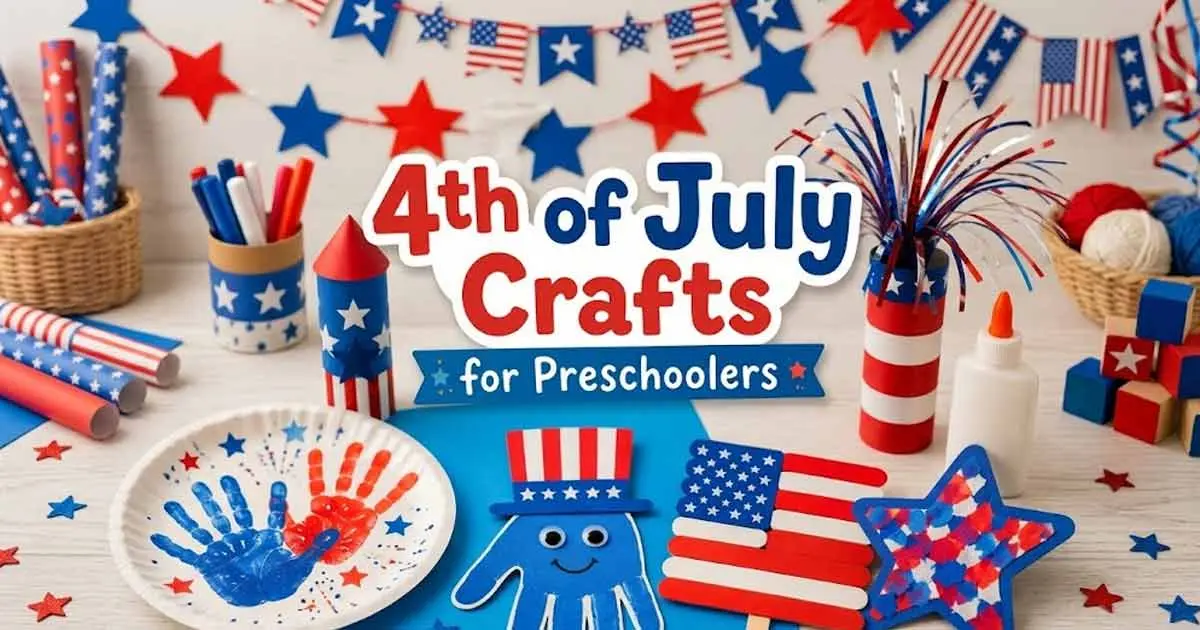
Preschool crafts for the 4th of July should be easier, quicker and less demanding than older children’s crafts. Children aged 2-5 have not yet developed the fine motor skills for accurate cutting or multi-step assembly and activities that involve pressing, dotting, stamping and gluing of pre-cut shapes are most effective. Each of the fourteen crafts in this guide is specifically designed for the preschool age group, and indicates the lowest and highest age range for which it is appropriate, as well as the skill that it develops, so that caregivers and teachers can choose activities that are appropriate for the child’s developmental level, not the general age that a “kids craft” book assumes.
Key Takeaways
- These are the best 4th of July crafts for preschoolers that don’t require cutting or do minimal cutting: stamping, dot painting, gluing pre-cut shapes and sensory play.
- Activities are graded to allow caregivers to choose an appropriate craft for a child’s developmental level in the general age range of 2-5 years.
- Handprint art, dot markers, and sensory bins are the most age-appropriate crafts for the youngest preschoolers (ages 2-3) that do not involve scissors.
- Crafts for ages 4-5 can include basic cutting, threading and multiple step assembly, like paper plate flags and pinwheels.
- All crafts are red, white, and blue and tie into the early learning concepts of color recognition, counting and basic flag symbolism.
- The activities are completed in 15-25 minutes, which is less time than crafts for older children require, due to the smaller attention span of preschoolers.
- Early childhood education sources state that hands-on seasonal crafts are beneficial for fine motor development, sensory processing and early color and shape recognition in the preschool age group.
The importance of crafts that are specific to preschool
Preschool children are not typically able to use scissors, focus on an activity for long periods, or make precise fine motor movements; crafts intended for general “kids” audiences often rely on these abilities. What works great for an 8-year-old, may not work for a 3-year-old, and can result in a session that ends in tears instead of creative satisfaction.
Preschool-appropriate crafts address this problem by using a limited number of fundamental actions: pressing (handprints, stamps), dotting (cotton swabs, dot markers), gluing pre-cut or torn shapes, and simple folding. These actions work on the same fine motor skills that the more complex crafts are designed to develop: hand-eye coordination, pincer grip, bilateral coordination, but at a level of complexity and pace that is appropriate for the 2-5 year old to do independently or with minimal adult support.
Crafts for the youngest preschoolers: Ages 2-3
1. Handprint Flag
Materials: White paper, red and blue paint, white paper for stars (pre-cut by adult).
How to do it: Paint the palm of a child blue and stamp it in the upper left corner of white paper to form the blue upper corner (canton) of the flag. Draw the same or the other hand again in red, pressing in horizontal lines across the remainder of the paper to create stripes. After drying, add small white star stickers or cut out stars to the blue area.
Skill focus: Pressing with controlled pressure, colour association with flag, no cutting required.
It is one of the easiest crafts for the very young preschoolers (with assistance from adults, they can press a painted hand onto paper).
2. Dot Marker Fireworks
Materials: Black or dark blue paper, red, white and blue dot markers (bingo dabbers).
Method: Show how to make a dot in the middle of the paper and then make more dots outwards in a ‘burst’. Children repeat the action freely all over the page, making their own fireworks displays in whatever colours and patterns they like.
Get the dot marker in the pincer grip, dabbing motion controlled, selecting colors.
This is one of the most physically accessible painting tools for toddlers and young preschoolers, as dot markers are specifically designed to be used with small hands and require less grip strength than a normal paintbrush.
3. Cotton Swab Painting
Materials: White paper and simple outline of a star or flag, red and blue paint in shallow dishes, cotton swabs.
How to do it: Dip a cotton swab in paint and dot the paint in the outlined shape. Children use the dotting technique to fill in stars, stripes, or simple shapes, one swab per color, so as not to mix colors.
Skill focus: Fine motor precision using a small tool, within a boundary, colour separation.
4. Star-Shaped Sponge Stamping
Materials: Red, white, and blue paint; star-shaped sponge or sponge cut into a star shape; white or blue paper.
Method: Star sponge, paint, paper.Steps: Dip the star sponge in paint and stamp onto paper several times to make a pattern of stamped stars. Allow for overlapping and diverse positioning, not a grid.
The skill that is being practiced is the repetitive stamping motion, spatial distribution across a page, basic shape recognition (stars).
5. Patriotic Sensory Bin
Materials: Red and blue dyed rice or kinetic sand, small star shaped cookie cutters, small plastic flags, scoops and cups.
Method: Place red, white and blue rice or sand in a small container. Have scoops, cups, and star cutters available. Children experiment with scooping, pouring and pressing stars into the material.
Skill focus: Sensory exploration, bilateral hand use, cause and effect.
This activity doesn’t need to be completed, and is especially good for children who are not yet motivated or able to create a representational craft. It still provides good fine motor and sensory play opportunities in open-ended exploration.
6. Tissue Paper Stuffing Flag
Materials: Paper plate or card with a basic outline of a flag, small squares of red, white, and blue tissue paper, glue.
Method: Glue a thin layer into each part of the outline of the flag. Children take the squares of tissue paper and make little balls out of them and press them to the glued spots, filling the stripes and canton with the right colours.
Focus skill: Pincer grip, scrunching, matching to the right section, sensory experiences with texture.
Tissue paper stuffing activities are considered to be one of the most effective ways to develop the specific pincer grip strength needed for later pencil control and early writing, according to general early childhood craft guidance.
Crafts for Older Preschoolers Ages 4-5
7. Paper Plate Flag with Pre-Cut Stripes
Materials: White paper plate, Pre-cut red paper strips, Blue paper square, White star stickers, Glue.
Method: Glue pre-cut red strips horizontally on a paper plate to make stripes. Glue the blue square in the upper left corner. Stick white star stickers on the blue section. Older 4s and 5s may try putting strips in without a lot of adult support.
Skill focus: Spatial planning, gluing precision, counting stripes (13) as literacy and math extension.
8. Practice cutting the simple star shape
Materials: Red, white and blue paper with star outlines pre-drawn, child-safe scissors.
Method: Give paper with well-drawn outlines of stars. The children learn to cut along the lines and adults help with the narrow star points. Completed stars may be glued onto a background or be threaded onto string to form a garland.
Skill focus: Introductory scissor control, following a curved and angled line, patience through a multi-cut shape.
It is a suitable first independent cutting activity for children who have some previous experience using scissors with more basic straight line cuts.
9. Patriotic Pom-Pom Garland
Materials: String or yarn, red, white and blue pompoms, large plastic needle or blunt threading tool.
Method: Make a knot at one end of the string. Using a blunt plastic needle or threading tool, children thread pom-poms onto the string in a repeating colour pattern (red, white, blue).
Skill focus: Bilateral hand coordination, pattern sequencing, sustained attention (repetitive task).
Early childhood fine motor resources state that some of the most direct precursors for hand control in buttoning, zipping and later handwriting, are the activities of threading.
10. Toilet Paper Roll Firecracker
Materials: Toilet Paper Roll, red and blue paint, tissue paper streamers, tape.
Method: Paint a toilet paper roll red or blue and allow to dry. Place red, white and blue tissue paper streamers inside one end to hang out like firecracker fringe. When celebrating, children can take the finished craft and use it as a substitute for a noisemaker.
Skill focus: Painting a 3-D object, simple assembly, imaginative play extension.
11. Patriotic Pinwheel (Simplified)
Materials: Pre-folded paper pinwheel template (square paper with diagonal cut-outs), pin, craft stick, adult assistance to assemble pinwheel.
Method: An adult pre-cuts diagonal slits towards the center of a red, white, and blue patterned paper square. Children fold all the other points to the middle and an adult pins them down through the middle and adds the craft stick handle.
Students will learn to fold precisely, observe and duplicate a multi-part process and to delay gratification (pinwheel only spins when fully assembled).
This craft is pre-cut for adults but the child is given ownership of the folding and decorating part; it is a suitable craft for a 4 or 5-year-old to do in collaboration with an adult.
12. Star Counting Flag Mat
Materials: Flag outline mat (laminated), small foam or wooden stars, marker for tallying.
Children will be counting aloud as they place stars on the blue canton of a laminated flag mat, one at a time, up to a target number (e.g. 10 or 13 depending on the focus of the lesson).
This skill focuses on one-to-one correspondence counting, fine motor placement and early math skills with a seasonal theme.
This is not a traditional craft, but rather a math manipulative lesson that is themed for the 4th of July and beneficial for classrooms that want to directly incorporate numeracy into the 4th of July unit.
13. Watercolor Resist Star
Materials: White paper, white crayon, red and blue liquid water color, wide paint brush.
Material: White paper, an adult or older child, white crayon (invisible at this point). Child uses red and blue watercolour to cover the whole of the paper. The wax crayon is able to withstand the paint and show the white stars underneath.
The focus is on skill: Wide brushwork, surprise and delayed reveal, introduction to the concept of resist techniques in art.
14. Red, White, and Blue Playdough Mats
Materials: Playdough (red, white and blue), laminated mats with star and flag outlines, rolling pins.
How to: Children roll and press playdough into the outline of the shapes on laminated mats, matching the colors to the correct area of a star or simple flag design.
Skill focus: Hand strength building, color matching, low pressure repeatable activity to not create a “finished” keepsake but to build significant hand strength.
Appropriate Crafts for Developmental Stage
| Age | Recommended Crafts | Why |
| 2 to 3 | Handprint flag, dot marker fireworks, sensory bin, tissue stuffing | No cutting, large motor actions, sensory focus |
| 3 to 4 | Cotton swab painting, sponge stamping, toilet roll firecracker | Introduces tool use and simple assembly |
| 4 to 5 | Paper plate flag, star cutting, pom-pom garland, pinwheel | Introduces independent cutting, threading, multi-step process |
| All ages (flexible) | Playdough mats, star counting mat | Adjustable difficulty, repeatable, no waste material |
Materials Checklist for Preschool 4th of July Crafts
| Material | Used In |
| Red, white, blue paint | Handprint flag, sponge stamping, firecracker |
| Dot markers | Dot marker fireworks |
| Cotton swabs | Cotton swab painting |
| Star-shaped sponge | Sponge stamping |
| Dyed rice or kinetic sand | Sensory bin |
| Tissue paper squares | Tissue stuffing flag |
| Pre-cut paper strips | Paper plate flag |
| Pom-poms | Pom-pom garland |
| Toilet paper rolls | Firecracker craft |
| Child-safe scissors | Star cutting practice |
| White crayon | Watercolor resist star |
| Playdough | Playdough mats |
| Laminated mats | Star counting, playdough |
Some tips for helping facilitate crafts with preschoolers
Expect shorter sessions. Preschoolers can maintain sustained attention on an activity for 10-20 minutes. Plan craft blocks accordingly not expecting a single long block to keep attention.
Focus on the process rather than the product. A dot marker firework page for preschoolers doesn’t have to look like a firework. What matters is the dabbing action, the colours and the ongoing interaction rather than creating a recognisable picture.
Cut all the pieces for ages 2-3. The youngest preschoolers should have all the pieces pre-cut for any craft that involves scissors. Wait to introduce scissors for crafts that are focused on the skill, such as the star cutting practice activity, and only with children who have demonstrated some interest and preparedness for scissor use.
Ensure use of washable, non-toxic materials. Craft activities are often times when preschoolers put things near their mouths and touch their faces. At this age, washable paint, kid-safe glue and non-toxic playdough are essential.
Include a sensory accommodation. Not all preschoolers will be interested in a particular craft on a specific day. The sensory bin can be used as an alternative activity for children that don’t want to paint or glue, so they can still join in on the theme of the season without getting their hands dirty.
In the larger 4th of July crafts for kids, there is a more comprehensive discussion about the importance of adjusting the complexity of activities to the developmental level of children, and not to their age, which is the same approach that is used to plan effective seasons with preschool activities.
Conclusion
The best 4th of July crafts for preschoolers are those that are tailored to a child’s developmental level, not just reduced in size from a craft made for older kids. The activities in this guide are designed to be accessible to the preschooler trying them: they are not independent scissor activities or multi-step processes, but involve pressing, dotting, stamping.
The best way to do this is to regard the craft session as a chance to build skills by repetition and sensory stimulation, and not as a race to a finished product. The handprint flag and the cut-and-threaded star garland have the same developmental goal: to create the fine motor skills, color recognition and attention span that will help the child to engage in more complex creative and academic activities in the future.
Visit Shani Levni for a wealth of guides to seasonal crafts, early childhood activities and developmentally appropriate creative projects.
Frequently Asked Questions
What are the simplest 4th of July crafts for kids in preschool?
Handprint flags, dyed red and blue rice or sand sensory bins and dot marker fireworks are the easiest crafts for preschoolers. No cutting is involved and there is not much fine motor precision needed for these activities, so they are accessible to children as young as 2 with adult support.
What are some 4th of July crafts for 2 Year Olds?
Handprint flag art, dot marker fireworks and sensory bin exploration with patriotic colored rice or sand are the most appropriate crafts for 2-year-olds. These activities are based on pressing, dabbing and scooping, and do not require cutting, gluing precision or several steps of assembly which are still being developed at this age.
When is it appropriate for preschoolers to begin cutting with scissors for crafts?
Basic scissor skills start to develop at age 3-4 years but varies from child to child. Star cutting practice and other cutting activities suitable for introducing children to cutting are best given to those children who have had some experience with simpler straight-line cutting activities, usually between 4 and 5 years.
What is the appropriate length of time for a 4th of July craft activity with preschoolers?
Most 4th of July arts and crafts for preschoolers should be 15-25 minutes, which is the time span of sustained attention for the 2-5 age group. Multi-stage crafts that need drying time can be broken up into two shorter sessions instead of one long session.
What materials are suitable for these crafts with preschool children?
The safest materials are washable, non-toxic paint, child-safe glue sticks, non-toxic playdough, and large dot markers for young children. Do not give small detachable parts (like loose googly eyes or beads) to the youngest preschoolers because they are a choking hazard.
What are some ways to modify 4th of July activities for mixed ages of preschoolers?
Create a craft that has different levels of complexity, such as pre-cut shapes for younger children to glue, and more challenging shapes for older preschoolers to try to cut out on their own. Items such as the playdough mats and sensory bin are well suited for all ages 2-5 and are not adjusted for different age groups.