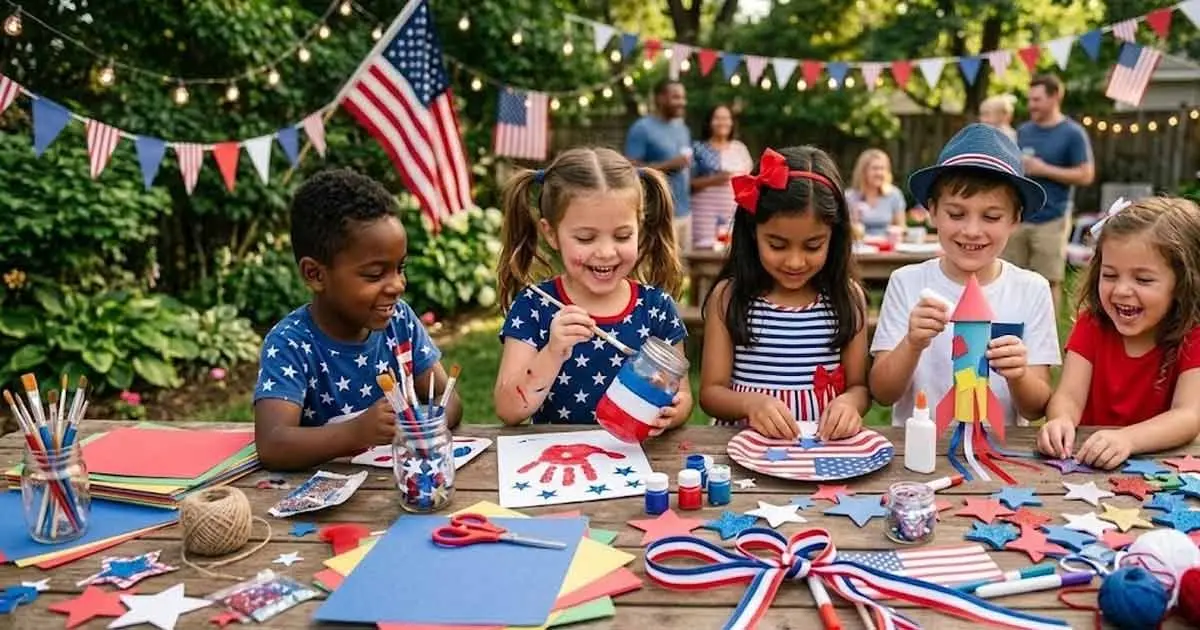
The best 4th of July crafts for kids feature red, white and blue paint, paper plates, tissue paper, coffee filters and pipe cleaners, which are all easily accessible in most households and classrooms. This book features 20 patriotic crafts that encourage children to practice a variety of skills: fine motor control, color patterns, printmaking, and early science. Most activities will range from 20-45 minutes in duration. Each craft in this collection has a real learning goal and can be used for a class project, family project, or a summer camp project.
Key Takeaways
- Most of the crafts in this guide will not need any special materials just paper plates, tissue paper, red, white, and blue paint, coffee filters, and pipe cleaners are all that’s needed for the best 4th of July crafts for kids.
- Activities are appropriate for children ages 3–10 and there are notes for adapting for the youngest and oldest children in each section.
- Each craft is related to a particular developmental skill such as fine motor control, color recognition, spatial reasoning, pattern work, and initial science observation.
- Most projects take 20-45 minutes, and a few are multi-stage projects that can be completed in two short sessions because of drying times.
- This is incorporated into several crafts in the guide and is a great way to use red, white, and blue as a tool for sorting and creating patterns in preschool math extensions.
- With brief, age-appropriate conversation, Independence Day crafts easily dovetail into the school-age history, civic identity, and early science.
- The craft-as-learning approach here is similar to that in the preschool crafts ideas for spring guide on this site: Making the craft is where the learning takes place, not the finished product.
The value of 4th of July Crafts for children
Seasonal crafts are best when they relate children’s observation of the world around them to what they are making at the table. The 4th of July offers easy-to-recognize, bold visual cues such as stars, stripes, fireworks, flags, which are easy for children as young as three years old to recognize. A child that chooses red and blue paint from a paint tray and presses a star-shaped sponge to a piece of paper is not just decorating. All in one short activity, that child is learning colour discrimination, controlled hand pressure and spatial awareness.
Craft activities build fine motor skills such as hand-eye coordination, finger dexterity and grip strength with the use of scissors, glue and paint, says mybrightwheel.com. These are the same physical skills that children use when they write, button, and perform many other everyday activities in primary school.
According to the mccaedu.org website, seasonal craft ideas can provide kids with more than just fun. They develop early learning skills and connect classroom or home to events in the wider world. This child is engaging in a shared cultural moment, albeit in small and tactile ways, by creating a paper flag for the 4th of July.
Art activities that are linked to actual seasonal events are more developmentally significant than abstract projects, according to Dr. Sandra Duncan, author of Inspiring Spaces for Young Children. The seasonal link provides the child with a context for the colors, shapes and materials that they are using, and this context increases engagement and retention.
Paper and Collage Crafts for 4th of July
1. Create a paper plate American flag
Materials: Paper plate, Red paint or construction paper, Blue paint or construction paper, White and Red paper strips, Glue, Star stickers or star shaped sponge stamp.
Method: Paper plate.Steps: Cut the paper plate in half. Paint or glue blue paper in the upper left 1/4. Stick or stamp white star stickers or stars on the blue part. Cut or tear strips of red and white paper into horizontal bands and glue them on the other three-quarters of the plate.
Skill focus: Dividing a surface in space, alternating color pattern, planned layout of stickers or stamps.
This is one of the easiest 4th of July crafts for preschoolers as the circular paper plate is a pre-made border! Children can start to tear and place the strips as early as 3 years old without using scissors.
2.Create a Flag Collage with Torn Paper
Materials: Red, white and blue tissue paper or construction paper, white card stock, glue stick.
Method: White card stock.Steps: Sketch a flag rectangle lightly on white card stock. Cut up the tissue paper into small bits. Glue pieces to the proper area of the flag, one color at a time. No trimming is needed.
Skill focus: Tearing uses the same hand muscles as early scissor work. Color sorting, filling a bounded shape are secondary skills.
Younger children can enter by tearing paper, a no-scissors activity. Torn paper collage is one of the most suitable forms for mixed-age groups because fine motor seasonal crafts are self-paced and low pressure, says the mccaedu.org website.
3. Fireworks Watercolor Splash
Materials: White watercolor paper, red and blue liquid watercolor or diluted food coloring in droppers, a drinking straw.
The method: Randomly place drops of red and blue watercolor on the paper. Blow each drop outwards with a straw in a starburst pattern. Use colours and let them overlap, and dry the paper flat.
Skill focus: Cause and effect, colour mixing observation, breath control.
Science extension: When red and blue drops are mixed, children notice that they form a purple colour. First introduction to the color wheel and a natural discussion of mixing colors for ages 4 and up.
4. Star-Spangled Handprint Banner
Materials: Red, white, or blue paint, white card stock in pennant shapes, string/twine, hole punch.
Method: Paint the hand of a child in red, white or blue paint and press it on to a pennant card. Allow to dry. Write a simple word or the child’s name on each pennant. Make two holes in the top corners and tie onto twine to hang as a banner.
Skill focus: Handprint printing technique, name recognition and early writing, sequencing a hanging display.
Handprint Banner is a natural family keepsake. It is particularly suited to be a cooperative project if multiple children each add one pennant to a single length of twine, adding a social element to the individual creation.
5. Red, White and Blue Tissue Paper Wreath
Materials: Paper plate with hole cut in the middle to create a ring, red, white, and blue tissue paper, glue.
Method: Fold or crumble tissue paper into small balls or puffs. Place them on the paper plate ring in a pattern: red, white, blue, red, white, blue. Let dry completely before putting a string loop on to hang.
Type of skill: Pattern recognition and creation (ABCABC sequence), fine motor scrunching, spatial coverage of a curved surface.
This type of pattern work is directly related to early math readiness. The ability to make and continue a 3-color pattern is the same logical thinking that is required to sequence numbers and early algebra.
Create paint and print crafts for the 4th of July
6. Sponge Fireworks Painting
Materials: Small pieces of sponge, red, white, and blue paint in shallow trays, black construction paper.
Method: Cut the sponges into stars, blobs and thin strips. Dip in paint and press on black paper to make a fireworks scene. Use shapes and colors to create a night sky effect.
Accurate sponge pressure, composition planning, and visual contrast (light colors on dark paper) are all skill foci.
The combination of black paper and red and white paint creates a strong visual effect. The contrast creates an instant fireworks effect even with simple pressing, which gives young artists a great and instant sense of achievement.
7. Fingerprint Firecracker Art
Materials: Black/dark blue paper, red, white and blue paint, fine gold or silver marker for older children.
Method: Children use fingertips to press into paint and then stamp it outwards from the centre creating individual firework bursts. One color or multiple colors may be used for each burst. Once the paint has dried, a fine-line tail may be added using a marker.
Skills: Controlled finger pressure, radial symmetry, color selection.
Fingerprint activities are some of the most age-appropriate art activities for children under 4 years old as they are not tool dependent. This is one of the easiest 4th of July crafts for toddlers that doesn’t need any brush or sponge.
8. Star-Shaped Potato Print
Materials: Potato, knife (adult only), red and blue paint in trays, white paper.
Method: The adult cuts the potato in half and carves a basic star shape by cutting away around the shape of the star. Children immerse the potato stamp in red or blue paint and repeatedly stamp onto white paper to form an all over star design.
Skill Focus: Printing technique, cause and effect, pattern making using natural object.
Crafts with pumpkins for preschool, such as real object stamping, offer a sensory aspect that foam or rubber stamps are not able to duplicate. The potato is heavy enough to make the activity interesting and each print is slightly irregular, giving a more interesting final image.
9. This is a Bubble Wrap Fireworks Print
Materials: Bubble wrap sheet, red and blue paint, white paper, brush or roller.
Method: Cut circle pieces of bubble wrap. Use a brush to paint one area in red paint and another in blue paint. Squeeze the painted bubble wrap tightly on white paper. Carefully lift and arrange in overlapping patterns to create a fireworks composition.
Art focus: Printmaking process, controlled pressing, understanding that an indirect tool transfers an image.
The dotted effect created by the bubble wrap is similar to the visual effect of a firework explosion, so children know what they’re looking for and will be pleased to demonstrate to others.
10. Coffee Filter Flag
Materials: White coffee filter, washable red and blue markers, spray bottle of water, craft stick, tape.
Materials: Flat coffee filter and red markers.Steps: Draw horizontal lines across the bottom of a flat coffee filter using the red markers. Use the blue marker to write in the top left corner. Spray with water to bleed colors slightly at edges. Allow to dry completely. Use tape or glue to attach to a craft stick as a little waving flag.
Skill focus: Color absorption observation, delayed result through the drying process, fine motor colouring control.
The same material is used to create butterfly wings and raindrop suncatchers in the preschool crafts ideas for spring guide, which is explored in detail. The approach is directly translatable to a patriotic flag with a change of color and intent, and it is a simple addition for any environment that already has this material.
For the 4th of July, 3D and Construction Crafts will be held
11. Toilet Roll Firecracker
Materials: Toilet paper roll, red or blue paint, red, white, and blue strips of tissue paper, star stickers, string or twine.
Method: Paint the toilet paper roll and allow to dry. Place tissue paper strips into one end, to protrude as the burst. Sticker stars around the outside. Loop a string through the other end and hang as decoration.
The skill focuses on 3D surface decoration, mixing materials of different types, inserting and fixing loose materials in a tube.
12. Paper Cup Uncle Sam Hat
Materials: Small paper cup, red and blue paint or paper, white star stickers, red and white paper strips, glue, card stock for brim.
Method: Paper cup, paint or masking tape. Stick on a blue strip near the top featuring white star stickers. Cut a brim out of card stock and glue it around the bottom of the cup. Place on a table or as a tiny hat on your head.
Skill focus: Planning the decoration of a cylindrical 3D surface, covering a curved surface with pieces of decoration, planning the placement of decoration around a curved form.
13. Yarn-Wrapped Star
Materials: Star shaped cardboard, red, white and blue yarn, glue or tape to secure starting points.
Method: Glue a little glue to secure the yarn in one place of the star. Start wrapping yarn around the cardboard star, alternating colors to create different colored sections. Fold over the last end. Use a loop of yarn to hang.
Motor skills: Bilateral hand coordination in wrapping motion, sustained attention, planning of sections in colour before starting.
The wrapping movement is a repetitive, calming movement. Useful activity for children who require sensory regulating activities, and the star is firm enough to be used as a decoration for the next few years.
14. Paper Chain Garland
Materials: Construction paper in red, white and blue, glue stick or tape.
Method: Tie strips together in a repeating sequence (red, white, blue, repeat) by looping each strip over the previous one and gluing or taping the ends together. Keep repeating until the garland length is desired. Use as a party or classroom decoration.
Skill focus: Prediction of and continuation in a pattern, fine motor linking, repeating a sequence.
15. Tissue Paper Fireworks Jar
Materials: Glass jar or clear plastic cup, red, white and blue tissue paper, diluted PVA glue or Mod Podge, brush, battery-operated tea light.
Steps: Cut tissue paper into small pieces. Coat the outside of the jar with a light coating of glue. Place tissue pieces on the surface, overlapping colors, one piece at a time. Put a final coat of glue on top of the whole surface. Allow to dry fully. Insert a tea light battery in it.
Skill focus: Decoupage technique, layering translucent materials, understanding that light passes through coloured paper in different ways to opaque materials.
The colors of the tea light overlap and glow when the light is lit in the completed jar. The delayed visual reward that can only be seen after the jar is dry is a real chance to discuss with children the concept that things take time to happen.
Make nature-based 4th of July crafts!
16. Make a pinwheel with Card Stock
Materials: Square piece of red, white, or blue card stock, scissors, brass paper fastener, pencil or thin wooden dowel, ruler.
Method: Make diagonal lines from each corner to the center of the square, but not all the way to the center. Make cuts along each diagonal to the indicated stopping point. Fold the corners over each other alternating towards the center without creasing and fasten all four with a brass fastener through the center. Attach to a pencil or dowel.
Focus on skills: Cutting lines accurately, understanding rotational symmetry, mechanical motion.
Science extension: A pinwheel is a device that transforms wind power into rotation. A first physics concept for older children is to test the effect of blowing harder or softer on the speed of rotation.
17. Painting with Red, White and Blue Ice Chalk
Materials: Ice cube tray, cornstarch, water, red and blue food coloring, outdoor pavement or a large tray.
For adults: Dissolve 1 part cornstarch in 1 part water. Split into three sections: red, blue, and white. Fill the ice cube tray and freeze for a night. Children take the frozen cubes of chalk outside and paint on pavement or paper. The ice melts and leaves a soft chalk finish due to the cornstarch.
Materials: Color, pencils, chalk, and any other mediums the student chooses to use.Skills: Cause and effect (watch a solid melt while making), color mixing, using an unconventional tool to make art.
This activity is an art and physical science observation that is done outdoors. Children watch a state change from solid to liquid in real time as they work and the summer heat causes the melting to happen quickly enough to keep them interested but not frustrated.
18. Patriotic Nature Collage
Materials: White card stock, outdoor items that were gathered (red berries, white flowers, green leaves, bark), glue.
Method: Do a quick nature stroll prior to the craft session. Gather different natural materials that best match the red, white and blue color scheme. Glue objects on white card stock in an intentional composition.
Skill focus: Nature observation, colour sorting from actual colour palette, direct link between outdoor experience and an indoor creative activity.
One of the best formats for young children is the nature walk and craft pairing. When a child watches something outside and then recreates it at the table, they have a stronger cognitive and creative link than if they are given materials to work with.
19. Baking Soda and Vinegar Fireworks Experiment
Materials: Baking soda, white vinegar, red and blue food coloring, small containers, shallow outdoor tray, droppers.
How to: Put small piles of baking soda on the outside tray. Place red or blue food coloring on each mound. Pour vinegar into small cups. Children drop vinegar onto each mound, creating a fizzing, bubbling burst, like a firework explosion.
Skills: Cause and effect, observing a chemical reaction, fine motor skills with the dropper.
Science activity based on a holiday theme. The fizzing reaction elicits genuine surprise and excitement at all ages, and can be introduced to the young (ages 6 and older) without ruining the fun by teaching the simple concept of an acid-base reaction.
20. Suncatcher Stars and Stripes
Materials: Contact paper (sticky on one side), red, white and blue tissue paper, star-shaped hole punch, craft sticks for a frame.
Method: Tape a sheet of contact paper to a flat surface, sticky side up. Children lay red, white and blue pieces of tissue paper on the sticky surface in an organized pattern. Add white paper stars with a hole punch that is shaped like a star. Cover with another sheet of contact paper to seal. Use craft sticks to frame and hang in a window.
Skill focus: Deliberate placement of elements on a flat surface, understanding the interaction of light and translucent materials, composing within a defined frame.
Enhancing 4th of July Crafts Across Curriculum Areas
Patriotic crafts can extend beyond art to other subjects with little extra preparation. These are suggestions and not requirements, and work best if introduced before or after the craft activity, not during the activity.
Literacy extension: Once they have made a flag or banner, children can dictate or write a sentence about what they have made. Simple sentence frames like “My flag has ____ stripes” or “I used ____ and ____ colors” help children develop their vocabulary and early sentence formation that is related to a visual object they created.
Math extension: Count the stripes on the American flag (13) and the stars (50) and compare to the number of stripes/stars each child was able to stamp/print. Count out 3 piles of red, white and blue craft materials. Practise and extend the concept of repeating patterns using the paper chain garland.
History extension: If children are over 5, a brief explanation of what Independence Day is is appropriate for the introduction of a craft. By explaining the meaning of the 13 stripes, as they represent the original 13 colonies, the flag craft becomes more than just an art activity, but a natural link to social studies.
Science extension: The ice chalk painting, baking soda fireworks, coffee filter flag and fireworks jar are all simple science observations. A brief discussion after the activity to discuss what happened and why will suffice to add a science element to the craft without making it a lesson.
The craft-as-curriculum approach is the same as employed in the seasonal guides throughout this site. The facilitator is shown how simple print-and-cut crafts can be used to enhance literacy and fine motor skills in the free printable 2026 New Year’s crafts guide, by linking the craft to a learning goal. This will be the case for all of the crafts in this guide.
Materials List for 4th of July Crafts
| Material | Used In |
| Paper plates | Flag craft, wreath base |
| Red, white, blue construction paper | Torn paper flag, banner pennants, paper chains |
| Tissue paper (red, white, blue) | Wreath, fireworks jar, suncatcher, torn collage |
| Coffee filters | Coffee filter flag |
| Washable markers | Coffee filter colouring, banner labels |
| Star stickers or star sponge stamps | Paper plate flag, Uncle Sam hat |
| Sponge pieces | Fireworks sponge painting |
| Bubble wrap | Bubble wrap fireworks print |
| Toilet paper rolls | Toilet roll firecracker |
| Yarn (red, white, blue) | Yarn-wrapped star |
| Contact paper | Stars and Stripes suncatcher |
| Brass paper fasteners | Pinwheel |
| Card stock | Pinwheel, pennant banner |
| Baking soda and white vinegar | Fireworks science experiment |
| Cornstarch and food coloring | Ice chalk painting |
| Collected natural items | Patriotic nature collage |
| Glass jar and battery tea light | Tissue paper fireworks jar |
| Potato | Star-shaped potato print |
Tips for Managing 4th of July Crafts in a Group Setting
Rotate by station. Establish 2-3 craft stations and rotate small groups of children every 15 minutes. This will shorten waiting time and enable one adult to focus more closely on one group while engaged in this activity.
Make paint trays ahead of time. Fill shallow trays with red, white and blue paint beforehand. Children who are able to independently recognize their colours, can self select, providing a moment of autonomy for older preschoolers in a structured activity.
Preplan a drying area before starting. Some of the crafts in this guide need to dry in undisturbed conditions prior to use. To prevent confusion when pieces are collected later, label each child’s piece while it is still wet.
Record the process and not the product. A picture of a child working with yarn or pressing a sponge is more indicative of engagement and skill development than a picture of the finished product. Documentation for the process is more helpful for developmental assessment and provides a more complete picture for the family.
Do not correct for variation. The flag does not have to have six stripes. If a child had reached for the wrong paint, a firework would not be a problem, it would be green. It is the process of making that has developmental value in any craft, not the similarity of the product to a model.
Conclusion
The best 4th of July crafts for kids are those in which the making is the goal itself. The 20 activities in this guide were selected for the skills they develop, such as fine motor skills, color pattern work, early science observation, and cooperative making, and for their natural and obvious association with the holiday.
The 4th of July is one of the most visually spectacular craft seasons of the year with bold primary colors, instantly recognizable symbols, and outdoor summer activities that can be done with ice chalk painting and the baking soda fireworks experiment that can’t be done indoors. When a child creates a pinwheel and lets it spin in the summer wind, he has constructed a simple machine, and he has witnessed the action of physics. A child who has pressed red tissue paper on a flag outline and waited for it to dry has practised the muscle control which will help their handwriting in the autumn.
The seasonal craft guides at Shani Levni are based on the same principle and include Spring, Autumn and Holiday themes for educators and families who wish to use this approach throughout the whole calendar year.
Frequently Asked Questions
What are the best ideas for 4th of July crafts for kids?
The top 4th of July crafts for kids are paper plate American flags, torn tissue paper flag collages, coffee filter flags, sponge fireworks paintings on black paper, yarn wrapped stars, toilet roll firecrackers and the baking soda and vinegar fireworks experiment. The right choice for any group will depend on the age range and materials available. No-scissors activities like fingerprint fireworks and torn paper collages are best for children under 4 years of age. Multi-step activities such as pinwheels, tissue paper fireworks jars, and suncatchers are more challenging for ages 5 and older.
What supplies do I need to make kid’s 4th of July crafts?
Most 4th of July crafts for kids require items that are available in a home or classroom: paper plates, red, white and blue construction paper, tissue paper, paint, coffee filters, pipe cleaners, star stickers, and glue. Some activities in this guide do use extra household materials, including cornstarch and food coloring for the activity “Ice Chalk Painting”, and baking soda and vinegar for the activity “Fireworks”. For any of the 20 activities, no specialist craft supplies are required.
What is the time it takes a kid to make a craft for the 4th of July?
For most activities in this guide, drying time is not included and should be about 20-35 minutes. Multi-stage crafts like the tissue paper fireworks jar and the coffee filter flag work best when done in two sessions: the first for the craft and the second after drying. Allocate a 45-minute block for one craft session (setup and cleanup).
Is there a way to make crafts for toddlers that are 4th of July themed?
Yes. Children ages 2-3 can participate in the following activities with adult assistance: Fingerprint fireworks, torn paper flag collage, sponge painting, handprint banners, tissue paper wreath. These activities do not involve scissors and are based on pressing, tearing and stamping that are accessible to very young children.
Are there any 4th of July crafts that can be related to the school curriculum?
Yes. The activities in this guide relate to literacy by using sentence prompts and vocabulary, math by counting flag stripes and stars, and science by doing the baking soda experiment, pinwheel physics, and ice chalk state changes, and social studies through brief age-appropriate conversations about the meaning of Independence Day and the history of the flag.
What’s the simplest 4th of July project for a big group?
The easiest crafts for 4th of July for large groups are paper chain garlands and torn tissue paper flag collages. There is little tooling required, no drying time for paint and kids can work at their own speed for both. Also, the paper chain garland creates a common end product to be hung together by everyone, adding a social dimension to the individual work.
Is there anything to do on the 4th of July outside?
Yes. The baking soda and vinegar fireworks experiment should be done outdoors on a tray. Ice chalk painting is meant to be painted on pavement or a table outside. The Patriotic nature collage starts with an outdoor walk to collect materials. Sponge painting and fingerprint art can be taken outdoors on a warm day, and do not require any modifications to the activity.