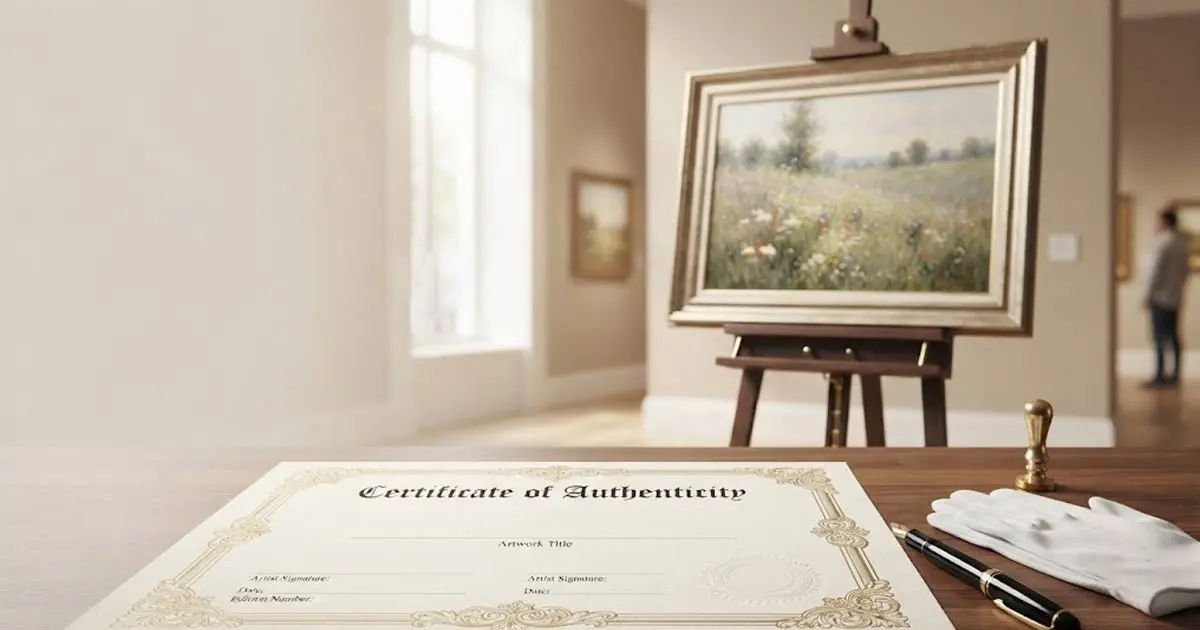
A certificate of authenticity for artwork is an official document that certifies that an artwork is authentic and was made by the artist whose name is on the document. It is a record of the artwork’s origin and confirms the artwork’s authorship, and accompanies the artwork as an integral part of its historical record. The stakes are high, as the Fine Art Ledger points out: In 1995, a painting by Braque that was sold at Christie’s for $600,000 was later deemed inauthentic by the acknowledged expert on Braque’s work, and the seller had to refund the money. Authenticity documentation is not just a piece of paper! It is the financial and legal insurance for all parties to an artwork’s life.
Key Takeaways
- A Certificate of Authenticity (COA) is an official document that certifies an artwork is authentic, that it was created by the named artist, and provides proof of authorship and provenance.
- QR Mark states that a reliable COA should contain the artist’s full name, the title of the artwork, the year it was made, the medium, the dimensions, a good photo of the artwork, an authentication statement, the date it was issued, and the artist’s signature.
- The most convincing COAs come from the artist or the artist’s estate or foundation, the latter by a recognized gallery that represents the artist.
- It’s good to make a COA at the time of the creation, says Jackson’s Art Blog, even if there’s no immediate intention to sell, since the documentation made at the time of creation is the most authoritative.
- There is no standard legal format for a COA in most countries, but in France, dealers and auction houses must provide a COA for the sale of artworks under law.
- The COA should contain the edition number (e.g. 3/50) and the total number of prints (e.g. 50) for limited edition prints.
- The new blockchain-based COAs are replacing paper COAs with records that are impossible to alter, resulting in an unalterable record that is tied to the physical art.
- Saatchi Art states that a hand signed COA is necessary for all pieces sent via their platform and it is an industry standard gallery practice.
What is a Certificate of Authenticity for Artwork?
AGI Fine Art states that a Certificate of Authenticity is an official document that proves the artwork is authentic and from the artist listed in the document. It assures buyers that the artwork is genuine and well-documented, demonstrates professionalism and attention to the artist’s legacy, and helps ensure that the artwork is in the proper hands in a digital age where AI-generated art and digital reproductions have made proper documentation more critical than ever.
The certificate is not attached to the piece of art. A COA is a secondary record that accompanies the work and is not lost in a box frame, obscured by mounting or simply lost over time, where a signature on the front or back of a canvas can be lost. A COA certificate helps to establish the provenance of an artwork and is important for the collector’s record-keeping and insurance of their collections, according to format.com.
Jackson’s Art Blog states that even if the artist is not a big hit now, it’s a good idea to get into the good business habits, otherwise they’ll be playing catch up later if they suddenly become a big hit.
The key elements of a Certificate of Authenticity
In most countries there are no universal legal requirements for COA format, but a consistent set of required elements have been established in the professional art market. The key fields that every COA should include, according to QR Mark’s 2025 guide, are:
| Field | What to Include |
| Artist’s full name | Legal full name, not initials or nicknames |
| Issuer’s name | If not the artist: gallery, dealer, or estate representative |
| Title of the artwork | Exact title; if untitled, write “Untitled [brief description]” |
| Year of creation | Year the work was completed |
| Medium | Materials used: paint type, canvas, paper, ink, and process |
| Dimensions | Height x width x depth in consistent units |
| Edition details | For prints: edition number (e.g. 3/50) and total edition size |
| High-quality image | Printed photograph of the artwork |
| Statement of authenticity | Direct declaration: “I certify that this artwork is an original creation by [Artist Name]” |
| Date of issue | Date the COA was created and signed |
| Artist’s signature | Handwritten whenever possible |
| Contact information | Studio address, website, or professional email |
In the case of prints, format.com states that the medium of the original artwork as well as the print itself should be included, such as paint or ink type, printing device or process, type of canvas or paper, and any other details that will help identify and conserve the work.
Optional but Recommended Additions
Artists seeking to enhance their documentation may also include: (according to AGI Fine Art 2026 guide)
- Provenance history (previous owners, exhibitions shown in, auction records)
- Conservation notes and care instructions
- A unique identifier or serial number that is linked to a hologram or QR code on the physical work
- If the artist keeps a catalogue raisonné, use that number.Use the catalogue raisonée reference number if the artist has one.
- Valuation of insurance at the time of the insurance.
A Certificate of Authenticity is issued by whom?
A COA is only as credible as its issuer. verifyed.io states that certificates have a distinct chain of credibility.
Artist (highest credibility). The most reliable form of documentation is a handwritten COA, as it is first-hand knowledge of the work’s creation.
Second tier: The artist’s estate or official foundation. After an artist’s death, their estate or an authorized foundation takes over authentication responsibilities. The Pest Control Office for Banksy works and the foundations of artists such as Basquiat or Warhol are key examples. Artist estates usually have a multi-layered process of authentication, such as panel reviews by experts, detailed physical inspections and reference to a catalogue raisonné, say verifyed.io.
Third tier: Galleries that are official artists’ galleries. Certificates from a gallery with an exclusive or primary representation agreement are very influential.
Secondary sources: Recognized authentication boards, qualified appraisers, established auction houses, certified art appraisers. They are suitable for use when the artist has died without an estate or a foundation authority or for works from past eras.
Certificates from a third party that is not known to the artist, small dealers with little or no experience in the artist’s work, or online services that are not verifiable are of little or no value to serious collectors, insurance companies or auction houses.
When to Create a Certificate of Authenticity
Artwork Archive’s help documentation states that a COA is an important document to have on every artwork, whether or not it is for sale. It’s best to establish it as early in the life of the artwork as possible, the more authority it will have.
Jackson’s Art Blog says it is advisable to make a painting label and Certificate of Authenticity at the same time as the painting itself. The most important information is on the back of the artwork and is affixed to the reverse with the label. The COA is an additional supporting document. Producing them at the same time ensures that the documentation is as close as possible to the moment of creation, and is based on the artist’s first-hand experience with materials and process.
This is especially true for:
Artists at early career stage and not yet selling commercially, but may be of great value in future years. Documentation produced at the time of making, is much more authoritative than documentation that has been reconstructed in retrospect.
Limited edition prints, in which the edition number and total are clearly defined before the print is released.
Digital and video works where it is more difficult to establish the provenance through the physical object.
Artworks for gallery representation should be accompanied by the COA when first leaving the studio.
How to make a certificate of authenticity
Format and Paper
According to Jackson’s Art Blog, use good quality paper and lay out the information in a neat and easy-to-read manner. Archival, acid-free paper is recommended because it will not deteriorate over the course of decades. Although embossing is not a requirement, it does give a level of professionalism and helps to deter forgery, according to AGI Fine Art. It is always a good idea to choose a good paper and it can make a paper look more professional, as Saatchi Art states in their COA guidelines for sellers.
The-white-page.org states that professional graphic design sites such as Canva have COA templates with artistic designs and security features. Alternatively, legal document services and art business consultants offer complete COA packages that consist of templates, instructions, and support, ranging from $50 to $300.
The COA will be attached to the physical artwork
Many new artists fail to take the time to establish a documented connection between the COA and the physical work it is covering. An identical hologram or code on the label (on the back of the work) and the COA are proof that the certificate is authentic, according to Jackson’s Art Blog. That is backed up by a QR code that connects to an online record of the work, which provides another layer of verification.
QR Mark claims that people with a regular phone camera can verify the authenticity of a certificate digitally as soon as they scan a QR code linked to the certificate. The QR Code is linked to a unique ID which can’t be duplicated without access to the issuer’s dashboard.
Signing
Saatchi Art states that the COA must be signed by hand and offers additional proof of authenticity which can only be given by the artist. The handwritten signature is what makes the COA an original COA and ties the issuing artist to the particular document. According to Artwork Archive guidelines, the artist’s name, date that the COA is signed, and artist’s handwritten signature must all be done by hand.
Digital and Blockchain COAs
The art authentication field has been changing rapidly. As per the verifyed.io, blockchain technology is increasingly used to create certificates of authenticity, which are permanent, tamper-proof verification systems that allow for tracking artworks over the course of their ownership.
The principle of a blockchain-based COA is to create a distributed ledger that is not subject to alteration after the fact, containing the key data of the art, including its artist, title, medium, date and edition details. A blockchain record is permanent and cannot be lost, forged, or decayed like a paper record, and can be checked by anybody with internet access.
The-white-page.org notes that the integration of NFTs is enabling the traditional physical art piece to have digital authentication elements added to it, improving security and traceability. This has been especially taken up by galleries selling high dollar contemporary pieces with a high likelihood of sophisticated forgery.
A handwritten COA on a paper or PDF is completely professional and appropriate for most working artists at the career level of preparing their first sales. The blockchain authentication process adds complexity and expense that is not worth it for lesser works or for emerging artists.
The legalities of Certificates of Authenticity
There is no legal requirement in most countries for a COA to be attached to every artwork sold, and no specific format for a COA. But there are a number of legal contexts to be understood.
In France, the law stipulates that art dealers and auction houses must issue certificates of authenticity for art works sold, including information on the artist, title, date and materials. There are very heavy penalties for selling artworks with false or misleading authentication certificates.
United States: There is no federal law requiring COAs for artwork sales. AI-generated art documentation, however, has implications for copyright protection, as the U.S. Copyright Office’s 2025 Report confirms that human authorship is still necessary for copyright protection.
Insurance and institutional use: verifyed.io states that insurance companies have individual requirements for the documents they will accept for insurance. For major claims, Lloyd’s of London will need certificates or reports from recognized independent authentication experts or major auction houses such as Sotheby’s or Christie’s. When looking for COA services, artists and collectors should check with their insurance company to determine which authentication sources they recognize.
Prints and Limited Editions are issued with a Certificate of Authenticity
There are COA requirements that are different for limited edition prints than the original one-of-a-kind prints. For prints, both the original medium and the print itself should be described, including the type of paint or ink, the printing device or process, the type of canvas or paper, and other special information, format.com says.
The edition information is particularly important. The COA should explicitly include:
- The number of the individual print in the edition (e.g. 3/50)
- The total number of copies (50 in the example above)
- Are there artist’s proofs and how many (usually represented by A/P)?
- That no more prints will be produced than the stated edition (if any).
This information will help to prevent collectors from publishers issuing another print after the stated edition has sold out, which will reduce the value of the collectors’ prints and is a form of fraud if the original COA used a “limited” edition that is implied to have closed.
The same concept that applies to limited edition prints – that is, making it clear what is being collected, how much, and by whom – is also true of collectible objects of any kind. The importance of clear authenticity documentation is discussed in the context of one particular product in the guide to the original 80’s edition of Monopoly, which hinges on the ability to clearly document the origin and manufacturing date of the product, making the difference between an original period made piece and a modern reproduction one.
The COA should be stored and attached to the appropriate location
Storage Options
Physical attachment: The COA may be attached to the reverse of the artwork in an envelope or archival sleeve, ensuring that the COA is physically attached to the artwork. Jackson’s Art Blog suggests to put it in an envelope or sleeve and place it in the back of the painting so it can go with it from one owner to another.
Separate file: If the artist keeps a physical file of duplicate COA records, it provides a reference catalogue of all the works that have been created and documented. This is useful for developing a catalogue raisonné, especially if one is being prepared.
Digital storage: PDF copies stored in cloud storage with date stamped records ensures that there is a backup in case of any physical loss. All COAs generated will be automatically saved in the Reports tab for easy access and reprinting, according to Artwork Archive.
If the COA is lost, what should you do?
The loss of a COA does not mean that the provenance record of a work has been lost. The original artist may issue a new certificate, stating that it is a replacement certificate and the date of replacement. In the meantime, supporting evidence of provenance can include exhibition records, sale receipts and gallery documentation. A direct artist COA may be replaced by an authentication by the artist’s estate foundation, or by a recognized independent authenticator, for works by artists who are dead.
Certificate of Authenticity Quick Reference
| Question | Answer |
| Is a COA legally required? | Only in France for dealer/auction sales; voluntary in most other markets |
| Who can issue a COA? | The artist, their estate, or an authorized gallery representative |
| Most trusted form of COA? | Hand-signed by the creating artist at time of sale or creation |
| Must include | Artist name, title, year, medium, dimensions, image, statement, date, signature |
| Paper quality | Archival acid-free paper recommended |
| For limited edition prints | Must include edition number, total edition size, and artist proof count |
| Digital alternatives | Blockchain COA provides tamper-proof immutable verification |
| Cost of professional templates | Free (Word/Canva) to $300 (legal document services) |
| Platform requirements | Saatchi Art requires a hand-signed COA with every artwork shipped |
Conclusion
Artwork certificates of authenticity are not just a business formality. It is the main document which helps to establish the origin of an artwork, helps protect the value of an artwork as it changes hands and protects the artist and collector from the repercussions of misattribution and fraud. In today’s art forgery landscape, where documentation is more important than ever, and the art market continues to grow, with more and more art in digital form, it is important to have clear and consistent documentation.
The most important COA is one that is artist-signed, physically attached to the work by a matching identifier, archival and maintained with the work during each subsequent transfer of ownership. Establishing COA production as a standard practice for all artists, regardless of stage of career, is one of the easiest and best professional habits to adopt, and most importantly, to do BEFORE the sale.
Find additional guides on art documentation, art provenance and the art collecting industry at Shani Levni.
Frequently Asked Questions
What is a certificate of authenticity for artwork?
A certificate of authenticity is a document that certifies that an artwork is authentic and that it was created by the artist listed on the certificate. It sets the context, offers proof of authorship and accompanies the artwork throughout its historical record. A good COA will contain the artist’s name, title, year, medium, dimensions, high-quality image, statement of authenticity and the artist’s handwritten signature.
Does a certificate of authenticity have to be notarized?
No. A COA is not required to be notarized for most countries. The most significant aspect of a COA’s validity is that it is signed by the artist and not by a notary. In the case of high-value works or institutional purchases, further verification processes might be necessary, but notarization is not a common condition.
Who can issue a certificate of authenticity for artwork?
The most trustworthy COA is one that is issued by the creating artist. Once an artist has passed away, his/her estate or authorized foundation assumes the authentication process. COAs can also be issued by galleries that exhibit the work of an active artist. When direct artist authentication is not available, secondary sources include third party authenticators, recognized appraisers, and established auction houses.
What should a certificate of authenticity include?
A COA should contain the artist’s complete legal name, the title of the work, the year it was created, the medium and materials it is made from, the size, a good quality, printed image of the work, a statement of authenticity, the date the COA was issued, and the artist’s handwritten signature. If it is a limited edition print, then the edition number and total edition size are also needed.
Can a certificate of authenticity be used in court?
In most countries, the COA is not a binding contract but is a declaration of authenticity by the COA issuer. A fake or false COA can be considered fraud in most legal systems. In France, there is a specific law that requires artworks bought and sold via dealers and auction houses to have a COA or or be subject to monetary penalties.
What is a certificate of authenticity for my artwork?
Use archival quality paper and fill in all required fields: artist name, title, year, medium, dimensions, image, authenticity statement, date and signature. Develop the COA during the creation of the artwork, affix a matching hologram, QR code or unique identifier on both the COA and the reverse label of the artwork and sign it by hand. You can find templates for free at Canva, Microsoft Word, and Google Docs or pay a legal document service for professionally designed templates, which range from $50 to $300.
What is a blockchain certificate of authenticity?
A blockchain COA is an artwork’s critical data (artist, title, medium, date, edition) recorded on a distributed digital ledger that is immutable. A blockchain record is permanent and can be accessed by anyone who has online access, whereas a paper record may be lost or forged. Blockchain COAs are increasingly used for high dollar, modern-day work where there is the highest risk of forgery.