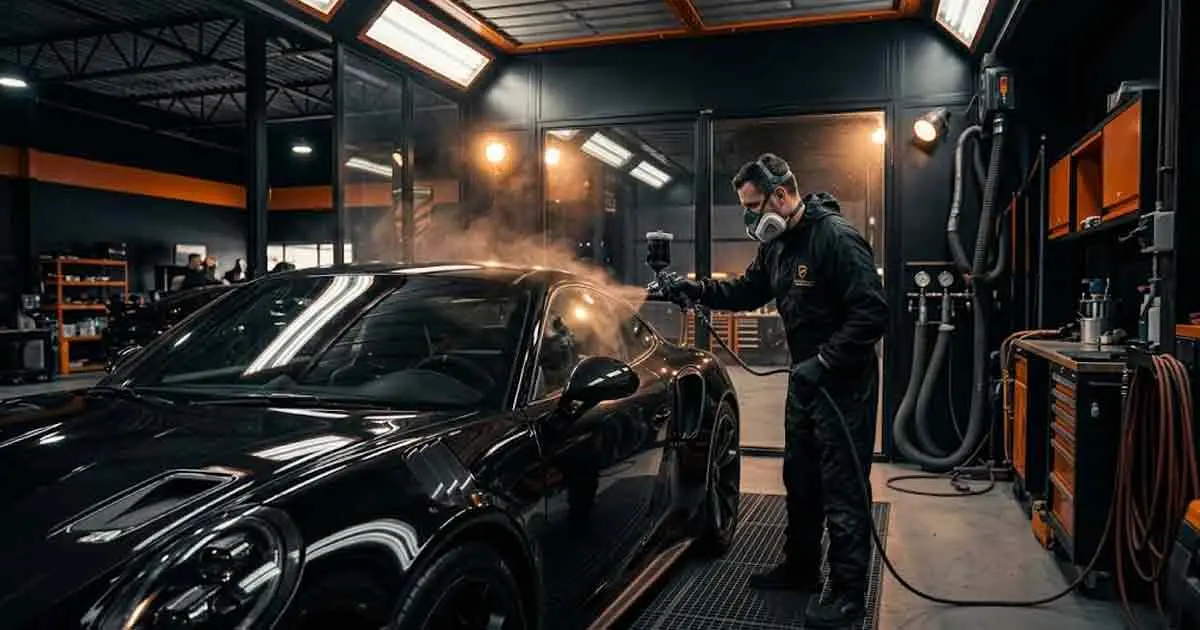
There are many different types of car painting shops and they all have different levels of quality, equipment and price. The basic repainting at a high volume shop begins at approximately $500. The average cost of a mid-range professional repaint by a certified body shop in 2026 is $2,000 to $5,000. A showroom paint job or custom paint job can cost $10,000 and over. These tiers are not just about looks. It’s all about preparation time, paint systems applied, shop equipment, and the experience of the techs applying the finish. This guide will help you discover a dependable car painting company close to you, questions to ask prior to hiring and what factors contribute to the ultimate price.
Key Takeaways
- The cost of car painting near you ranges from $500 to $10,000+ based on the quality level, vehicle size, and preparation needed.
- A basic paint job costs $500 to $1,500. A mid-range job costs $2,000 to $5,000. A premium or custom job costs $5,000 to $10,000 or more.
- Relux Collision (2026) says that most drivers will need to spend anywhere from $3,000 to $5,000 for a decent, mid-range paint job.
- The most reliable way to find a reputable shop is to seek out I-CAR Gold Certification or ASE certified technicians, read reviews on Google with pictures, and obtain three written estimates.
- AAA Approved Auto Repair Facilities will back up their service and will provide AAA members a 10 per cent discount on labor.
- Over half of the total cost of a professional repaint is preparation, such as sanding, priming and masking.
- A professional mid-tier repaint can be performed in 3-5 days. Premium or custom job will take 1-2 weeks.
Choosing a Painting Shop for Cars in Your Area
Search Methods
The best methods for finding the closest car painting services to you are:
- Use Google maps search: Enter “car painting shop near me” or “auto body shop near me. Look for rating and photo reviews of finished paint jobs, not just exterior shots in the paint shop.
- AAA’s Approved Auto Repair locator: AAA has over 7,000 auto repair shops in the United States that are members of its Approved Auto Repair network. Technicians at AAA Approved Auto Repair Facilities are factory trained or Automotive Service Excellence (ASE) certified and all repair shops warrant their work. AAA members also get 10% off labor charges.
- The Inter-Industry Conference on Auto Collision Repair (I-CAR) certifies shops and technicians. An I-CAR Gold Class certification indicates that the shop has the best training and repair quality in the industry. ER Collision and Auto Body Shop says I-CAR Gold Certification is a good measure of automotive paint work precision.
- Manufacturer referrals: The manufacturer’s website will usually have a list of collision and paint repair shops in your area that are approved.
- Insurance network: If it is a paint chip that is caused by accident damage, your insurer has a network of approved shops. A shop that is insurer approved will make the claims process much easier.
When assessing a shop, you should take into account the following:
When choosing any car painting shop, consider the following:
- Certifications: I-CAR Gold Class or ASE certification required for paint techs.
- A detailed written quote: Any reputable shop should supply a detailed written quote. Don’t go to shops that just give you an oral quote.
- Spray booth: A specially designed spray booth with controlled conditions in the workspace to avoid the dust, dirt and moisture from ruining the painting as it dries in a professional shop. Unlike most DIY paint jobs, body shops have spaces that are air-conditioned, which helps to prevent dust and dirt from ruining the paint during drying.
- Paint systems applied: Professional shops apply a name-brand automotive coating system like PPG, Axalta or Sherwin-Williams Automotive Finishes. ER Collision in Huntington Beach says that top-of-the-line systems such as PPG or Axalta automotive coatings are commonly used by professional auto body shops, and offer greater durability, color accuracy, and fading resistance.
- Computerized color matching: Good shops have a computer color matching system to ensure that the new paint is as close as possible to the original vehicle paint. This is particularly important for partial repaints.
- Warranty: A shop that is sure of its work will offer a written warranty on the painting. If you are looking for a full paint job with a warranty of several years, then you should plan on spending at least $3,500, according to Kelley Blue Book.
- Portfolio and reviews: Request to view samples of past work. The best independent evidence is from Google reviews with before and after photographs.
Car Painting Shop Costs in 2026
Cost based on Quality Tier
Kelley Blue Book estimates that a basic paint job will run from $1,000 to $1,500 and will involve a single stage synthetic enamel paint and minimal prep work. A medium-level paint will cost between $2,000 and $5,000 and will feature a thorough preparation, multiple coats of high-quality paint and a clearcoat finish. A high-quality paint job costs $5,000 to $10,000 or more.
| Quality Tier | Cost Range | What Is Included |
| Basic | $500 – $1,500 | Single-stage enamel, minimal prep, short warranty |
| Mid-Range | $2,000 – $5,000 | Multi-coat system, sanding, primer, clearcoat, 1 to 3 year warranty |
| Premium / Custom | $5,000 – $10,000+ | Full prep, multiple paint layers, ceramic coating option, showroom finish |
| Touch-Up (local repair) | $120 – $580 | Small area, color matching, spot application |
Most drivers will find a mid-range paint job to be $3,000 to $5,000, according to Relux Collision’s 2026 cost guide. Each vehicle is unique and an accurate estimate will only be made by a professional inspection.
Cost per Vehicle Size
A small car could run from $2,000 to $3,500, and a larger SUV or truck could run from $3,500 to $7,000, AAA Automotive reports. The more surface area the shop needs to prepare, prime and paint, the more material is used and the more labor hours are required, and the larger the vehicle.
| Vehicle Type | Estimated Cost (Mid-Range) |
| Small car / compact | $2,000 – $3,500 |
| Midsize sedan | $2,500 – $4,000 |
| Large SUV / truck | $3,500 – $7,000 |
| Luxury or exotic vehicle | $5,000 – $15,000+ |
| Classic car restoration | $17,000+ (varies significantly) |
Other costs to consider in your plan:
- Rust repair: If the rust has infiltrated the metal surface, the surface should be repaired before painting. CARFAX estimates the cost of rust repair varies from thousands of dollars to severe. Rust should never be painted over, as it will cause cosmetically bad and structurally weak results.
- Small dents are usually fixed before painting – dent and ding repair. Additional bodywork is extra.
- Cost of color change: If the color change is to a color that is different from the current color, cost will increase because the shop will have to paint additional surfaces such as door jambs and trunk lids to avoid noticeable mismatches. Changing the color will require more paint application and sanding time, according to AAA Automotive.
- The cost of a matte finish on a car is $2,000 to $6,000 more expensive than a glossy finish. Metallic and pearl finishes are also pricier than standard colors.
- Protective coating: Wax coating of the product is $100-$200. The price of a ceramic coating upgrade is $500 to $2,000.
How to Car Paint Job Works
You’ll be able to assess if a shop is cutting corners by understanding the process. When you hire a professional paint job at a professional painting company, you know exactly what to expect through the different steps of the process. West Coast Body and Paint states that professional paint techs spend hours and hours sanding surfaces in order to get them perfect before painting.
Stage 1: Assessment and Estimation
The shop tests the car and gives you a written quote. A good shop will be able to quote you for surface preparation, body work, paint materials and labour. Be wary of quotes that only include the paint application, and not the preparation.
Stage 2: Disassembly and Masking
Exterior accessories such as bumpers, grilles and trim pieces are stripped away to enable edge-to-edge painting without masking artifacts. Automotive grade tape and paper are used to mask glass, rubber seals and unpainted parts.
Stage 3: Surface Preparation
This is the most labour intensive and the most important step to quality. Preparation is one of the most critical steps in getting a high-quality paint job, and it involves sanding the old paint, removing trim pieces, masking and fixing dents or scratches, among other things, according to Frank and Son Auto Body (2026). If the new paint is properly prepared, it will bond properly and will last longer.
Usually a series of sanding grades from coarse to fine are used. The Primer-surfacer is used to fill in small scratches and imperfections in the surface, and is sanded again before the colour coat is applied. West Coast Body and Paint says that professional paint techs will use the necessary number of coats of primer-surfacer to fill in small sand scratches and other minor blemishes. The surfaces are also sanded to perfection before coloring is applied.
Stage 4: Paint Application
Paint application is done in a controlled spray booth. Most professional paint jobs follow a three-step process: primer, base coat (color) and clear coat. The usual number of coats of clear coat is 3, according to West Coast Body and Paint. Coats can be cured before adding another coat. Heat lamps speed up curing and help the paint to adhere completely to the surface.
At this stage, the inspection is conducted, and the finishing is completed.
Once the clear coat has dried, the vehicle is examined in controlled lighting for surface defects. To remove any blemishes, fine-grit sandpaper (1,200 to 2,000 grit) is used to smooth. If necessary, additional clear coat can be applied. The whole car is then buffed with a fine polish and soft buffing pad to achieve the final finish.
The final stages of the process involve re-assembling and detailing the parts
The components that are removed are replaced with new ones, and new gaskets and seals are installed in exactly the right place so as not to damage the new paint. After that the vehicle is detailed inside and out prior to delivery.
How Long Does a Car Paint Job Take
Time will vary based on the quality tier, Kelley Blue Book says.
| Quality Tier | Time Required |
| Basic paint job | 1 to 2 days |
| Mid-tier paint job | 3 to 5 days |
| Premium or custom paint job | 1 to 2 weeks |
| Classic car restoration | Several months |
If you hire someone to do a mid-range paint job, expect your car to be without a paint job for three to five days. A rush job to return the car back to the owner earlier than the process permits is a frequent reason for bad work.
Before you book a car painting shop, there are some questions you should ask
Prior to leaving a deposit or authorization, ask yourself the following questions:
Are your technicians I-CAR or ASE certified?
Certification is a sign of training and conforming to industry standards.
Have a spray booth?
For any good paint job, a controlled environment is a must.
Which system of paint do you use?
The professional grade standards are PPG, Axalta and Sherwin-Williams Automotive. Don’t buy from stores that can’t tell you what system they use.
What does your preparation process involve?
If the shop doesn’t have a good handle on the sanding, priming and masking process, they are probably taking shortcuts.
Do you give any guarantee on the paintwork?
Mid-range work usually comes with a written 1-2 year warranty. Premium stores will generally provide extended warranties.
Will you give a written, itemized estimate?
Verbal estimates are not finalised. Always get the scope of work and cost in writing before authorizing any work.
Do you have examples of work done?
A good store will be able to demonstrate their work. If a shop refuses or is unable to provide examples, this is a red flag.
Are you a claims adjuster?
If the repaint is insurance-related, a paint shop that has experience in direct painting can make the process much easier.
The Data on DIY vs. Professional Car Painting
For some, painting their own car is all about saving money. Quality differences between professional and DIY are great, but not just because of skill.
Unlike most home setups, body shops have spaces that are not affected by dust and dirt while the paint dries, according to AAA Automotive. When you add up the price of the professional equipment you need to do the job (spray gun, air compressor, proper paint booth, heat lamps, ventilation, etc.), the actual cost of a DIY project can be thousands of dollars.
CARFAX says that the cheapest body shop paint job will probably be superior to what most car owners with no painting experience could do on their own. Professional painting will provide you with high-quality results, expert application that will last for a long time and sometimes even a warranty. In certain instances, DIY painting may be more cost effective, but this is only if the operator has previous painting experience, the necessary equipment and a suitable environment.
Just like in many other precision craft activities, the quality of the final product depends upon the quality of the tools and the environment used. That’s the same principle that is presented in the guide to painting swimming pool with epoxy paint, where surface preparation and controlled application conditions are demonstrated to be far more significant to the longevity of the finished paint application than is the paint product itself.
After the car painting job, how do you assess the quality of the work done?
Before signing the release, take the time to thoroughly check the paint job when picking up your car.
Inspect in natural light, not under artificial shop light, as this can mask surface defects. Search for the following:
- Orange peel texture: Orange peeling means that there was not enough sanding between coats or that the paint was applied too thick. Minor orange peel is OK on basic jobs, but should not be seen on a mid-range or premium repaint.
- Runs or sags: Paint that has run or sagged while being applied and has dried in this condition. A good store will detect and correct these problems before shipping.
- Overspray: If paint is on rubber seals, glass edges or trim, it is a sign of poor masking.
- Color mismatch: Go around the car in full daylight and check for any panels that are slightly different in shade or tone from the rest.
- Panel gaps: When reassembling exterior and trim, there should be no new gaps.
If you see any of these problems, discuss them with the shop before leaving. While most quality shops will honor the warranty for legitimate problems, it will be much easier to get problems fixed before you own the car.
Car Painting Shop Cost Summary
| Factor | Impact on Price |
| Vehicle size | Larger vehicles cost more (surface area and labor) |
| Preparation extent | More prep = higher cost, better result |
| Paint system quality | Professional-grade systems cost more per gallon |
| Color complexity | Metallic, pearl, matte, and custom colors cost more |
| Color change | Increases cost due to additional surfaces to paint |
| Shop certification level | Certified shops charge more but deliver consistent results |
| Location | Labor rates vary by region and city |
| Bodywork required | Rust, dents, and damage repair billed separately |
| Protective coating | Wax adds $100 to $200; ceramic coating adds $500 to $2,000 |
Conclusion
Choosing a car painting service near you in 2026 goes beyond the cost of the services. The most important factors are the level of certification that the shop has, the type of equipment they use, the preparation process that they adhere to, and a written warranty that they issue for their work. Mid-range, professional repainting at a certified shop ranges from $2,000 to $5,000 and can take 3 to 5 days. This investment will yield a finish that will last for several years with proper care and will keep the vehicle’s resale value intact.
The most critical variable in any paint job, is preparation. If the shop takes the time to sand, prime, and surface correct the vehicle before they start to spray, the vehicle will last much longer than a vehicle that is rushed to the spray stage. The difference in costs between a well-prepared mid-range job and a basic job done in a rush is not only a difference in appearance, it’s a difference in durability.
Always obtain a minimum of three quotes in writing before booking any shop, check for certifications, look at the spray booth and ask to see samples of their work. The 15 minutes of properly asking the questions before giving permission to the work will save a lot more time and money than dealing with poor results afterwards.
Learn more about auto maintenance, home maintenance, and other consumer choices in Shani Levni‘s complete library of guides.
Frequently Asked Questions
What is the price of a car paint job in 2026?
Car paint job costs in 2026 range from $500 to $1,500 for a basic repaint, $2,000 to $5,000 for a professional mid-range job, and $5,000 to $10,000 or more for a premium or custom finish. Relux Collision says that most drivers should expect to pay anywhere from $3,000 to $5,000 for a satisfactory, long-lasting finish. The prices depend on the location, size of the vehicle and the level of preparation needed.
What is the best way to locate a car painting shop that is close to me?
Use Google maps to find the best-rated auto body shop near me. Seek I-CAR Gold Class certification or ASE certified techs, ask for a spray booth on site, obtain a written itemized estimate, and ask for samples of their work. AAA’s Approved Auto Repair locator is for over 7,000 certified facilities throughout the United States.
How long does it take for the professional car painting?
A simple paintwork job will take 1-2 days. A medium level professional repainting job can be done in 3-5 days. Premium or custom job will take 1-2 weeks. Haste makes for poor quality. Most good shops will provide you with a definite time frame in their written estimate.
Is car painting covered by insurance?
If the damage is caused by a covered event like a collision, hail damage or vandalism, insurance will cover repainting. Cosmetic repainting, fading and normal wear are excluded from insurance coverage. When the repaint is for insurance, have a shop that is knowledgeable about direct insurance billing and ask for authorization for OEM aligned repair methods prior to the work being performed.
What’s the difference between a base and an upscale car paint job?
A basic paint job involves minimal surface preparation, a single stage enamel paint and will give a short term finish without a clear coat. The high quality paint work includes a lot of sanding, several coats of primer, color and a professional clearcoat system, followed by fine-grit polishing. Most of the difference in longevity is due to the amount of preparation work.
Should I repaint my whole car or just the damaged panel?
It is much cheaper to just repaint the damaged panel, but only achieves a seamless finish if the shop’s colour-matching is accurate enough to recreate the existing finish. If the original paint is faded on older cars, it may be hard to match one panel to the rest of the car. A shop that has computer color matching can determine if the panel repair will be visually seamless before taking on the job.
What kind of paint systems do car painting shops use?
Professional auto body shops employ automotive coating systems from PPG, Axalta and Sherwin-Williams Automotive Finishes. These systems deliver a more accurate colour match, improved adhesion, superior UV resistance and longer-lasting finish than consumer products. A shop that utilizes a named professional paint system is a simple sign of quality.