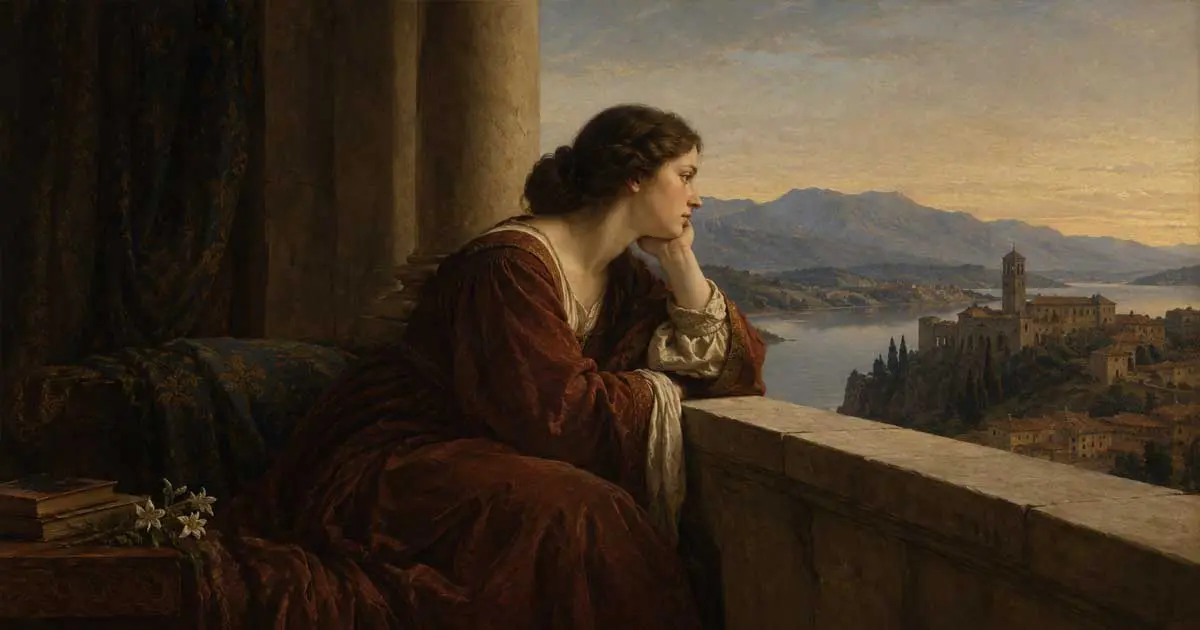
Solitude in Italian Renaissance painting isn’t the contemporary sense of being alone in a blank room, isolated and disconnected. It’s more like its inverse an engaged form of withdrawal, to enhance the contact with world, with God, with the self.
This is the definition of the saint who is the hermit, as a model of a life lived in the bosom of nature, not as a punishment or as a chance but as a chosen condition, which runs through the best paintings of the Renaissance on the theme. The figure in the landscape is alone, but the aloneness is purposeful. It is the place where thinking occurs, it is the place where prayer occurs, it is the place where a human being and something greater than human society can meet.
This view was inherited from two traditions by the humanists of the Italian Renaissance. They borrowed the concept of the contemplative life (vita contemplativa) from classical antiquity, where Aristotle and the Stoics considered it the highest form of human life. They adopted the Desert Fathers, the early Christian hermits who lived in the Syrian and Egyptian desert in the third and fourth centuries in search of direct spiritual experience, free from the distractions of society. These two traditions were combined in paintings of saints Jerome and Francis, where the two were shown in the landscape and the visual argument was that the person alone in the landscape has access to something the person in the city does not.
Key Takeaways
- In Italian Renaissance paintings, the theme of solitude is one of the most constant and highly developed, and is especially evident in paintings of saints, scholars and hermits in landscapes.
- The three most important paintings from the Renaissance dealing with solitude are those by Giovanni Bellini, Saint Francis in the Desert (c. 1480, Frick Collection, New York); Giorgione, The Tempest (c. 1506–8, Gallerie dell’Accademia, Venice); and Leonardo da Vinci, Saint Jerome in the Wilderness (c. 1480, Vatican Museums, unfinished).
- More than anyone else in the Renaissance, Giovanni Bellini explored the theme of solitude, returning to the figure of Saint Jerome, the scholar-hermit who went to the desert to translate the Bible, in at least five significant paintings throughout his career.
- Renaissance thought did not equate solitude and loneliness. It was understood as the condition for intellectual and spiritual development the intentional separation from society to achieve a deeper contact with truth, nature and God.
- The Venetian Renaissance (late 15th – early 16th century) centered in the city of Venice is the most complex visual depiction of solitude, in its use of landscape, atmospheric light and contemplative mood.
- The setting of these paintings of isolated figures is not just a setting, it is the visual counterpart of the inner state. In Renaissance paintings, nature reflects the soul.
- The Tempest by Giorgione is the most discussed Renaissance painting on solitude, as the subject has never been clearly established and the nature of its isolation is not readily understandable.
Giovanni Bellini: The Master of Solitude
Giovanni Bellini (c. 1430–1516) was more than any other painter of the Italian Renaissance a recurrent and more considered artist of solitude. His handling of the solitary figure in landscape is always precise, always atmospheric, always detailed, always grounded in his exact perception of light and nature, and is the most consistent visual meditation on aloneness in the whole period.
Saint Francis in the Desert (c. 1480)
Saint Francis in the Desert by Bellini (1549-1562) in the Frick Collection in New York City is the best one-painting book on solitude, and has been for many years in a room of its own.
Somehow Giovanni has captured both the ecstasy that was thought to go with the stigmata and the solitude and community with nature of a life lived in contemplation.
The painting shows Saint Francis of Assisi stepping out of his cave cell into morning sunlight, his arms slightly raised, his face upturned. He has left his solitary cell to stand by himself in a detailed landscape, rocky outcrops, a carefully observed vineyard, a distant town, a heron standing in a pool, a donkey grazing near a fence. All the elements of landscape are depicted with botanical and geological accuracy. But all is bathed in a golden morning light and the scene has the quality of a revelation.
The painting’s traditional title, Saint Francis in the Desert, cannot do justice to the fertile hills of northern Italy. There is no desert in Bellini’s landscape, but rather an extraordinarily alive, detailed and specific landscape, one that is full of observable natural fact. In this reinterpretation of a miracle, a saint has turned away from solitude and death to embrace life.
Few artists in history can make this kind of statement as Bellini, a figure completely isolated yet completely involved in the rest of the world. Francis is not alone, for he is in the world’s fullness, exactly because he is not in the city.
The association of Francis with Jerome and of the Christian ascetic tradition with the humanist scholar-hermit is the key to understanding what Bellini was doing throughout his career. It wasn’t a single subject for him. It was his major theme, his subject matter and he did it from many angles and many saints.
Saint Jerome in the Desert (Various versions)
Jerome was a favorite of Bellini’s and was re-painted several times during his career. The earliest known version is from c. 1450 (Barber Institute of Fine Arts, Birmingham). A large version of c. 1480 is housed in the Uffizi in Florence. A later version of c. 1505 is in the National Gallery of Art, Washington, D. C. A later version, Saint Jerome Reading in a Landscape, is in the National Gallery, London.
The image shows Saint Jerome in the desert, possibly studying or praying. Jerome is sitting under a rock overhang, holding a book in his lap, suggesting that he is reading or studying. At his feet, a lion is seated, possibly a reference to the legend of St Jerome, who is depicted with a lion at his feet.At his feet, a lion is seated, possibly a reference to the legend of St Jerome, who is depicted with a lion at his feet. The background is filled with a vast expanse of open land, with a few scattered trees and bushes, creating a serene and contemplative atmosphere.
Over the course of these many visits to Jerome, what Bellini discovered was a person who combined two forms of solitude: physical solitude, solitude in the desert, and intellectual solitude, solitude in the book. Jerome had been in the Syrian desert, translating the Hebrew and Greek scriptures into Latin, the Bible used for western Christianity for over a thousand years. He was in the wilderness alone, writing the document for a civilisation. No one better captured the Renaissance humanists’ vision of the productive as opposed to the pious solitude than the figure of Erasmus.
The Tempest and the enigmatic Giorgione
Giorgione (c. 1477-1510) was a young artist who died from plague or other causes, and whose small oeuvre has attracted more scholarly discussion than that of virtually any other artist of the Renaissance. His most popular work, The Tempest (c. 1506–8), is the most mysterious depiction of solitude in any Renaissance painting.
For centuries art historians, teachers and viewers from all over the world have been fascinated by the mysterious mood of Giorgione’s The Tempest. The canvas is covered in darkness from the colours he used to the subject matter itself, making this one of the most argued-over Renaissance paintings to find its inner meaning. A man wearing a Venetian costume is looking at a woman who is holding her baby, located on the left side of the image. The images appear to be quite peaceful, with a dark, stormy sky in the background and a city behind the figures.
The man and the woman do not seem to be acquainted. They are in the same landscape, but a stream in between. They don’t face one another. It is hard to see how the storm above the city, behind them, is related to their respective tranquility. There is no explanation of anything in the painting. The subject is never been identified. The possible interpretations are the Fall of Adam and Eve, a soldier and a gypsy, a classical pastoral poem, and nothing but allegorical combinations without any narrative.
The belief that nature was a mirror of the lover’s soul, and an idyllic world of refuge, is the key to understanding the subject of The Tempest, if not its specific subject. The storm is not a separate occurrence that is happening to the figures. It is an exteriorisation of an interior. The stillness of man and woman in the midst of the oncoming storm is a radical embrace of solitude, a solitude so complete as to make no difference in the weather.
It has been one of the most debated Renaissance paintings to uncover its meaning, thanks to The Tempest by Giorgione. Together with the moistness of the landscape, the enigma has made The Tempest the symbol of Giorgione’s poetry.
Leonardo da Vinci: The Unfinished Meditation on Solitude
Saint Jerome in the Wilderness (c. 1480, Vatican Museums, Rome) by Leonardo da Vinci is one of the most important unfinished paintings in the history of western art, partly because of what it does in its unfinished state, and partly because of what its unfinished state implies about Leonardo’s attitude to his subject.
The oil draft of an unfinished painting is a representation of Saint Jerome in old age, when he lived the life of a hermit in the desert of Syria.
The painting depicts the figure of Jerome, who is depicted as a skeleton with his flesh peeled away by years of asceticism, kneeling in the desert. Every bone, tendon and muscle is clearly exposed under the skin, his figure drawn with the anatomical precision Leonardo was known for, and the suffering he is experiencing is read as a fact, not a pious convention. His head is on the side, facing the light source. In the foreground, there is a lion. In the background, there is a gap in the rocks that shows a distant view of the terrain.
Leonardo’s depiction of Jerome is unique because of its physical detail of the solitude. It is not a pleasant reclusiveness. This is the result of a body after years of purposeful deprivation in a desert setting. Leonardo painted solitude as a physical state, rather than just a spiritual one.
The painting was never completed. It was put together by Leonardo in the early 1480s, but he apparently abandoned it. The reasons are not documented. The unfinishedness, the underpainting that shows through, the barely-marked background all this gives the painting a kind of accidental incompleteness, which is fitting for a painting of a man who never completed his withdrawal from the world.
Raphael and the Contemplative Interior
Rather than the landscape of the wilderness, Raphael (1483-1520) looked inward, toward the space of thought. His School of Athens (1509–11, Vatican Museums) is not a painting about physical solitude, but it does portray one of the most powerful images of intellectual solitude of the Renaissance: Michelangelo as Heraclitus, alone on the steps, his head bent over a writing tablet, absorbed in his own thinking, absorbed nowhere else.
The figure is unlikely to be Heraclitus himself, but was added by Raphael who saw Michelangelo’s work on the Sistine ceiling and was possibly inspired by him. The message conveyed by the figure is the kind of intellectual solitude that can be experienced: being alone in the midst of others, being totally alone, since the internal process of thinking takes up all one’s attention.
This is also a common theme in Raphael’s portraits. In his Portrait of Pope Julius II (1511, National Gallery, London), the most powerful man in Europe is shown alone in his chair, his eyes lowered, his expression withdrawn not the posture of a man receiving visitors, or exercising authority, but the posture of a man in a private moment of something that could be doubt, or grief, or simply age. The solitude of the powerful, as opposed to the solitude of the saint, is also a Renaissance subject and Raphael is its most precise painter.
Sandro Botticelli and Melancholic Solitude
Sandro Botticelli (c. 1445–1510) spoke of solitude in a different emotional register than Bellini or Giorgione. In his great mythological paintings, such as The Birth of Venus (c. 1484–1486, Uffizi) and Primavera (c. 1477–1482, Uffizi), the landscapes are filled with numerous figures, but the figures are always separated from one another. The shell is the only one in which Venus sits alone. The Three Graces are touching each other but facing different directions. Mercury stands apart.
Botticelli’s solitude is relational, that is, those who are physically close and emotionally distant. It is nearer to the modern concept of loneliness than to the Renaissance concept of solitude. His figures are not withdrawing in order to get closer to the truth. They are just, lovely, lonely, in the company of others.
This is a painting for a private setting, the Medici family, and it was intended for educated readers who would be able to understand the allegories and myths. The emotional tone it conveys, however, is not subject to any allegorical reading. It is a painting about people who are together, and not together, each figure complete in his beauty, and his isolation.
The Landscape as Interior: How Renaissance Painters Expressed Solitude
The technical most important thing about solitude in Renaissance painting is the figure and the landscape. In these works the landscape is not background. It is the visual representation of the figure’s internal state.
The author-curators of a famous exhibition on Bellini discussed the subject of the wilderness and landscape beyond the walls of the city, the depth of fields and the capacity of the latter to provoke or inspire reflection. In these paintings, the landscape is a sanctuary, broadly conceived, in one’s garden, in the wilderness.
While the Renaissance painters did not invent this type of landscape as psychological space, they did develop it in a way that has never been seen before. Bellini’s landscapes are the most meticulously observed natural environment in European painting prior to the seventeenth century Dutch masters. The rocks are geologically unique. Vegetation is botanically identifiable. The light varies throughout the day and in different weather conditions. All of this precision is for the theme of solitude: it is only when the solitary figure is really present to the natural world in all its particular, unignorable detail that one can understand that he receives something from it.
Giorgione extended this relationship, making the landscape not just observationally accurate, but psychologically active. The storm in The Tempest is not just a meteorological event, it’s a psychological one. The landscape is not just an enclosure for the figure; it is a part of what is going on to the figure.
The practice of using the landscape to represent interior states is linked to the history of the artist’s conception of the self and its relationship to the natural world, a conception that has been the focus of artists throughout the ages since then. In the Shani Levni guide to Ad Reinhardt abstract painting (1957) the contrast between this relationship and its modern counterparts is examined, one of the most radical possible stripping away of landscape, figure and external reference in search of a purely interior solitude. From Bellini’s Jerome reading in the desert to Reinhardt’s all-black paintings is the entire length of Western art’s connection to solitude as a visual theme.
Where to See Italian Renaissance Paintings About Solitude
The great Renaissance paintings on solitude are spread in various institutions, the majority of which are open to the public.
| Painting | Artist | Date | Location |
| Saint Francis in the Desert | Giovanni Bellini | c. 1480 | Frick Collection, New York |
| Saint Jerome in the Desert (Florence) | Giovanni Bellini | c. 1480 | Uffizi Gallery, Florence |
| Saint Jerome in the Desert (Washington) | Giovanni Bellini | c. 1505 | National Gallery of Art, Washington D.C. |
| Saint Jerome Reading in a Landscape | Giovanni Bellini | c. 1480–85 | National Gallery, London |
| The Tempest | Giorgione | c. 1506–8 | Gallerie dell’Accademia, Venice |
| Saint Jerome in the Wilderness | Leonardo da Vinci | c. 1480 | Vatican Museums, Rome (unfinished) |
| Pastoral Concert | Titian (attr.) / Giorgione | c. 1509 | Louvre Museum, Paris |
| Primavera | Sandro Botticelli | c. 1477–82 | Uffizi Gallery, Florence |
| The School of Athens | Raphael | 1509–11 | Vatican Museums, Rome |
Proper conservation is as important as knowing where to look, for those who own original oil paintings from any period including Renaissance or later works in the same tradition. The Shani Levni guide to how to clean an oil painting discusses the steps and restrictions of home cleaning for oil paintings, the Q-tip test to determine what is safe to try and when a professional conservator is the best resource. All of the above paintings of solitude in the Renaissance period are preserved and cared for by professional conservation teams in major institutions, and so is the case with any original oil painting in a private collection.
The Philosophy Behind Renaissance Solitude
To appreciate these paintings, it is necessary to have an understanding of the Italian humanists’ ideas on solitude in the fifteenth and sixteenth centuries.
The most direct expression of the humanist view was the work of Francesco Petrarch (1304-1374), who wrote a treatise De Vita Solitaria (On the Solitary Life) in which he made the case that the solitary life was not an escape from society, but the life of full engagement with ideas, nature, and God. Petrarch said, “When I am alone, I am not alone. The words express the message of all the Renaissance painters of solitude.
This was a far from a negative stance. Petrarch was not saying that society was corrupt or that relationships man to man were of no value. He was saying that there is a particular way of engaging with the world, the physical world, the beautiful world, the meaningful world, and that it is only when one withdraws from the social world that it can become possible. The hermit and the scholar are not running away from life. Its most basic shape is what they are seeking.
This philosophical viewpoint accounts for Bellini’s Jerome and Francis depicted reading, studying, or receiving revelation in the landscapes of extraordinary beauty and vitality. They are not shown as sad or hungry or beaten. They are portrayed as living more fully present to the world they have withdrawn from society to see.
Solitude and the Female Figure in Renaissance Painting
The paintings of solitude that were mentioned in the Renaissance, are all centered on a male figure. The active solitude, the solitude of choice, the philosophically productive solitude is given to men: Jerome, Francis, Michelangelo-as-Heraclitus, the man in The Tempest.
In these paintings women are depicted in certain roles. In The Tempest, the woman who is nursing her child is the more exposed, more vulnerable, she is alone in a different way from the man who stands erect and clothed on the other bank. The females in Botticelli’s mythological paintings (Venus, the Three Graces) are beautiful when alone, but not intellectually productive, that is, do not seem to be thinking. They simply are.
This difference is not due to a fault of the painters: it is a reflection of the social reality of the period they were painting in and for. In its Renaissance form, the contemplative life was a reality for men, for scholars, for priests, for monks, for hermits. There was a female version, the mystic, the cloistered nun, but it was not always portrayed in the same light.
This is an important part of being familiar with the paintings. The solitude that is expressed in these works is true and is truly explored. It’s also incomplete, a part of a larger human experience of isolation that the art of the era could only partly capture.
Conclusion
Italian Renaissance painting about solitude is among the most intellectually serious and visually rewarding bodies of work in the history of Western art. From Bellini’s repeated returns to Jerome and Francis in landscape to Giorgione’s inexplicable Tempest to Leonardo’s anatomically precise unfinished hermit, these paintings argue consistently for a view of solitude that the modern world has largely lost: that aloneness is not deprivation but possibility, that withdrawal from society is not defeat but the condition for the deepest possible engagement with the world.
The landscapes that frame the lonely individuals in these paintings the fertile hills of northern Italy, the rock-strewn deserts, the stormy Venetian skies are as significant as the figures. In these paintings, nature is not a backdrop. It’s the medium in which solitude is made visible, it’s the mirror in which the interior state of a person who has chosen aloneness can be read.
To be in front of Bellini’s Saint Francis at the Frick and to understand what it is doing is to understand why the Renaissance is a reference point for thinking about the relationship between the self, nature, and the conditions under which genuine thought becomes possible.
Check out the full library of art history, Renaissance painting, and the care and appreciation of original artworks at Shani Levni.
Frequently Asked Questions
What are the most important Italian Renaissance paintings about solitude?
The most important Italian Renaissance paintings dealing with solitude are by Giovanni Bellini (Saint Francis in the Desert, c. 1480, Frick Collection, New York), Giorgione (The Tempest, c. 1506–8, Gallerie dell’Accademia, Venice), and Leonardo da Vinci (Saint Jerome in the Wilderness, unfinished, c. 1480, Vatican Museums, Rome). The many paintings of Saint Jerome by Bellini (Florence, Washington, London, Birmingham) are the most continuous single-artist exploration of solitude in the Renaissance.
How was solitude used in Italian Renaissance painting?
During the Renaissance in Italy, solitude meant to isolate oneself from society to become more connected to nature, God and truth, rather than to isolation or loneliness as it is understood today. The Renaissance painters were influenced by the classical philosophy (the Aristotelian vita contemplativa) and the Christian asceticism (the Desert Fathers and the hermit tradition) that portrayed solitude as a productive, chosen state: the condition in which the deepest intellectual and spiritual work became possible.
Why did Renaissance artists make so many paintings of Saint Jerome?
Saint Jerome was so often painted during the Renaissance because he possessed two qualities highly sought after by the humanists: scholarship and intentional solitude. Jerome had gone to the Syrian desert to translate the Hebrew and Greek texts into Latin, the language of Western Christianity, and he had done so as a deliberate act of withdrawal that resulted in the basic text of Western Christianity. At the same time, he was a scholar and a hermit, an intellectual and an ascetic, and thus an ideal subject for the Renaissance contemplation of the value of solitude.
What does The Tempest tell us about in Giorgione’s work?
There is no clear-cut answer. The Tempest (c. 1506-8) depicts a man and a woman, separated by a stream, neither looking at the other, set in a landscape under a stormy sky. Despite centuries of study, the subject has never been determined. Interpretations offered range from Adam and Eve, to classical pastoral figures, to purely allegorical combinations. The message of the painting is not so much in the story it tells as in the atmosphere, the particular sense of isolation and separation between two people in the same landscape, but not connected at all.
Where to see Italian paintings of solitude in the Renaissance?
The most important works are at the Frick Collection in New York (Bellini’s Saint Francis), the Gallerie dell’Accademia in Venice (Giorgione’s The Tempest), the Uffizi in Florence (Bellini’s Florence Saint Jerome and Botticelli’s Primavera), and the Vatican Museums in Rome (Leonardo’s Saint Jerome and Raphael’s School of Athens).
In what ways did the Renaissance artists depict loneliness through the use of landscape?
Landscape was the visual equivalent of the figure’s interior state, as was employed by Renaissance painters, particularly the Venetians. The psychological and spiritual state of the figure was reflected and engaged in the natural environment around him or her. Bellini’s landscapes are observationally accurate, bringing the natural world to life in a way. The Tempest by Giorgione is a psychologically active landscape, the storming externalizing some inner state of the figures in it. In both, the landscape suggests that the solitary figure is not isolated from the world, but is in the deepest connection to the world.