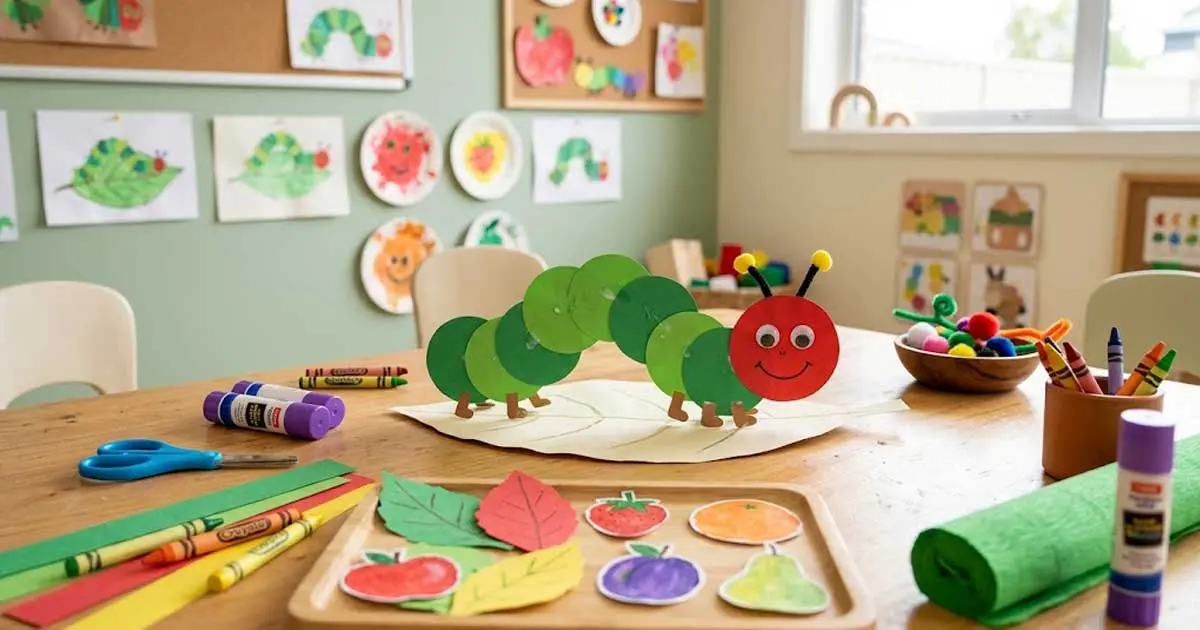
The Very Hungry Caterpillar by Eric Carle, first published in 1969, is more than a picture book. It is a curriculum resource, a science introduction, a counting and days-of-the-week lesson, and because of how Eric Carle made the illustrations a direct model for children’s own art-making.
In addition to being great extensions for the Eric Carle book, these Very Hungry Caterpillar crafts are wonderful creative activities to add to unit studies on bugs and butterflies.) The lifecycle embedded in the story egg, caterpillar, chrysalis, butterfly gives teachers and parents a biological framework to hang the crafts on, turning an art activity into a science discussion without requiring any additional materials or preparation.
Carle’s illustration technique is equally important for preschool craft purposes. He created each page by first painting sheets of tissue paper in textured patterns and then tearing and layering those sheets into the final images. After the paint was dry on hand-painted papers, Carle cut each piece into a large oval for the caterpillar’s body, then used construction papers in red, blue, yellow, green, and brown to create the head and feet children can do exactly the same. This means the visual style of the book is directly achievable by preschool hands, and the finished work looks genuinely like the original rather than like a child’s approximation of something adult-made.
Key Takeaways
- The Very Hungry Caterpillar by Eric Carle has been in print since 1969 and remains one of the most widely used picture books in early childhood education worldwide, with more than 50 million copies sold.
- The best Hungry Caterpillar crafts for preschoolers are egg carton caterpillars, cupcake liner caterpillars, fingerprint caterpillars, sponge painting, and tissue paper collage all completable in 15 to 30 minutes using basic classroom materials.
- Eric Carle created his illustrations using hand-painted tissue paper torn and layered into collages a technique children aged 3 and up can replicate with washable paints, tissue paper, and glue.
- Hungry Caterpillar crafts work as standalone art projects, as extensions of a book reading, as springtime or lifecycle unit activities, and as displays for classroom bulletin boards and hallways.
- The lifecycle of a butterfly egg, caterpillar, chrysalis, butterfly embedded in the story provides a natural science connection that extends the craft activity into early biology learning.
- All crafts in this guide use washable, non-toxic materials appropriate for children aged 2 to 5, with difficulty scaled across the age range.
- Father’s Day falls on the third Sunday of June in the United States. In 2026, it is June 21. Many of the handprint and fingerprint techniques in this guide can be adapted for Father’s Day crafts by changing the finishing message.
Egg Carton Crafts
1. Egg Carton Very Hungry Caterpillar
This is the most recognised and most reproduced Hungry Caterpillar craft for preschoolers, and it earns that status by being genuinely satisfying to make and genuinely durable when finished.
The egg carton caterpillar uses a cardboard egg carton from Two Pink Peonies. Paint each cup segment a different bright colour green, yellow, red, blue then paint the first cup red for the caterpillar’s head. Add googly eyes, pipe cleaner antennae, and small felt feet cut and glued underneath each segment.
Materials: cardboard egg carton, washable paint in multiple colours, googly eyes, pipe cleaners, felt or foam for feet, glue Time: 20 minutes active + drying time Age: 3 and up
In a classroom setting, prepare the egg cartons by cutting them into single rows of six or eight cups before the session begins. Children paint the cups at the art station and add the face details once the paint has dried typically the following day’s activity.
2. Egg Carton Caterpillar to Butterfly Transform
Create a cardboard tube craft that transforms from a caterpillar to a butterfly an ideal project to pair with the book. Make the caterpillar from an egg carton row, then separately make a butterfly from the same tube with wings cut from coffee filters or tissue paper. Display both together to show the lifecycle.
This two-part version doubles the craft time but adds the lifecycle narrative that makes the activity a more complete science connection. The butterfly can be made from the same carton by cutting the base cups into wing shapes and adding tissue paper.
Materials: cardboard egg carton, washable paint, coffee filters or tissue paper, pipe cleaners, scissors, glue Time: 30 to 40 minutes across two sessions Age: 4 and up
Painting Crafts
3. Sponge-Painted Very Hungry Caterpillar
The sponge-painted caterpillar looks just like the one from the book. Cut circular sponge shapes in two sizes large for the body segments, small for the head. Dip each into paint and press onto white paper in a line, slightly overlapping, to build up the caterpillar’s body.
Sponge painting is an excellent technique for 2 and 3-year-olds because it requires no precise brush control. The circular shape of the sponge does the visual work automatically, and each press creates a recognisable body segment. Use a smaller sponge dipped in red for the head at one end.
Materials: circular sponges or sponge cut into circles, washable paint in green and red, white cartridge paper, googly eyes, glue Time: 15 minutes Age: 2 and up
4. Fingerprint Caterpillar
This fingerprint caterpillar activity for kids includes an adorable finger-painted caterpillar craft to create after reading Eric Carle’s book. Press a fingertip into green paint and stamp a row of overlapping fingerprints to form the caterpillar’s body. Add a thumbprint in red for the head. Once dry, draw on a face with marker.
Fingerprint crafts are the fastest technique on this list and the most appropriate for children aged 2 to 3. The body forms itself from the natural oval shape of a pressed fingertip, and the caterpillar’s segmented appearance is built into the technique.
Materials: green washable paint, red washable paint, white paper, marker Time: 10 minutes Age: 2 and up
5. Fork-Painted Caterpillar
Dip the tines of a plastic fork into thick green paint and press onto paper in a rolling circular motion to create textured, segmented body sections. The fork’s tines create a striped texture within each segment that closely resembles the hatching style in Carle’s original illustrations.
The fork-painted caterpillar is an easy painting activity perfect for little hands and a fun way to bring a favourite story to life.
Materials: plastic forks, washable green paint, white paper, marker for face details Time: 15 minutes Age: 3 and up
6. Pom Pom Painted Caterpillar
Clip a pom pom into a clothespeg to create a simple stamp that produces soft, circular body segments. Dip into paint and press onto paper in a row. This technique is lower-mess than direct sponge printing and particularly useful in classroom settings where paint quantity is being managed carefully.
This easy pom pom painting activity is perfect for little hands and a fun way to bring a favourite story to life.
Materials: pom poms, clothes pegs, washable paint, paper, googly eyes Time: 15 minutes Age: 2 and up
7. Potato Masher Caterpillar
Press a kitchen potato masher into paint and stamp onto paper. The circular grid pattern of the masher head creates a textured circular impression that serves as each body segment.
The Very Hungry Caterpillar potato masher craft is any easy painting craft using a potato masher. This technique is best for a demonstration project or a group mural rather than individual work, as a full-sized potato masher is large relative to a small child’s hand. Adults can hold the masher and allow the child to guide the placement.
Materials: kitchen potato masher, washable paint, large paper Time: 15 minutes Age: 2 and up with adult assistance
Paper and Collage Crafts
8. Cupcake Liner Caterpillar
Cupcake liners make the caterpillar’s body look colourful and textured, and the craft is easy to assemble with just a few supplies. Gently press the cupcake liners flat so they are easy to glue. Arrange in a row on cardstock with slight overlap between each liner to form the body. Add a red liner or red circle for the head.
The cupcake liner technique produces a finished caterpillar that has genuine three-dimensional presence on the page because the fluted edges of the liners create relief texture. The colour variety available in standard baking paper liner packs means children can choose their own combination without any painting required.
Materials: colourful cupcake liners, cardstock, glue stick, googly eyes, black marker for antennae Time: 15 to 20 minutes Age: 2 and up
9. Tissue Paper Collage Caterpillar (Eric Carle Method)
This is the most directly connected to Carle’s actual illustration technique and the most appropriate for children aged 4 and 5 who can manage the additional steps involved.
After reading the book, talk with children about how Eric Carle is an artist and look at all the textures and colours mixed together on the pages. Children then make their own Eric Carle-style textured papers by painting tissue paper sheets with washable paint applied in layers, sometimes adding a second colour while the first is still wet to create blends. Once dry, the painted tissue paper is torn into rough oval shapes and glued in overlapping layers onto cardstock to form the caterpillar’s body segments.
The tearing rather than cutting is important it produces the soft, irregular edges characteristic of Carle’s collage style. Scissors produce straight, uniform edges that do not look like the book illustrations.
Materials: tissue paper sheets, washable paint in multiple colours, glue or Mod Podge, cardstock, sponge brushes for painting tissue Time: 30 to 45 minutes across two sessions (paint first day, collage second day) Age: 4 and up
This technique connects directly to the broader tradition of collage as a fine art medium. The approach Carle used in his books draws on the same principles that artists study when learning to build images from layered materials an understanding developed through formal art practice. Shani Levni’s guide to oil painting classes covers how structured art instruction develops these foundational skills, which are as relevant to children’s collage work as to adult studio practice.
10. Crumpled Paper Caterpillar
This crumpled paper caterpillar uses torn and scrunched tissue paper or crepe paper in green and other colours. Roll pieces of tissue paper into loose balls and glue in a line to a piece of cardstock to form the body. The three-dimensional crumpled texture closely resembles the fuzzy appearance of a real caterpillar.
Materials: green and coloured tissue paper or crepe paper, cardstock, glue Time: 15 minutes Age: 2 and up
11. Paper Plate Caterpillar
This simple paper plate craft is a fun way for kids to make their own version of the Very Hungry Caterpillar. Paint the underside of a paper plate green and allow to dry. Cut the plate into a spiral, starting at the edge and working inward, to create the caterpillar’s segmented body. The spiral can then be stretched slightly to create a three-dimensional wriggling effect.
Materials: white paper plates, green washable paint, scissors, googly eyes, red construction paper for the head Time: 20 minutes Age: 4 and up for cutting; 2 and up with adult cutting assistance
3D and Construction Crafts
12. Upcycled Lid Caterpillar
Collect bottle caps, jar lids, or milk bottle tops in varying sizes. Paint each lid green or in alternating colours and arrange in a row on a strip of cardboard, gluing each lid flat onto the base. The circular lids create perfectly even body segments that are more regular and bold than painted circles.
The upcycled lid caterpillar from Entertain Your Toddler uses recycled lids to make a very hungry caterpillar craft.
Materials: collected bottle caps or lids, washable paint, cardboard strip, glue gun (adult only) or strong craft glue, googly eyes Time: 20 minutes Age: 3 and up
13. Pipe Cleaner and Bead Caterpillar
The hungry caterpillar bead and pipe cleaner craft uses green pipe cleaners threaded with green beads. Fold the pipe cleaner into a loose coil with the beads forming the body segments, and add a red bead at one end for the head. Bend short sections of pipe cleaner into legs beneath each segment.
Threading beads onto a pipe cleaner is a fine motor activity that develops the pincer grip used in writing. For children aged 3 and 4, the pipe cleaner holds the beads without a knot and is stiff enough to guide through without a needle. For 2-year-olds, use larger pony beads rather than small beads.
Materials: green pipe cleaners, green beads (large pony beads for younger children), red bead for head Time: 15 to 20 minutes Age: 3 and up
14. Sock Caterpillar
This easy sock caterpillar craft for kids is a fun and simple craft for preschoolers and kids of all ages to make in spring or when learning about caterpillars. Fill a green sock with polyfill or rice to create a plump body shape. Tie off sections along the length with rubber bands or green yarn to create the body segments.
The sock caterpillar is the softest, most tactile result of any craft on this list and particularly appealing to children who engage strongly with texture. The finished caterpillar can be used as a puppet or a stuffed toy, making it a lasting item rather than a display piece.
Materials: green sock, polyfill stuffing or dry rice, rubber bands or green yarn, googly eyes, fabric glue, felt for antennae Time: 20 minutes Age: 4 and up
15. Cardboard Tube Caterpillar
This easy and colourful craft uses cardboard tubes from toilet rolls or paper towel rolls cut into rings and threaded onto a length of ribbon or string. Paint each ring in alternating bright colours before threading. The rings can slide along the ribbon to create a wriggling effect when the ribbon is held at each end.
Materials: cardboard tubes cut into rings, washable paint, ribbon or string, googly eyes, pipe cleaner antennae Time: 20 to 25 minutes active + drying time Age: 3 and up
Wearable and Interactive Crafts
16. Very Hungry Caterpillar Finger Puppet
These Very Hungry Caterpillar puppets are a great way to get your toddler or preschooler interested in the classic book. Cut a small oval from green felt. Stitch or glue together along the bottom and sides, leaving the top open for a finger. Add googly eyes, a small red felt circle for the mouth, and pipe cleaner antennae at the top.
Finger puppets serve a dual purpose: they are craft objects and they extend the reading activity by allowing children to retell the story using the puppet as a prop. In a classroom setting, making the puppet in the first session and using it to retell the story in a second session creates a natural two-day extension.
Materials: green felt, red felt, needle and thread or fabric glue, googly eyes, pipe cleaners Time: 20 to 25 minutes Age: 4 and up
17. Caterpillar Headband
Cut a strip of green cardstock wide enough to form a comfortable headband and sized to fit a child’s head. Decorate with green painted circle stamps or green tissue paper segments. Add two pipe cleaner antennae through holes punched at the top of the headband. Staple or tape the strip into a circle once decorated.
The Very Hungry Caterpillar headband and crown printables allow children to wear their craft and use it in dramatic play or story retelling activities.
Materials: green cardstock, green paint or tissue paper, pipe cleaners, hole punch, stapler or tape Time: 15 minutes Age: 3 and up
18. Caterpillar and Butterfly Lifecycle Wheel
Create a spinner wheel divided into four sections showing the four lifecycle stages: egg on a leaf, caterpillar, chrysalis, butterfly. Children illustrate each stage in their own style, then attach a paper arrow through the centre with a brass fastener so the wheel can be rotated.
The lifecycle connection in The Very Hungry Caterpillar provides a natural science extension. Making the caterpillar-to-butterfly transformation craft helps children understand metamorphosis.
Materials: paper plates or cardstock circles, brass fasteners, pencils, crayons, markers Time: 25 to 30 minutes Age: 4 and up
Nature-Connected Crafts
19. Leaf Rubbing Caterpillar
Collect large oval leaves on a nature walk. Place each leaf under a sheet of white paper and rub a green crayon over the surface to transfer the leaf’s texture and vein pattern. Cut the resulting rubbings into oval shapes and arrange in a row to form the caterpillar’s body. The natural texture of the leaf shows through in each segment, creating a result that resembles Carle’s own layered paper texture.
This craft connects the classroom book reading directly to the natural world the caterpillar lives in. A nature walk to collect the leaves is a natural preceding activity.
Pair the leaf rubbing caterpillar with a nature walk and discuss what caterpillars eat and where they live before making the craft.
Materials: collected oval leaves, white paper, green crayons, scissors, glue, cardstock backing Time: 30 minutes including nature walk Age: 3 and up
For classrooms and home projects that incorporate natural craft materials beyond collected leaves, the Shani Levni guide to bulk natural grapevine for crafts covers sourcing and working with grapevine and other organic materials for craft projects a resource relevant to the broader category of nature-connected creative activities for children.
20. Eric Carle Inspired Group Mural
In this group art project for preschool and elementary students, each child creates one body segment of a very long caterpillar. Each child paints a large sheet of paper with their own texture and colour combinations. Once dry, the sheets are cut into large ovals and assembled into a single caterpillar that spans the width of a classroom wall.
This is the highest-impact project on this list in terms of classroom display. A caterpillar made from twenty children’s painted segments becomes a substantial and genuinely impressive piece of group art. The shared ownership of the result each child contributing one distinctive segment supports the social-emotional learning goals of collaborative projects.
Materials: large sheets of white paper, washable paint in multiple colours, sponge brushes, scissors for adult cutting, cardstock or craft paper for head and feet Time: 30 to 45 minutes across two sessions Age: 2 and up
Classroom Setup Tips for Hungry Caterpillar Craft Sessions
Read First, Make Second
Always read the book before beginning the craft. The craft serves as an extension of the reading experience children who have just heard the story and looked at Carle’s illustrations are more engaged with the visual challenge of recreating the caterpillar’s appearance. Find your copy of The Very Hungry Caterpillar and read it before tackling these crafts. Once you are finished with the story, set up the book to serve as a model for the children to look at while they make their own colourful caterpillars.Choose the Right Craft for the Age Group
- 2 to 3 years: Fingerprint caterpillar, cupcake liner caterpillar, sponge painting, pom pom painting all require minimal fine motor control and produce a recognisable result quickly.
- 3 to 4 years: Egg carton caterpillar, pipe cleaner bead caterpillar, crumpled paper caterpillar require slightly more manipulation but remain achievable without frustration.
- 4 to 5 years: Tissue paper collage (Eric Carle method), finger puppet, lifecycle wheel, group mural require multiple steps, waiting for drying, and more precise cutting or threading.
Materials Preparation
For painting crafts, pre-pour paint into shallow trays or onto foam plates before the session begins. For egg carton crafts, pre-cut the cartons into single rows. For bead crafts, pre-cut pipe cleaners into manageable lengths. Preparation time invested before a session dramatically reduces mid-session interruptions.
Display and Documentation
Hungry Caterpillar crafts make strong bulletin board and hallway displays because the caterpillar’s recognisable form creates immediate visual impact. Group murals are particularly effective for entrance or hallway displays where the length of a continuous caterpillar body can be appreciated fully. Photograph each child’s individual work before assembly for documentation portfolios.
The same planning principles apply across all seasonal and themed preschool craft projects. The Shani Levni guide to Father’s Day crafts for preschoolers covers the same preparation framework materials, age scaling, classroom setup, and developmental benefits for another major annual preschool craft occasion. And the preschool crafts for spring guide covers the broader seasonal context in which Hungry Caterpillar activities most naturally fit, since the book’s themes of growth, transformation, and the natural world are inherently springtime themes.
The Developmental Value of Hungry Caterpillar Crafts
Hungry Caterpillar crafts are not simply fun activities. They contribute to several areas of preschool development that early childhood educators explicitly target.
Fine motor development. Painting, tearing tissue paper, threading beads, pressing fingerprints, and gluing all strengthen the hand muscles and develop the pincer grip children need for writing.
Colour recognition and mixing. The multi-coloured body of the caterpillar invites children to name and choose colours deliberately. Painting activities where colours mix on the page introduce early colour theory what happens when you put yellow next to blue, what green looks like when it is mixed from other colours.
Counting and sequencing. The Very Hungry Caterpillar is structured around the days of the week and a counting sequence one apple, two pears, three plums. Crafts that require arranging body segments in a specific order reinforce this numeracy connection naturally.
Science knowledge. The lifecycle embedded in the story egg, caterpillar, chrysalis, butterfly introduces metamorphosis at a developmentally appropriate level. Lifecycle wheel crafts and caterpillar-to-butterfly projects extend this into a hands-on science activity.
Narrative engagement. Making a character from a book the child has just heard strengthens their connection to the story, their ability to retell it, and their motivation to engage with books more broadly.
Conclusion
The Very Hungry Caterpillar has remained in print for more than 55 years because it works on multiple levels simultaneously as a story, as a counting book, as a lifecycle introduction, and as a visual invitation to make art in the same way its creator did. That last quality is what makes it uniquely suited to preschool craft activities: the illustration technique is achievable by young children, the character is immediately recognisable, and the finished work looks like the book.
The twenty crafts in this guide span the full range of materials, techniques, and age levels relevant to preschool settings from 10-minute fingerprint stamps for 2-year-olds to 45-minute tissue paper collage projects for 5-year-olds. All use washable, accessible materials. All connect back to the book and its central character in a way that reinforces the reading experience rather than replacing it.
The caterpillar that munches through the pages of Carle’s book ends the story as a butterfly. The crafts that bring that character to life in a child’s hands end the session with something the child made, something they can look at and say with complete accuracy “I made that.”
For more craft guides, seasonal activity ideas, and creative resources for children and families, explore the full library at Shani Levni.
Frequently Asked Questions
What are the best Hungry Caterpillar crafts for preschoolers?
The most popular and most widely used Hungry Caterpillar crafts for preschoolers are the egg carton caterpillar, the fingerprint caterpillar, the sponge-painted caterpillar, the cupcake liner caterpillar, and the tissue paper collage using Eric Carle’s own illustration technique. All are appropriate for children aged 2 to 5 and completable in 15 to 30 minutes.
What materials do I need for Hungry Caterpillar crafts?
The core materials for most Hungry Caterpillar crafts are washable paint, white cardstock or paper, googly eyes, glue, and a green material to form the body whether sponges, cupcake liners, egg carton cups, pom poms, or fingerprints. For 3D crafts, add pipe cleaners, beads, or a cardboard egg carton.
How do you make an egg carton Very Hungry Caterpillar?
Cut a cardboard egg carton into a single row of six to eight connected cups. Paint each cup a different bright colour and paint the first cup red for the head. Allow to dry, then add googly eyes, pipe cleaner antennae pushed through the top of the head cup, and small felt shapes glued underneath as feet. The finished caterpillar can stand upright on a flat surface.
What is Eric Carle’s illustration technique and can preschoolers do it?
Eric Carle created his illustrations by first painting sheets of tissue paper with textured paint layers, then tearing those sheets and layering them into collages. Preschoolers aged 4 and 5 can replicate this process by painting tissue paper with sponge brushes, allowing it to dry, tearing it into rough oval shapes, and gluing the shapes in overlapping layers onto cardstock to form the caterpillar’s body segments.
When is the best time to do Hungry Caterpillar crafts in the classroom?
The Very Hungry Caterpillar is particularly well suited to spring units on insects, lifecycles, and the natural world. It also works as a back-to-school activity in early autumn, as a standalone art unit at any time of year, or as part of a general Eric Carle author study. The book’s themes growth, transformation, days of the week, counting make it relevant to multiple curriculum areas simultaneously.
Can I adapt Hungry Caterpillar crafts for very young toddlers (aged 2)?
Yes. For 2-year-olds, the best options are fingerprint stamping, sponge painting, and cupcake liner assembly all of which require minimal fine motor precision and produce a recognisable caterpillar with minimal adult intervention. Adult assistance is needed for cutting, gluing, and any step involving pipe cleaners or small beads.