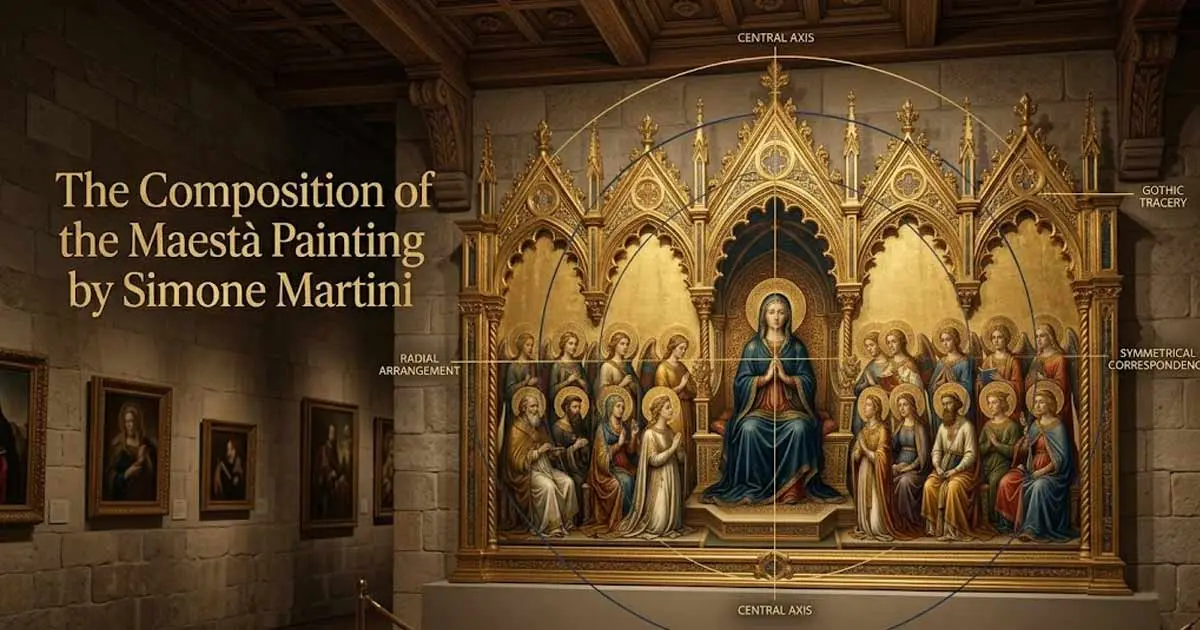
The painting of the Maestà by Simone Martini depicts the Virgin Mary seated in majesty, holding the Christ Child, with a large symmetrical group of angels, apostles, and saints below a luxuriant canopy. The fresco was painted directly on the wall of the council chamber in the Palazzo Pubblico in Siena, and was finished on June 15, 1315, and arranges the figures in a formal and balanced manner: angels in the foreground presenting flowers, the Virgin and Child at the visual and symbolic center, and ranks of saints and apostles radiating outwards in formal rows. The composition is a blend of religious sentiment and overt civic and political rhetoric, and it is one of the most important paintings of early 14th-century Italian art.
Key Takeaways
- In Simone Martini’s Maestà the Virgin Mary is seated, carrying the Christ Child, and accompanied by a symmetrical court of angels, the apostles and the saints, who are placed under an ornamental canopy.
- The fresco was created on 15th June 1315 in the Sala del Mappamondo (also known as the Sala del Consiglio) of the Palazzo Pubblico in Siena, and was revised in 1321.
- The fresco is estimated to be 763 x 970 cm, covering the entire wall of the council chamber of the city of Siena, where the governing body of the city used to meet.
- Angels are depicted in the foreground carrying flower vases presented to the Virgin, while apostles and saints are depicted symmetrically behind them.
- The most striking aspect of the composition is the deep and three-dimensional throne, which is a novelty in Martini’s otherwise decorative and Gothic style and that was a novelty in the 14th century, when it was introduced from the influence of Giotto’s naturalism.
- The painting contains two political inscriptions from the Virgin, one from 1315 and a later one in 1321 after the Carnaioli Conspiracy, which are embedded in the religious structure, and civic governance is included.
- It is one of the earliest and most important works of the International Gothic style, a synthesis of French courtly elegance, Sienese decorative tradition and early Italian spatial realism.
The Maestà reveals much about the composer’s personality and his musical approach
This grand fresco, which takes up an entire wall of the room, shows the Virgin Mary enthroned, holding the Child and surrounded by angels and saints. The term “maestà” means “majesty” and it is the Virgin who sits majestically on a throne with the young Jesus Christ, flanked by the apostles and the saints.
The compositional structure can be subdivided into a number of different zones, each of which helps to create the overall hierarchy:
The Central Throne Group
The center of the composition is the Virgin Mary seated on a richly ornamented Gothic throne with the infant Christ in her hands. The central pairing is the most visually weighty, and is depicted with a special focus on spatial depth. The solutions, as well as the representation of the throne with its marked depth, show the impact of the work of Giotto, who Martini had presumably seen firsthand in Assisi, where he had witnessed the innovations of naturalism and concrete spatiality.
The Flanking Angels
Angels are also on each side with bowls filled with flowers being given to the Virgin Mary. These angels are in the front rank closest to the viewer and are symmetrically placed on either side of the throne, their gesture of offering flowers further emphasising the devotional purpose of the whole piece.
The Court of Saints and Apostles, in which the Holy Apostles are the judges
The angels are followed by a broad formal assembly behind them. The surrounding saints and apostles of the Virgin are arranged in a way that follows Duccio’s tradition, and their aristocratic calm and soft expression are without any trace of violence, according to Google Arts & Culture. This results in a dignified and processional music, rather than a dramatic, each figure being presented as a part of a courtly assembly, not as a story actor.
The Decorative Frame
A painted frame with medallions of Christ giving his blessing, prophets, evangelists, with their iconographic symbols, the black and white Balzana and the coat of arms of the Sienese people, a rampant lion on a red field, surrounds the entire scene, all of which is set under an elegant canopy. The religious theme is directly connected with the civic identity, and the political symbols of Siena are embedded in the architecture around the sacred theme.
Where is the Maestà?
The Maestà is an entire room of a particular and important room in Siena’s town hall. The fresco is in the Sala del Mappamondo (Siena’s Council Hall) in the Palazzo Pubblico in Siena, Italy.
This is the room in which, according to Smarthistory, the general council, the highest administrative body in Siena, would gather: the central government building of the city. It was, in a sense, the meeting room for 300 or more representatives to make decisions about war and peace. The decision to have a monumental religious fresco in this particular civic chamber, not in a church, is itself a major compositional and contextual choice, and a blending of sacred imagery with the role of secular governance.
| Detail | Information |
| Location | Sala del Mappamondo, Palazzo Pubblico, Siena |
| Medium | Fresco with gold leaf |
| Completion date | June 15, 1315 |
| Revisions added | 1321 |
| Dimensions | Approximately 763 x 970 cm |
| Commissioned by | The Nine (Council of Nine Governors and Defenders of the Commune) |
| Artist lifespan | c. 1284 – July 1344 |
Who commissioned the Maestà and why?
The Maestà was commissioned by the Commune of Siena from Simone Martini in 1315 for the most important room in the Palazzo Pubblico. Art in Tuscany states that the fresco was a study on the careful fusion of religious iconography and political intent, and was commissioned by the governing committee of Siena, the Nine Lords Governors and Defenders of the Commune and People of Siena.
The Nine were a council of nine representatives of the city, even from the middle class, artisans, who commissioned the fresco because they preferred Simone Martini to the then more famous Duccio di Buoninsegna, perhaps because Duccio was not so experienced in the matter of wall painting.
The subject of the Virgin Mary as protector of the city was clearly political. Beautiful and elegant, Mary was asked to protect the city and its governors, and the composition became a religious act and a civic talisman to protect the government and representatives of Siena.
The Political Inscriptions Within the Composition
An unusual feature of the Maestà’s composition is the presence of text inscribed directly to the Virgin Mary, containing political messages within the sacred scene.
Hypercritic dates the Maestà to June 1315, when it was finished by Simone Martini, but says he amended his fresco in 1321. The first sentence, which is at the bottom of the frame, dates from 1315 and is a promise of blessing to all citizens, except those who oppress the weak, a reference that was interpreted as a secret political declaration of the Rule of the Nine, the oligarchy in power at the time in Siena.
The second sentence that Our Lady speaks is written on a black step between the two central angels, and was added to the revisions in 1321. This second modification was politically motivated, in relation to certain civic events: the Nine who claimed this addition in 1318, when the oligarchy was tested by the Carnaioli Conspiracy in the city. The rulers brutally suppressed the conspiracy and the alteration in the composition of the Maestà, the inclusion of a warning from the Virgin herself, was a tacit acknowledgment of the power of the Nine, who were directly warned by the Mother of God within the painted scene.
The devotional imagery and the political message are two of the hallmarks that set the Maestà apart from strictly liturgical religious painting of the time.
The Maestà’s Composition and Technical Innovations
The Maestà was a work of art that was technically and materially innovative, different from the earlier Sienese painting traditions.
Among the many fresco innovations that can be seen in the work is the first depiction of blue irises in Italian painting history, a botanical detail incorporated into the decorative program of the work, according to Hypercritic. Moreover, in the first time in all the history of the fresco, Simone Martini used real parchment sheets for the plaster of the fresco, giving the first physical texture and material variation to certain parts of the painted image.
The sharp graphic style, the sinuous and light line that delineates the bodies and spaces, the striking realism of the faces and gestures, and the use of these new materials and techniques that were not known to Italian painting at the time of its creation, all contribute to the realism of the faces and gestures, which is striking, according to BeCulture.
Stylistic Sources: Duccio and Giotto, French Gothic Influence
The Maestà is a combination of several different artistic traditions that were brought together by Simone Martini.
The Duccio Tradition
It is believed that Martini was a pupil of the leading Sienese painter of the time, Duccio di Buoninsegna, and the influence can be seen in the direct way in which the composition of the Maestà is used. The saints and apostles who surround Martini’s Maestà retain the same order and the same characterization of the figures as in Duccio’s work, and the aristocratic calm and soft expression continues the Sienese decoration sensibility that Duccio had developed.
The Giotto Influence
This grounding in Sienese tradition is not without its influence, however, on the composition. Some scholars hold that Simone was the pupil of Giotto di Bondone, and that he travelled with him to Rome to paint at the Old St. Peter’s, an idea that is disputed by Giorgio Vasari, the Renaissance art biographer. In any case, the teacher/student relationship is likely to have been a very close one in which Giotto’s innovations, both the naturalism and the concrete spatiality, would have impressed the young painter while he was exposed to Giotto’s work in Assisi, and which is evident in the very pronounced spatial depth of the throne in the composition of the Maestà.
French Gothic Elegance
The power to combine the refined and gentle character of French Gothic courtly style with the innovative search for reality in Italian painting of the time is what makes Simone Martini the founder of the Italian Gothic, or International Gothic style as it is known more widely. The Maestà is seen as a masterpiece of this synthesis, with its elongated figures, decorative gold work and courtly grace, and spatial innovation.
The artist behind the composition: Simone Martini
Simone Martini (c. 1284 to July 1344) was an Italian painter born in Siena who became a major figure in the development of early Italian painting and greatly influenced the development of the International Gothic style. In his compositional originality, his new compositions and his handling of gold, he was a master of transforming the painting.
There is little that is certain about the life of Simone Martini. He was probably working in Siena at the beginning of the 14th century, in the workshop of Duccio, and the Maestà, created in 1315, is one of his earliest known large-scale works. By this time, his own artistic style was well defined, but we don’t know what he was painting before that with the same certainty.
He was not only active in Siena, but also in his career. He painted the Maestà as a large, public symbol of civic virtue in the town hall, and his career was to extend throughout the peninsula, where he was a painter for popes, kings, and members of the Renaissance dynasties. He was an innovator in the construction, design and imagery of altarpieces, producing polyptychs for churches in such cities as San Gimignano, Pisa and Orvieto.
In particular, his friendship with the poet Petrarch was well known. In the later years of his career, Simone Martini moved to Avignon to work for the papal court, and there the two met, with Simone Martini dying there in July 1344.
The Maestà’s Place in Art History
It is regarded as one of the finest Gothic masterpieces in all of Europe, and the structural framework of the Maestà has been followed by later religious paintings throughout the 14th century. The Isabella Stewart Gardner Museum says Simone Martini became the painter of the city in Siena by virtue of his conceptual originality, novel compositions and masterful use of gold, which made him a painter of great originality before his career spread throughout the Italian peninsula.
As a devotional image and as an explicit instrument of civic political messaging, the work’s composition is a particularly rich topic for art historical analysis. Very few other paintings of the period integrate religious imagery with such forthright and easily comprehensible political statement within the actual painting, as is done here in the words inscribed on the Virgin’s lips, which comment directly on the city’s governance.
The use of a visual composition to convey multiple messages, as a devotional object and as a means of institutional authority and political messaging, is something that happens in art history in various ways. The layered function of composition is explored in a very different way in the guide to Ad Reinhardt Abstract Painting 1957, in which the removal of all referential content was a statement, not just of the philosophy and even of the politics of what painting is, but of the elimination of all referential content.
Maestà Composition Quick Reference
| Element | Description |
| Central figures | Virgin Mary enthroned, holding Christ Child |
| Foreground figures | Angels presenting bowls of flowers |
| Surrounding figures | Symmetrical ranks of apostles and saints |
| Architectural framing | Decorative canopy and painted frame with medallions |
| Frame symbols | Christ blessing, prophets, evangelists, Sienese civic emblems |
| Spatial technique | Deep throne reflecting Giottesque influence |
| Material innovation | First blue irises in Italian painting; real parchment inserted into fresco |
| Political content | Two inscribed messages from the Virgin (1315 and 1321) |
| Stylistic synthesis | Duccio’s Sienese tradition + Giotto’s naturalism + French Gothic elegance |
| Commissioning body | The Nine (governing council of Siena) |
Conclusion
The Maestà painting by Simone Martini reveals more than a typical devotional scene of the Virgin enthroned. It is a formal and symmetrical progression of sacred figures, technically novel in Italian painting in the 15th century, and, at the same time, a tool of civic political power via direct Virginian inscriptions.
The fresco, completed in 1315 and revised in 1321 in response to political turmoil in Siena, illustrates how religious composition in the early 14th century could function on several levels simultaneously: as a gesture of communal piety, as an opportunity for a bold young artist to prove himself, and as a conscious instrument of government for the council that commissioned it. It was a synthesis of the Sienese tradition of Duccio, the spatial naturalism of Giotto, and the French Gothic elegance that ensured its status as one of the earliest works of the International Gothic style and that it continues to be the object of close compositional study seventy centuries later.
Read the entire collection of art history, painting analysis and masterpieces of European art guides at Shani Levni.
Frequently Asked Questions
What can you infer from the composition of the Maestà painting by Simone Martini?
In the composition, the Virgin Mary is seated enthroned in the center of the whole piece, holding the Christ Child in her hands, while around her are arranged symmetrically angels, apostles and saints. Angels in the foreground bring the Virgin bowls of flowers, while the ranks of saints and apostles spread out, under a decorative canopy with medallions of Christ, the prophets, and the evangelists, as well as the civic symbols of Siena.
In which city is the Maestà by Simone Martini?
The Maestà is housed in the Sala del Mappamondo (Siena’s town hall) in the Sala del Consiglio (town hall council chamber) in the Palazzo Pubblico (town hall) of Siena, Italy. It is located in the room where Siena’s general council, the city’s highest administrative body, met, taking up the entire north wall of the room.
In what year was the Maestà finished?
The date of the completion of the Maestà is June 15, 1315, which Simone Martini recorded along with his name on the pseudo-marbled decoration on the bottom of the fresco. In 1321 he returned to make changes to the work, adding a second political inscription in the name of the Virgin.
Who paid for the Maestà and for what purpose?
The Maestà was commissioned by the Commune of Siena, which was governed by the Nine, a council of nine representatives. They opted for Simone Martini, rather than the more experienced Duccio di Buoninsegna, perhaps because Duccio was less experienced in fresco wall painting. It was used for devotional purposes, for the Virgin to defend the city and its governors, and for political purposes, for civic authority to be woven into the composition itself.
Which art influences are reflected in the Maestà?
The composition is inspired by three main sources: the Sienese decorative tradition of Duccio di Buoninsegna, seen in the dignified and aristocratic treatment of the saints and apostles; the spatial naturalism of Giotto, seen in the depth and three-dimensionality of the throne; and the courtly elegance of French Gothic, seen in the elongated figures and decorative gold work. This synthesis is the reason for Simone Martini’s status as the precursor of the International Gothic style.
What kind of political messages are there in the composition of the Maestà?
In the Maestà there are two inscriptions that are believed to be by the Virgin Mary. The first, dating from 1315, is a blessing to the citizens, except those who are the cause of the weakness of the weak, which is a political statement supporting the ruling Nine. The second (1321), written after the Carnaioli Conspiracy of 1318, speaks directly to the conspirators and strengthens the authority of the governing council of Siena after the uprising was put down.
Which technical innovations are seen in the Maestà?
The first known representation of blue irises in the history of Italian painting is in the Maestà. For realism, Simone Martini also placed actual parchment sheets in the fresco’s plaster, a method that had not been used in Italian wall painting before. The innovations, along with the graphic linework of the fresco, helped make this one of the most technically innovative paintings of its time.