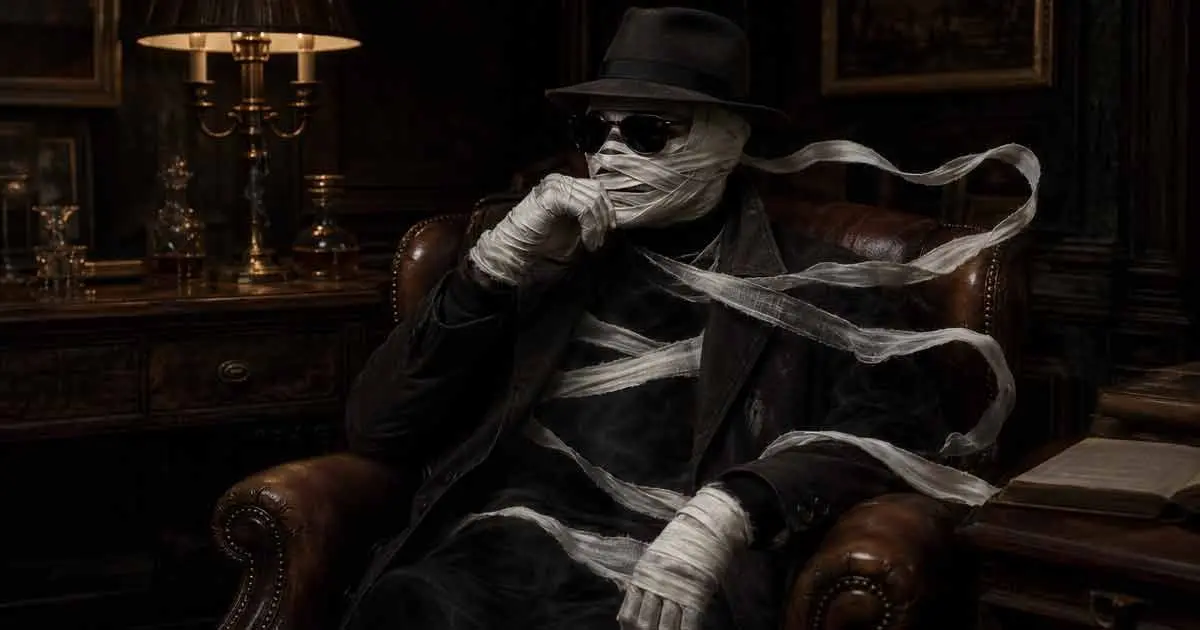
In H.G. Wells’ 1897 novel The Invisible Man, a select few characters know that the bandaged man – whose true name is Griffin – is invisible beneath his bandages. Griffin himself knows, of course, since he has made himself invisible through chemical experimentation. The reader, given an omniscient point of view by Wells’ third-person narration, is also privy to this knowledge from the beginning of the novel. Dr. Kemp is told by Griffin during a lengthy argument. Mrs. Hall, Teddy Henfrey and most of the townspeople of Iping, on the other hand, think the bandages hide injuries or deformities.
This split between those who know and those who do not is significant. It is the narrative motor of the novel’s drama and its commentary on sight, power and responsibility.
Key Takeaways
- The invisible man (Griffin) knows he is invisible, because he made himself so.
- The reader knows the bandages hide nothing, thanks to the structure of the story.
- Dr. Kemp finds out from Griffin during their fight.
- Mrs. Hall and Teddy Henfrey are not aware – they think the bandages are covering up injuries.
- Thomas Marvel is forced to help and comes to believe, albeit reluctantly.
- The secret is a key plot element in H.G. Wells’ novel, and the source of much tension.
Who is the Bandaged Man, Griffin?
Griffin is an ex-student of medicine and physics, who turned his back on mainstream science to follow his one great aim: to make living matter invisible by changing its refractive index. He succeeded. It worked on him, but not on the undoing.
He travels to the English village of Iping in winter, and disguises his deformity with a full set of bandages on his head, dark blue-tinted goggles over his eyes and a broad-brimmed hat. He has gloves, a greatcoat and beard (when needed). His disguise is utilitarian: without it his head would be invisible.
He stays at the Coach and Horses Inn, owned by Mr. and Mrs. Hall, and asks for privacy. The townspeople presume some terrible accident or illness has befallen him. Griffin doesn’t disabuse them of this idea. It suits his needs – until the money runs out and suspicion is aroused.
Griffin’s character is significant. He is not a lovable waif. Before his experiment, he stole his father’s money and, after his father’s suicide, is unaffected by it. Invisibility did not transform Griffin; it simply removed the restraints that had been keeping in check a character already defined by pride, self-centeredness and contempt. At the end of the novel, he declares a self-imposed Reign of Terror, in which he will commit murder and rule.
The Characters: Who Knows, and Who Does Not
Knows About the Invisibility
Griffin (the Bandaged Man)
Griffin knows about the invisibility. He did it, he wants it, he suffers. He knows not only in the abstract but in a practical sense: he works out how to navigate the world without his secret being discovered, when to use it to his advantage, and how to manipulate others with the threat of an unseen enemy. When he finally unbinds himself in front of the shocked townspeople of Iping, it is a defiant act of anger, not a mistake.
The Reader
Wells’ novel gives the reader information that the characters do not know. The third-person omniscient point of view allows the reader to be privy to the story’s logic. We know that Griffin is wearing bandages for dramatic effect rather than medical reasons. This sets up a constant irony between the reader’s perspective and that of the characters. It is a form of dramatic irony – and Wells uses it very carefully in the early part of the novel.
Dr. Kemp
Kemp is a doctor in Port Burdock who was a student at University College London with Griffin. He is the character to whom Griffin reveals his backstory. When Griffin turns up – bruised, tired, and in need of a temporary hiding place – he takes off his mask and confesses all. Kemp’s realisation is not a gradual one; Griffin’s confession is made on the basis of a shared profession. Kemp listens and thinks, and then calls the police. His sensible, moral nature contrasts with Griffith’s paranoid self-serving nature. Kemp’s knowledge of the invisibility is used to track down and destroy Griffin.
Thomas Marvel
Marvel is a tramp whom Griffin meets in the country after fleeing Iping. He is forced by Griffin to work against his will through fear of moving objects, speaking from nowhere and threats of violence. At first, Marvel thinks he is dreaming. After a period of time, through contact and specific instruction from Griffin, he accepts that it is real. His understanding is reluctant and panicked. Eventually, Marvel is able to contact the police and escape Griffin’s power, stealing Griffin’s notebooks. In the novel’s epilogue, he owns the Invisible Man Inn, and continues to try and make sense of the stolen notebooks – implying his belief in invisibility became total.
Does Not Know About the Invisibility
Mrs. Hall
Mrs. Hall is the proprietor of the Coach and Horses Inn and the first person to study the bandaged man. She is pragmatic, shrewd and territorial, and she is wary of Griffin but not of his true circumstances. She assumes that his bandaged face and avoidance of social contact is due to injury, illness, or privacy – or all three. She treats him with curiosity and increasing frustration about his failure to pay his bills, not growing suspicion that he is not hiding anything. When she finally takes off his bandages in front of her, she is flabbergasted.
Teddy Henfrey
Teddy Henfrey is the local clock-maker, summoned to repair the clock in Griffin’s room. He has a suspicious view of the stranger. He sees Griffin’s disguise as a sign of criminality – a criminal on the run, perhaps – and his unease adds to the village’s gossip. He never finds out the truth. His perception of the bandaged man is entirely through misinterpretation, which is the point: Henfrey is the limit of perception when the imagination is limited by the familiar.
The General Villagers of Iping
The rest of Iping’s population spends the early part of the novel speculating on the strange visitor. A bad accident, some said. A piebald complexion. A fugitive. A lunatic. None comes close to the truth. Their response to Griffin’s eventual unveiling – removing the bandages to reveal nothing – is one of fear and panic not vindication.
Why This Division of Knowledge Matters
Who knows the bandaged man is invisible is not just a test of plot recall. It is a clue to what Wells is really looking at.
In the novel’s architecture, knowing about Griffin’s condition is a matter of power. Those who know can act. Those who don’t are coerced, terrorised, or simply sidelined by Griffin. Kemp’s knowledge leads him to fight Griffin. Marvel’s involuntary acquisition of it ensnares him until he can escape. The villagers’ ignorance serves Griffin’s early plan to hide, and later, his Reign of Terror.
Wells also makes use of the reader’s superior knowledge to create an irony: we see characters make sense of the bandaged man in terms of disease, accident, insanity, and we see them fail. This is something that Wells prized in his science fiction in general: the tendency to see the unfamiliar as normal is a weakness. We will imagine the simplest explanation first.
The bandaged man is not invisible because no one can see through his disguise. He is invisible because people will see what they want to see.
Awareness in The Invisible Man
| Character | Aware of Invisibility? | How Awareness Develops |
| Griffin (Bandaged Man) | Yes | He created the condition deliberately |
| The Reader | Yes | Granted by the omniscient narrative |
| Dr. Kemp | Yes | Told directly by Griffin |
| Thomas Marvel | Yes (reluctantly) | Forced to accept through repeated coercion |
| Mrs. Hall | No | Believes bandages conceal injury |
| Teddy Henfrey | No | Suspects criminal concealment, not invisibility |
| Iping villagers | No | Interpret Griffin through ordinary assumptions |
The Invisible Man as a Study in Perception
First serialised in Pearson’s Weekly in 1897, The Invisible Man was one of Wells’ early efforts in what he termed “scientific romance” – fiction that employs a credible scientific idea to explore human psychology and social interactions. The invisibility is not the focus of the story so much as a tool.
Wells is more interested in the effects of removing social constraints. Griffin’s invisibility takes him out of the normal sphere of observation. He is not seen, and cannot be held to account in the usual ways. The consequences are obvious: someone who is already selfish and hates others becomes a predator when he is invisible.
The visibility of others is so important because it defines Griffin’s territory. He is a threat to those who don’t know. He is brought down by those who do.
Frequently Asked Questions
Who knows that the bandaged man is invisible in The Invisible Man?
Griffin, the reader, Dr. Kemp, and, eventually, Thomas Marvel know the bandaged man is invisible. Mrs. Hall, Teddy Henfrey, and the other townspeople of Iping do not – they believe his bandages cover an injury or disease.
Is Mrs. Hall aware of his invisibility?
No. Mrs. Hall, the proprietress of the Coach and Horses, assumes the bandages conceal an injury or deformity. She grows paranoid of his behaviour, but doesn’t realise the bandages are hiding nothing.
Does Teddy Henfrey know the bandaged man is invisible?
No. Teddy Henfrey believes the bandaged man’s disguise to be a sign of criminality – a criminal on the run. He does not learn of Griffin’s invisibility.
When does Dr. Kemp discover the bandaged man is invisible?
Dr. Kemp discovers the truth when Griffin turns up at his house in Port Burdock, weary and in need of a rest. Griffin takes off his bandages and tells Kemp everything. Kemp then informs the police, and becomes the key to Griffin’s downfall.
What does Thomas Marvel do with his knowledge of the invisibility?
Marvel escapes Griffin’s clutches and takes Griffin’s notebooks and stolen funds. In the novel’s epilogue, he is running a successful inn – called the Invisible Man – and still trying to decipher the notebooks, which indicates he is convinced he saw the truth.
Why does H.G. Wells allow the reader to know before the characters?
Wells employs third-person omniscient narration to effect dramatic irony. The reader’s foreknowledge enhances the experience of seeing the characters misread what is right under their noses – one of the novel’s key themes about how we see the world and how we rationalise the extraordinary in terms of the ordinary.
What does the knowledge that the bandaged man is invisible signify?
Knowing Griffin’s secret is a source of power. The aware can fight him or defend themselves. Those who don’t are susceptible to fear or manipulation. The line between those who know and those who don’t delineates the boundaries of Griffin’s power – and his downfall.