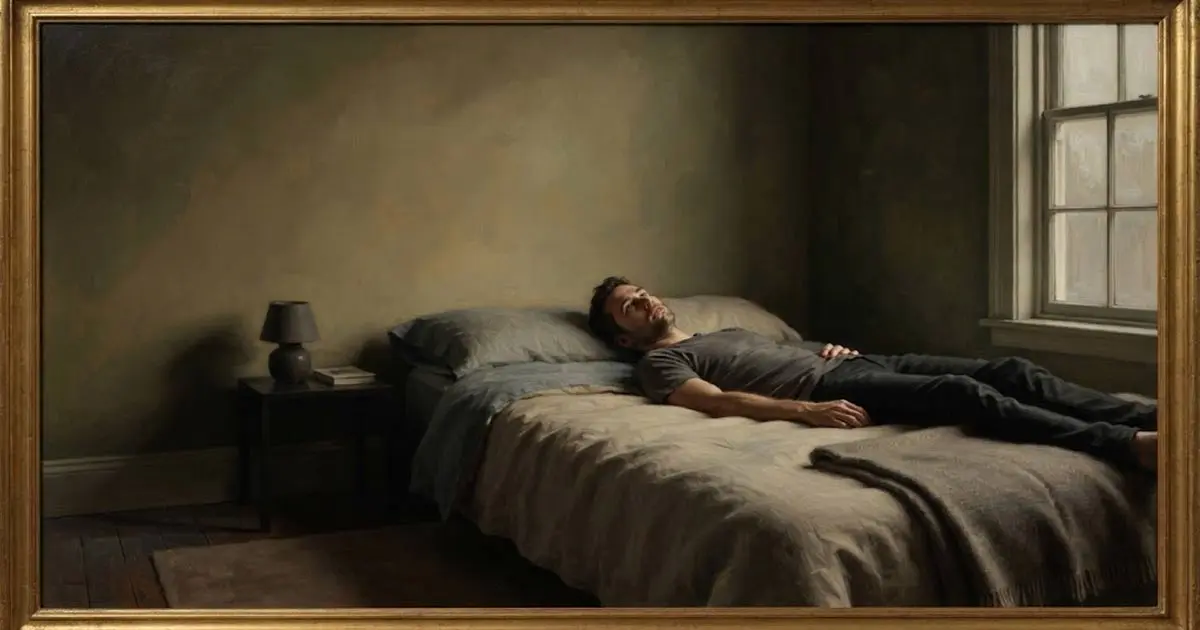
The Man on the Bed is an oil painting by Robert M., a volunteer illustrator for the AA Grapevine that was first published in the December 1955 issue of the AA Grapevine as a center spread. This painting shows Bill Wilson and Dr. Bob Smith visiting Bill Dotson (AA Number Three) at Akron City Hospital during the summer of 1935. It is one of the most widely known photographs in the history of Alcoholics Anonymous, and was even called by Bill W. himself “the whole heart and essence of AA in one photo.” The original is displayed at Stepping Stones, the former residence of Bill and Lois Wilson, and reproductions are given to AA intergroup stores around the world.
Key Takeaways
- Man on the Bed is an oil painting by Robert M., volunteer illustrator for the AA Grapevine, published in the December 1955 issue of the AA Grapevine magazine, as a center spread.
- In June 1935, Bill Wilson (Bill W.) and Dr. Bob Smith (Dr. Bob), co-founders of Alcoholics Anonymous, visited Bill Dotson (AA Number Three) at Akron City Hospital.
- The original painting was presented to Bill W. by the artist in 1956, and is still in Bill and Lois Wilson’s historic home, Stepping Stones, in Bedford Hills, New York.
- Bill W. wrote this thank-you letter about the painting: “The whole heart and essence of A.A. can be seen just by looking at it.”
- So popular was the image after it was first published in Grapevine that four-color prints were offered on their own and it has now been one of the most widely reproduced images in AA history.
- Reproductions are made by AA Grapevine, AA intergroup stores in the region, and international AA literature distributors in 9 x 12 inch restored print format.
- Bill W. and Dr. Bob bringing the message to a sick alcoholic is the beginning of the Twelve Step carrying the message of recovery.
A man in a bed is depicted in the painting
The Man on the Bed was painted by volunteer illustrator Robert M. during the 1950’s as part of the AA Grapevine. The AA Grapevine store listing and AA Melbourne Literature Store indicate that the artist was not a commissioned professional artist but a volunteer contributor to the Grapevine, which is unique in AA tradition as the work was created as a service to the fellowship, not as a commercial commission.
Bill W. has given the original oil painting as a gift to Robert M. and wrote the following in his thank-you letter: “Your painting of ‘The Man on the Bed’ hangs in my studio at Bedford Hills, and the whole spirit and soul of AA can be seen just by looking at it.”
This short letter has been one of the most widely cited answers in AA to the painting and it made the image an integral part of the fellowship beyond illustration. It was a visual declaration of intent.
What is the painting about?
The Scene
This scene was in June 1935, when Bill W. and Dr. Bob took the message of recovery to “A.A. Number Three,” Bill D., at an Akron hospital, and it marks the birth of the principle that AA members carry the message of recovery to others who are still suffering.
Who Is Bill Dotson
Bill Dotson, also known as the “Man on the Bed,” was a lawyer from Akron, Ohio, whose hospital room was filled with alcoholism when Bill W. and Dr. Bob visited him, following Dr. Bob’s rule that if they were going to stay sober, they should get busy carrying the message to others.
The next question that Bill W. and Dr. Bob asked was whether or not Bill believed that he could stop drinking for 24 hours. “‘Sure…anybody can do that, for 24 hours,'” said Bill. The two A.A. co-founders said, “‘That’s what we’re talking about. Just 24 hours at a time. Now that was a relief said Bill.
Dotson’s answer to their visit, and his subsequent sobriety, set the groundwork for the Twelve Step approach to one alcoholic talking to another. His report of what Bill W. and Dr. Bob had shared with him, that he had a disease and not a moral fault, and that one day at a time, he would be able to recover, became a key part of AA’s self-understanding.
The Message Delivered
The historical documents recorded by the Preston Group tell him of the seriousness of his condition, that it was an allergy of the body and an obsession of the mind, but also of hope for recovery. We told him what we had done,” Bill wrote, “how we got honest with ourselves as never before, how we had talked our problems out with each other in confidence, how we tried.
At first, Dotson was skeptical. He admitted that it was great for Bill and Bob, but not for him, because his case was so bad he didn’t want to leave the hospital. He said that he didn’t need to be sold religion, that he still believed in God, but that he wasn’t sure that God believed in him. The painting is a tribute to the perseverance of Bill W. and Dr. Bob over the years and to Dotson’s eventual healing.
The Grapevine is published in December 1955
The AA Grapevine was first published in June 1944 and is the international monthly journal of Alcoholics Anonymous. It became the main voice of the fellowship by 1955, and the December 1955 issue was a major event in the visuals of the program.
This is a newly restored version of the popular oil painting with multiple AA literature sources: Capturing the rich colors of the original. Originally developed for AA Grapevine, it was used as a center spread in the December 1955 issue.
The painting’s size and the fact that it was placed on the two facing pages in the center of the magazine made it a very striking presentation. It was so popular that it was released as a four-color print on its own, and became the visual icon that it is in the AA fellowship, thanks to the reader response.
The decision to have an illustrative painting of this particular scene, rather than a photograph or a document, is a conscious attempt to convey a sense of timelessness and devotion to the scene, rather than a journalistic one. A painting can be reproduced in any scale, displayed on a wall, gift-wrapped, and installed in an AA meeting room, without having to use a specific medium or technology. It is not a record, but serves as an icon.
Where the Original Painting Is Kept
The original painting was donated to Bill Wilson by the artist and is still in the Bill and Lois Wilson’s historic home in Bedford Hills, NY, which has been preserved as a historic landmark and museum by the Stepping Stones Foundation since the Wilsons’ deaths. The home is open for tours and is a preserved record of Bill W.’s life, correspondence and early history of Alcoholics Anonymous.
The painting in Bill W.’s studio at Bedford Hills, as he wrote in his note of thanks to Robert M., is the particular place mentioned in the note. Visitors to Stepping Stones have the opportunity to see the original painting in the environment in which Bill W. himself lived and worked.
An original artwork kept in the location where it was first received, not a museum or institutional archive, imparts a sense of lived continuity. The painting stayed in the room where Bill W. wrote, met members and talked about the fellowship he helped create. Its location in that room is a link to the continuing life of AA’s early history that institutional storage would not provide.
Why is the Painting important to AA Members?
The Man on the Bed has a very particular place in Alcoholics Anonymous that is more than just illustrative. In a single picture, it embodies the fundamental principle that sets AA apart from most other recovery programs of its time and from many that have since come and gone: The belief that the key to the program’s success is the sharing of one recovering alcoholic to another.
The person in the picture is not a teacher, a therapist or a preacher. It’s two people who are sober talking to another person who hasn’t yet gotten sober. The composition of the painting, showing two men, one Bill W., one Dr. Bob, standing at the side of a man in his hospital bed, conveys this peer-to-peer support—they are not a professional and a patient.
When AA members see reproductions of the painting in meeting rooms, intergroup offices, and sponsors’ homes, it serves as a visual statement of purpose: This is what the program is and where it is from. It has been described by Bill W. as capturing the whole heart and essence of AA; it is frequently quoted in literature celebrating the anniversaries, in workshop literature and in personal testimony.
The significance of one image for a whole tradition’s core meaning in one community is analogous to the most important historical paintings throughout the history of art. The compositional approach, with people grouped around a central figure who is in need, is a structural tradition with roots in religious painting and continuing to the present in narrative illustration. The Man on the Bed is situated in this tradition but uses it for a very 20th century topic. In the analysis of the composition of the Maestà painting by Simone Martini, the idea of hierarchy is explored in the arrangement of the figures around a central enthroned figure, which also encodes the values and the authority structure of an entire community in a single painting.
The Man on the Bed AA Painting (Reproduction) is available in the following locations
The original oil painting is not for sale. There are numerous reproductions available from AA literature distribution channels.
| Source | Format | Notes |
| AA Grapevine Store (aagrapevine.org) | 9 x 12 inch print | Newly restored reproduction, full color |
| New York Inter-Group (nyintergroup.org) | Available through NY regional AA store | |
| AA Sacramento (aasacramento.org) | Available through regional intergroup | |
| NH Area Assembly (shop.nhaa.net) | Restored reproduction of original | |
| AA Melbourne Literature (aaliterature.org.au) | Available internationally |
This is a recently restored reproduction of this popular oil painting, capturing the rich colours of the original, according to the AA Grapevine store listing. It was originally developed for AA Grapevine and was used as a center spread in the December 1955 issue. SIZE: 9 x 12
The 9 x 12″ standard reproduction size allows the image to be displayed and framed in an AA meeting room, a sponsor’s home, or a personal recovery area. The newly restored version is listed on several distributors, which means the image has been digitally cleaned and color-corrected to create the clearest reproduction possible.
The image is used on AA medallions and chips (commemorative coins with the image on one side), bookmarks given away at AA meetings, and in digital format via AA intergroup websites.
The Man on the Bed in AA History and Culture
The painting is not only used as a decorative or commemorative object but also plays a significant role in the culture of AA. It is regularly found in certain contexts.
AA anniversary literature: The image appears in many of AA’s anniversary publications, including the historical record of the founding years of the movement.
The Man on the Bed is reproduced and displayed in the meeting room of many AA groups, along with The Steps and other AA literature and pictures.
In Alcoholics Discussions: Sometimes this image is used as a visual reminder of the 12th Step, which is to “carry the message to the alcoholics who still suffer.
The image is usually included as a key visual in AA history presentations, especially when the presentation is about the Akron period (1935-1939).
As I was reading the 50 Shades of Aging blog, I noticed a copy of “The Man on the Bed” painting, soon after I arrived, it was very ingrained in AA culture. The casual recognition: upon entering into a new space, noticing the painting and commenting on it immediately, is an indication of the degree to which the image has become shorthand for shared AA identity among long-term members.
The Man on the Bed: Quick Reference
| Detail | Information |
| Title | The Man on the Bed |
| Artist | Robert M. (volunteer illustrator, AA Grapevine) |
| Year created | First published December 1955 |
| Medium | Oil painting |
| First published | AA Grapevine, December 1955 (center spread) |
| Figures depicted | Bill W., Dr. Bob, Bill Dotson (AA Number Three) |
| Scene depicted | Akron City Hospital, June 1935 |
| Original location | Stepping Stones, Bedford Hills, New York |
| Bill W.’s description | “The whole heart and essence of AA” |
| Reproduction size | 9 x 12 inches (standard print) |
| Where to purchase | AA Grapevine store, regional AA intergroup stores worldwide |
Conclusion
The Man on the Bed AA painting is one of the most popular and reproduced images in the history of AA. It was drawn by volunteer illustrator Robert M. and first published in December 1955, and illustrates the AA hospital visit in June 1935, which became the foundation of the AA program: “One alcoholic talking to another alcoholic is the best help.
Bill W.’s comments about the painting’s capturing the whole heart and essence of AA have influenced the interpretation and usage of the painting by the fellowship for nearly 70 years. It is currently on display in the studio where Bill W. received it at Stepping Stones and the original is kept there. Reproductions are sent around AA intergroup stores throughout the world and can be seen on walls in AA meeting rooms, in sponsors’ homes and in the hands of members who instantly recognize it as a statement of shared purpose.
The painting’s depiction of a documentary subject and its devotional association with the AA community makes it one of the more unusual and interesting instances in which a single work of art can become a community’s sense of identity and purpose.
To learn more about other artworks, cultural items and the history behind them, check out the full spectrum of Shani Levni‘s content.
Frequently Asked Questions
What is The Man on the Bed AA painting?
The Man on the Bed is an oil painting by Robert M. (Robert Morris), who was a volunteer illustrator for the AA Grapevine, first published as a center spread in the December, 1955 issue of the magazine. It shows the founding members of AA, Bill W. and Dr. Bob Smith, visiting AA Number Three, Bill Dotson, at Akron City Hospital in June 1935. The scene is symbolic of the birth of the Twelve Step method to carrying the message of recovery.
Who painted The Man on the Bed?
The painting was painted by Robert M., a volunteer illustrator for the AA Grapevine in the 1950s. He gave the original oil painting to Bill W. as a gift in 1956. In a thank-you letter, Bill W. wrote of its “whole heart and essence of AA.
In which country was the original Man on the Bed painting?
The original oil painting is at Stepping Stones, the historic home of Bill and Lois Wilson in Bedford Hills, NY, now maintained as a museum and landmark by the Stepping Stones Foundation. It is displayed in Bill W.’s studio, where he mentions in his thank you letter to the artist.
Who is the man on the bed in the AA painting?
That guy on the bed is Bill Dotson aka AA Number Three. He was a lawyer from Akron, Ohio, who had been admitted to the hospital in June 1935 suffering from severe alcoholism when Bill W. and Dr. Bob visited him. The twelve step method of one recovering alcoholic passing the message on to another was the model he set after his visit.
Where can I get a copy of the painting The Man on the Bed?
Reproductions are available from the AA Grapevine store at aagrapevine.org, AA intergroups throughout the country and AA literature distributors in other countries. The standard size is 9″ x 12″ and printed in full color from a newly restored version of the original image.
What is the meaning of The Man on the Bed in AA?
The painting represents the first step in the Twelve Step process: two recovering alcoholics going to a third person who is still suffering and sharing their experience with him. It has been described by Bill W. as capturing the whole heart and essence of AA and has become practically an icon within the fellowship. It is used in meeting rooms, anniversary materials, sponsorship discussions and AA history presentations around the world.
What year was The Man on the Bed first published?
The painting was originally featured on the main page of the AA Grapevine, the December 1955 issue. Its readership made it popular and so four colour prints were produced and are now available separately and through AA literature channels the world over.