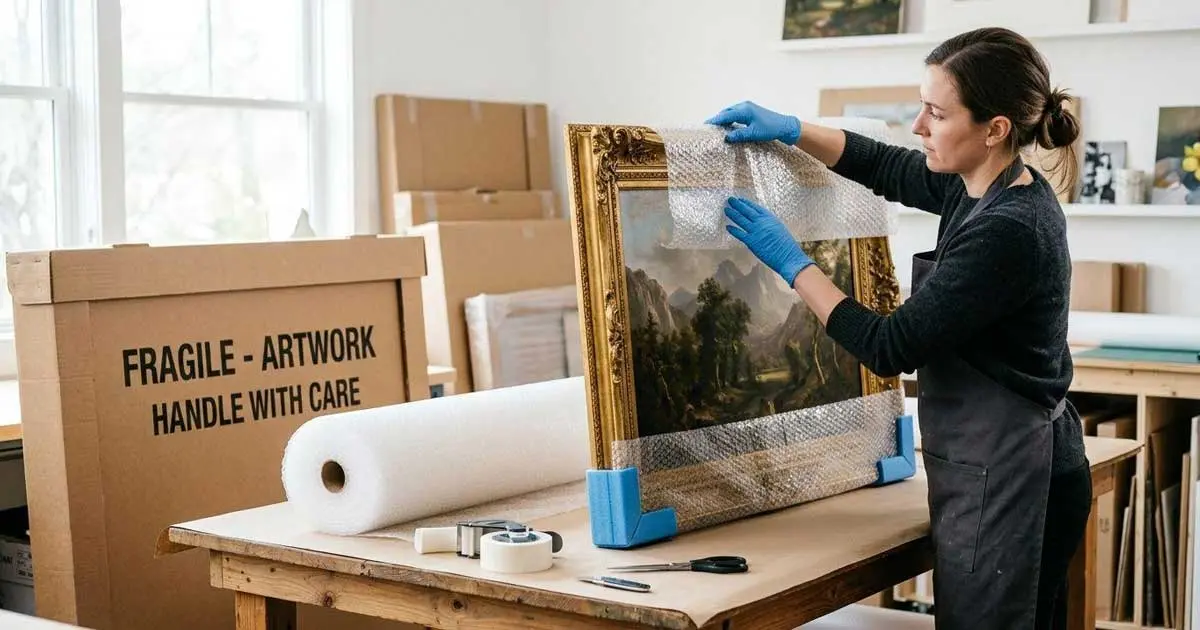
When moving artwork, first protect the surface and then the outside. If the piece is framed, tape the glass in an X shape, place glassine or acid-free paper over the front, put corner protectors on the corners, wrap with bubble wrap on the outside and put it on its side in a tight picture box. Do not place bubble wrap, plastic wrap or newspaper on the paint. Mark the box as fragile, protect it from extreme temperatures and use a fine art shipper for valuable artwork.
Key Takeaways
- If the art is to be framed, tape an “X” across the glass, cover the front with glassine, then attach corner protectors and wrap with bubble wrap with the bubbles facing out and stand the art up in a secure picture box.
- Do not place bubble wrap, plastic wrap, or newspaper on painted surfaces. The National Park Service’s museum guidance recommends the use of glassine or Tyvek and cautions against the use of plastic which can retain water.
- Pack artwork in an upright position, label everything fragile, and have an inventory with you and not in the truck.
- Do not transport paintings in extreme heat or cold, according to the Canadian Conservation Institute.
- Interstate movers default released value coverage pays 60 cents per pound per article, which is not enough to cover valuable art, so it requires additional coverage or special shipper.
What You Need
| Supply | Purpose |
| Glassine or acid-free paper | First layer against the artwork surface |
| Blue painter’s tape | Marks an X on glass and holds wrapping without residue |
| Corner protectors | Absorb impact at the most vulnerable points of a frame |
| Bubble wrap | Outer cushioning layer, bubbles facing out |
| Picture boxes, mirror boxes, or telescoping boxes | Snug outer container |
| Moving blankets | Extra outer layer for large canvases |
| Packing tape | Seals the outer box only |
| Cotton gloves | Keeps skin oils off the work |
| Marker and labels | Mark boxes “Fragile. Artwork.” |
Before you pack: Document and Assess
- Take a picture of each piece front, back and any damage. If something goes wrong, these photos will help with an insurance claim.
- Measure each piece so that you can buy the right box.
- Prepare an inventory of titles, size and estimated value; carry a copy.
- Check the condition. If paint is peeling off or the frame is cracked, Moving.Homes recommends that the piece be moved under the guidance of a conservator. A conservator is the appropriate entity to determine damages when they are actually there.
- Take away hanging hardware like wires and hooks and wear clean gloves. The Canadian Conservation Institute recommends gloves be worn when handling paintings.
In this step-by-step tutorial, you’ll learn how to pack framed artwork
- Tape an X on the glass. Put blue painter’s tape from corner to corner. If the glass breaks, this absorbs shock and helps hold the shards in place, explains Extra Space Storage.
- Cover with glassine on front. Wrap the piece in glassine or acid-free paper, and tape it to itself on the back.
- Add corner protectors. Place cardboard or foam protectors over each corner and secure with tape to the frame.
- Use bubble wrap to wrap. Do not tape the bubble wrap to the painting; keep the bubbles facing outwards.
- Choose a snug box. Use a picture box or mirror box that fits snugly, and has a little padding at the bottom.
- Hold the piece up vertically. Paintings should be transported upright, particularly if the painting is glassed.
- Seal and label. Use packing tape to close box, and label it on the outside with Fragile. Artwork.
- Carry inventory. Please don’t leave the list in the moving truck.
How to pack unframed canvas and oil paintings
Since unframed canvases have no glass to protect, the surface layer is most important.
- Glassine or Tyvek should be used against the paint. According to the National Park Service’s Museum Handbook, wrapping paintings in glassine paper or Tyvek, but not plastic, is recommended since plastic can trap moisture if there is a sudden drop in temperature in transit.
- Do not place any bubble wrap on the paint. The same instructions also recommend that bubble wrap should be used with the bubble layer on the bottom.
- Attach a hard shell face shield. Attach a hard shell face shield. Cover front with a board to prevent pressure on paint.
- Do not tape the artwork! Tape only the wrapping.
- Skip newspaper. The ink may transfer to the surface.
Some moving company guides cover glassine with plastic wrap. Do not place plastic against a painting; as with valuable or oil work, do the museum’s standard practice.
Special Cases
| Item | How to pack it |
| Framed prints and posters | Follow the framed steps. Official limited-edition prints, such as those covered in our guide to assassin’s creed shadows artwork, also benefit from a glassine face layer and corner protection |
| Mirrors | Tape an X on the glass, wrap in glassine and bubble wrap, and use a mirror box |
| Large paintings | Use telescoping or oversized boxes, and add a moving blanket as an outer layer, never as the only protection |
| Sculptures | Wrap in padding on all sides and place in a box with filler around it |
| Children’s artwork | Keep flat between sheets of acid-free paper in a portfolio or flat box |
Paper crafts for kids like the projects in our letter i crafts for preschoolers are treasures that should be preserved. Label the back of each piece prior to packing.
Keep Art Safe from Temperature and Humidity
A painting can suffer as much from the weather as it can from a bump when it’s being moved.
- Don’t expose to extreme heat or cold. The Canadian Conservation Institute says: “Avoid moving paintings in extreme hot or cold environmental conditions.
- Watch for cold. As the temperature drops below 5°C (41°F), acrylic paint layers become more prone to cracking, the same source reports.
- Don’t leave art in an attic or garage, or in a parked car.
- Let it adjust. Let the box rest in a room temperature area for a few hours after a hot or cold trip before opening, then unwrapping. This is just in case of condensation.
Here are a few of the most common mistakes to steer clear of:
| Mistake | Why it matters | Better approach |
| Bubble wrap against the paint | It can leave circular imprints | Put glassine under it, bubbles outward |
| Plastic wrap on a painting | It can trap moisture | Use glassine or Tyvek |
| Newspaper as padding | Ink can transfer | Use acid-free paper |
| Laying framed art flat | Pressure can crack glass | Pack and carry upright |
| Taping the artwork | Residue and damage | Tape only the wrapping |
| Skipping the corner protectors | Corners take the hardest hits | Protect every corner |
When to Hire a Professional Fine Art Shipper
Use a specialist for valuable, antique, extremely large or fragile work. Find a shipper that provides custom crates, climate control and art insurance. If you notice flaking paint, a cracked frame or another condition that is problematic, hire one immediately before the piece moves, and have the piece assessed by a conservator.
Check Your Moving Coverage
The Federal Motor Carrier Safety Administration requires a moving company to provide two liability options when moving art across state lines. Full Value Protection automatically applies to all goods and puts the ball in the hands of the mover for replacement value. Released Value Protection is free but pays no more than 60 cents per pound per article. With that choice, a 25 lb. TV costs just $15.
That formula can leave a big gap for artwork. Request full value coverage, list high dollar items on the inventory and consider separate fine art insurance. Under the FMCSA’s valuation guide, an article of extraordinary value is anything that is valued at over $100 per pound.
Conclusion
There are a few good habits to get into when packing artwork for a move. Cover with glassine, use bubble wrap and corner protectors to cushion, place in a tight box and cover with bubble wrap to protect from temperature changes. A conservator’s examination and an expert shippers are valuable for valuable work and any move should be covered in proportion to the value of the art.
Begin a week early, record each piece and package most fragile items with extreme care. To get more practical advice on art care and collecting, visit the complete library at Shani Levni.
Frequently Asked Questions
How to pack up a painting for moving?
Cover with glassine, add corner protectors, wrap with bubble wrap (bubbles out) and hang the painting in a tight picture box. If the item is glass-fronted, tape an X on the glass first.
Is it OK to use bubble wrap on a painting?
Use on the exterior only. Glassine can be placed over paint and the bubbles should be facing away from the paint so they don’t leave marks in the paint.
Should you wrap a painting in plastic wrap?
No for valuable paintings or oil paintings. The National Park Service museum guidance cautions about the trapping of moisture by plastic. Instead use glassine or Tyvek.
Pack art in a flat or upright manner?
Upright. Paintings must be transported on their side, not on their flat surface, especially if the painting is glassed.
How to pack framed art with glass?
Use blue painter’s tape to tape an X across the glass, wrap in glassine, add corner protectors, wrap in bubble wrap and use a picture or mirror box.
Does a moving company accept artwork for moving insurance?
Not automatically, no. Released Value Protection pays 60 cents per pound per article, so valuable art should be insured under Full Value Protection, an itemized inventory or separately.