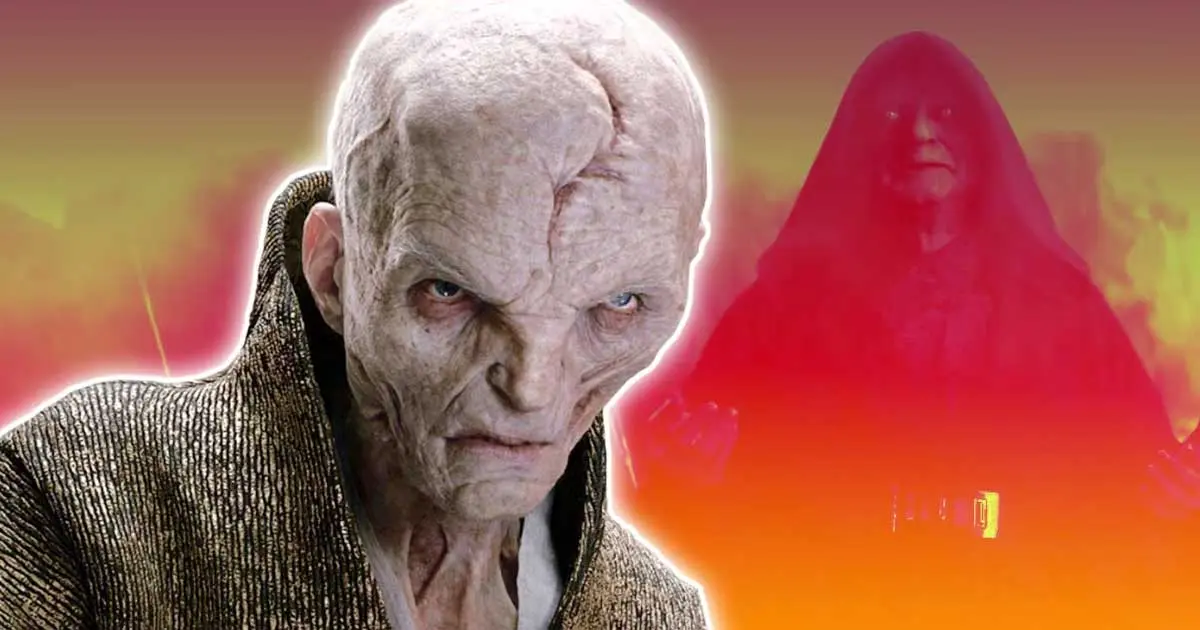
Supreme Leader Snoke is the Supreme Leader of the First Order and the master of Kylo Ren in the Star Wars sequel trilogy. Emperor Palpatine created Snoke to be his proxy through which he could regain his power. Although Snoke was bio-engineered in a lab on Exegol, he was a strandcast, not a true clone. This Star Wars jargon means Snoke is not an exact copy of anyone, but is not natural-born either. Palpatine’s ultimate plan was to use Snoke as his voice to whisper in Kylo Ren’s ear.
The full answer to who Snoke is requires separating what the first two sequel films appeared to present a powerful, ancient, independent dark side master of unknown origin from what The Rise of Skywalker ultimately revealed: a manufactured being who never knew his own nature, serving a purpose he was never told about.
Key Takeaways
- Supreme Leader Snoke is a fictional character in the Star Wars franchise the Supreme Leader of the First Order and the master of Kylo Ren, introduced in The Force Awakens (2015).
- Snoke is not a naturally born being. He is an artificial strandcast a genetic creation engineered by Emperor Palpatine on the secret Sith planet Exegol, designed to serve as Palpatine’s proxy in controlling the First Order.
- Snoke was not a true clone of Palpatine but a composite creation combining Palpatine’s DNA with that of other Force users. He was deemed the superior version among all strandcast experiments, yet his body decomposed rapidly making him unsuitable as a vessel for Palpatine to permanently inhabit.
- Crucially, Snoke did not know he was a created being. He believed himself to be a genuine, independent power in the galaxy, which was precisely what made him useful to Palpatine as a convincing ruler.
- Snoke was killed by Kylo Ren in The Last Jedi (2017), when Kylo used the Force to activate Snoke’s own lightsaber mid-speech, cutting Snoke in half.
- Snoke was voiced and performed via motion capture by Andy Serkis in all three sequel trilogy films.
- The character was designed partly with reference to Peter Cushing, who played Grand Moff Tarkin in the original 1977 Star Wars film.
- Snoke predates the events of the original trilogy he was likely created before 12 BBY, prior to the creation of Dathan, Rey’s father.
Snoke’s Origin: The Strandcast Experiment on Exegol
What Is a Strandcast?
A strandcast is a term introduced in The Rise of Skywalker to describe a genetically engineered being who is neither a natural birth nor a true clone of a single source.Snoke was engineered to be a new clone body for Emperor Palpatine to extend his life force upon his death. Palpatine had Imperial scientists working extensively on cloning but it was the work of the Sith Eternal cult on Exegol that made the most progress. Snoke was not a true clone of Palpatine, but an artificial strandcast with no knowledge of his true lineage.
The distinction between a strandcast and a clone matters in the Star Wars context. A clone is a direct genetic replica of a source individual. A strandcast is a new combination in Snoke’s case, a composite genetic creation blending Palpatine’s DNA with that of other Force-sensitive beings. Snoke is implied to be part-Palpatine, combined with the DNA of other Force users. This composite nature explains both his Force sensitivity which was real and substantial and his physical deterioration, since the genetic combination produced a body that decomposed more rapidly than a natural being.
Where Was Snoke Created?
Snoke was created on Exegol, the hidden Sith planet in the Unknown Regions of the galaxy. Snoke’s origin is Exegol. Exegol was the secret base of operations for the Sith Eternal, a cult of Sith loyalists who had been working in secret since the fall of the Empire to restore Palpatine’s power. The cloning facilities on Exegol visible in the background of The Rise of Skywalker as vats of liquid containing failed or redundant Snoke bodies represent the scale of Palpatine’s genetic experimentation program.
When Was Snoke Created?
As for Snoke’s creation date, it is highly likely that the being who would become Supreme Leader was actually created before the events of the original trilogy. Snoke was said to predate the creation of Dathan, the failed clone of Palpatine who became Rey’s father, who was made in 12 BBY 12 years before the original trilogy. This places Snoke’s creation at some point in the era of the original trilogy or earlier, meaning Snoke was already in existence while the events of the original trilogy were unfolding while Luke was destroying the first Death Star, while Darth Vader was revealed as Luke’s father, while the Emperor was defeated at Endor.
Snoke’s Role: The Perfect Puppet
Why Palpatine Needed Snoke
After his defeat and apparent death at the Battle of Endor in Return of the Jedi, Palpatine’s spirit survived weakened, dependent on dark side power to maintain coherence, and desperately in need of a suitable physical vessel. His own body was destroyed. His clone bodies were imperfect physically deteriorating, lacking the Force sensitivity he required.
With his own clone body decrepit but his spirit still strong in the Force, Palpatine could possess other people but was looking for a permanent new vessel. Since Palpatine had to hide his weak clone body from everyone except his secret Sith acolytes, he placed Snoke in charge of the day-to-day growth of the First Order.
Snoke served two functions simultaneously. He was the visible, commanding face of the First Order the public ruler whose authority organised the remnants of the Empire into a new military and political force. And he was the instrument through which Palpatine pursued his real objective: finding a worthy heir, specifically by turning Ben Solo (Kylo Ren) to the dark side and eventually positioning either Kylo or himself as the supreme ruler of the galaxy.
The First Order Under Snoke
The First Order is a fictional military movement in the Star Wars franchise led by puppet ruler Supreme Leader Snoke until he is overthrown by Kylo Ren. Through Snoke, Palpatine seduced Leia’s own son Ben Solo to the dark side, who renamed himself Kylo Ren.
Snoke’s leadership of the First Order spanned approximately the period from 21 ABY to 34 ABY in Star Wars canon chronology. During this time, the First Order transformed from the scattered remnants of the Empire in the Unknown Regions into a military power capable of threatening the New Republic culminating in the destruction of the Hosnian system in The Force Awakens.
Snoke Did Not Know His True Nature
One of the most significant details about Snoke is that he was unaware of his own origin. Snoke was the superior version of all the strandcasts, despite the fact that his body would decompose at a rapid rate, but still did not suit Sidious’ purposes. Palpatine found him unworthy as a vessel to inhabit and continued his cloning efforts. This was another hint from Palpatine to his subconscious, who became obsessed with turning a Skywalker to the dark side.
Snoke genuinely believed himself to be a powerful, independent dark side master who had risen to command the First Order through his own strength and intelligence. He had no knowledge of the Sith Eternal on Exegol, no knowledge of the vats of his own copies stored there, and no knowledge that his every action served Palpatine’s larger plan. This ignorance made him a more convincing ruler and ultimately made him more useful as a disposable instrument.
Snoke’s Physical Appearance: Why He Looks the Way He Does
Snoke’s appearance tall, skeletal, heavily scarred, with a deeply asymmetrical face and visibly decomposing physical form is one of the most striking in the sequel trilogy. The design choices behind it reflect both the in-universe biology of strandcasting and the out-of-universe creative decisions of the Lucasfilm production team.
In-Universe Explanation
Supreme Leader Snoke is actually a clone of Palpatine, meant to provide the former Emperor with a body to possess in the event of his destruction. Midi-chlorians are a biological quality in Star Wars, and attempting to control and manipulate a body’s capacity for them can have disastrous results. Almost every clone seen on Exegol seems to look more like Snoke than Darth Sidious, implying that the cloning technology cannot keep up with Palpatine’s expectations.
The scarring, deterioration, and physical distortion visible in Snoke’s appearance reflect the failure of the strandcasting process to produce a stable, healthy body. The same Force sensitivity that made Snoke powerful accelerated the biological breakdown of his genetic structure. His body decomposed even as he lived which is why, in the background of The Rise of Skywalker, his clones in the Exegol vats share his characteristic deteriorated appearance rather than the healthy human form of Palpatine.
Out-of-Universe Design
Creature creative supervisor Neal Scanlan did not want Snoke to be old and decrepit like Emperor Palpatine. Designer Ivan Manzella, influenced by a reference from director J.J. Abrams to Hammer House of Horror, partially based a maquette of Snoke on Peter Cushing, who portrayed Grand Moff Tarkin in the original 1977 Star Wars film. The robe Snoke wears in The Last Jedi carries glyphs referencing four philosophers whose statues appeared in Palpatine’s office in Attack of the Clones a detail that retroactively connected Snoke’s visual presentation to the Palpatine lineage before that connection was made explicit in the story.
The question of how a character’s physical presence communicates their nature menace, authority, decay is one that visual designers engage with across every creative medium. The deliberate choices behind Snoke’s silhouette, texture, and proportion follow the same logic that any artist applies when designing a figure intended to convey specific qualities to an audience. Shani Levni’s exploration of Shani Levni art style addresses the principles behind visual character and expressiveness in a different context the way an artist’s choices of form, colour, and line communicate meaning beyond the literal subject. Those same principles of visual communication underpin character design in every creative field.
Snoke’s Power: What Could He Do?
Force Abilities
Snoke was a genuine and powerful Force user. The fact that he was a manufactured being did not diminish the reality of his abilities his strandcast composition incorporated Force-sensitive DNA, and the Force sensitivity that resulted was authentic and substantial.
His documented Force abilities include:
Force projection: Snoke connected Rey and Kylo Ren across vast galactic distances through a Force bond that even he did not fully understand. This connection a “Force dyad” in the deeper lore was something Snoke manipulated but ultimately could not control, because it was a phenomenon rooted in Rey and Kylo’s specific relationship rather than in Snoke’s own power.
Telekinesis: In The Last Jedi, Snoke demonstrated the ability to throw Rey across the room with a gesture and to hold her suspended in the air while examining her.
Force torture: Snoke extracted mental information from Rey through a process that caused her visible physical and psychological distress.
Mind manipulation: His long-term cultivation of Kylo Ren involved sustained psychological influence over years, gradually deepening Ben Solo’s commitment to the dark side through a combination of guidance, manipulation, and Palpatine’s underlying direction.
Palpatine’s ultimate plan was to use Snoke as his voice to whisper in Kylo Ren’s ear. He expanded the First Order’s borders just as Palpatine had planned.
Snoke’s Height: A Notable Physical Characteristic
Snoke is consistently depicted as significantly taller than the human characters around him an imposing physical presence that reinforces his authority even before he speaks.
Snoke was engineered to be the superior version of all the strandcasts, despite the fact that his body would decompose at a rapid rate. In the films, Snoke’s physical stature is used deliberately to create an imbalance of scale in scenes with Kylo Ren and Rey he looms rather than simply stands. His official height in Star Wars canon is approximately 2.17 metres (7 feet 1 inch) tall.
The same instinct that makes Snoke’s unusual height a meaningful design element the connection between physical scale and perceived authority, threat, or power is what drives general public curiosity about the real-world heights of public figures. The Shani Levni guide to how tall is Ashton Hall reflects the same underlying interest: what does height communicate about a person, and how does physical scale shape our perception of who someone is?
Snoke’s Death in The Last Jedi
Snoke’s death is one of the most memorable moments in the sequel trilogy a scene that subverted audience expectations while remaining consistent with the internal logic of the characters involved.
In The Last Jedi (2017), Snoke ordered Kylo Ren to kill the “true enemy” meaning Rey, who was kneeling before Snoke’s throne. Kylo used the Force to move Snoke’s own lightsaber, which was on the armrest beside Snoke’s throne. As Snoke’s attention was directed at Rey, Kylo activated the lightsaber and it cut through Snoke from the side, killing him instantly.
Snoke’s death allowed Kylo Ren to become the new Supreme Leader, further destabilising the galaxy and paving the way for Palpatine to reveal himself and attempt to reclaim ultimate power.
The significance of the death was threefold. For Kylo Ren, it represented a decisive break from his master and an assertion of independence a moment of genuine agency after a lifetime of being directed by others. For the audience, it removed the character who had been established across two films as the primary antagonist of the sequel trilogy. And for Palpatine’s plan, it was an acceptable outcome Snoke had served his purpose in delivering Kylo Ren to his current state, and Kylo could now be manipulated directly.
Who Played Snoke? Andy Serkis
Snoke was voiced and performed by Andy Serkis in all three sequel trilogy films. Serkis is one of the world’s foremost practitioners of motion capture performance, known for his work as Gollum in The Lord of the Rings and Caesar in the Planet of the Apes reboot trilogy.
Serkis performed Snoke on a motion capture stage, with his physicality and facial performance translated into the digital character through Lucasfilm’s technical pipeline. The result was a character whose emotional expressiveness the contempt, the intelligence, the moments of what appeared to be genuine pain when he was killed reads as a real performance rather than a digital construction.
The Darth Plagueis Theory: The Fan Theory Snoke Disproved
Before The Rise of Skywalker resolved Snoke’s identity, the most popular fan theory about his origin was that he was Darth Plagueis the Sith master of Palpatine, whom Palpatine was said to have killed in his sleep and who was described in Revenge of the Sith as having discovered a way to prevent death through the Force.
The theory was elegant: Darth Plagueis, who had studied midi-chlorians and the manipulation of life itself, survived his apparent death and eventually emerged as Snoke, having rebuilt himself in a new form over decades in the Unknown Regions. The physical scarring would reflect the difficulty of that survival and reconstitution.
The theory was ultimately incorrect. The Rise of Skywalker confirmed that Snoke was created by Palpatine rather than being Plagueis in a new body. Snoke was secretly created by the resurrected Emperor Palpatine to control the First Order after purging its previous leadership. The Plagueis connection, while thematically satisfying, was not the direction Lucasfilm chose a creative decision that remains divisive among Star Wars fans.
Snoke and the Sequel Trilogy: A Narrative Assessment
From a storytelling perspective, Snoke occupies an unusual position in the sequel trilogy a character built up across two films as a major antagonist who was killed before his origins were explained, with those origins revealed in a third film that many viewers found unsatisfying as a resolution to the mystery.
The decision to kill Snoke in The Last Jedi (director Rian Johnson) without resolving his backstory was a deliberate narrative choice that prioritised Kylo Ren’s character development over Snoke’s identity. Johnson has described the decision as necessary to the story he was telling the point was Kylo’s act of agency, not Snoke’s biography.
The subsequent resolution in The Rise of Skywalker that Snoke was a Palpatine creation all along satisfied some audience members and frustrated others. Critics of the reveal argued that it reduced a genuinely mysterious and menacing character to a plot device. Defenders of the reveal argued that it created a coherent through-line connecting all nine films of the Skywalker saga, placing Palpatine as the hidden hand behind all three trilogies.
Snoke’s Timeline in Star Wars Canon
| Period | Event |
|---|---|
| Before 12 BBY | Snoke created on Exegol by Palpatine’s Sith Eternal scientists |
| 0 BBY to 4 ABY | Events of the original trilogy; Snoke exists but is not yet a public figure |
| 4 ABY (Battle of Endor) | Palpatine apparently defeated; Snoke begins organising First Order remnants |
| 21 ABY (approx.) | Snoke formally established as Supreme Leader of the First Order |
| 28 ABY (approx.) | Snoke begins cultivating Ben Solo toward the dark side |
| 34 ABY | The Force Awakens: Snoke leads the First Order; Hosnian system destroyed |
| 34 ABY | The Last Jedi Snoke killed by Kylo Ren; Kylo becomes Supreme Leader |
| 35 ABY | The Rise of Skywalker: Snoke’s origin revealed; Palpatine steps from the shadows |
Conclusion
Supreme Leader Snoke is one of the most unusual villain constructions in the Star Wars franchise a character of apparent immense power and mystery who turns out, on full examination, to be a created instrument of someone else’s will who never understood his own nature.
The answer to who Snoke is operates on two levels. In the story, he is a strandcast engineered by Palpatine to serve as his proxy ruler, a being of genuine Force power who lived and died without knowing he was manufactured, without knowing the vats of his copies that existed on Exegol, and without knowing that every decision he made served a plan designed before he was born. In the narrative, he is a structural device a false antagonist whose removal cleared the space for the real threat to emerge and whose existence retroactively connected all three trilogies under a single orchestrating intelligence.
Whether that construction serves the story effectively remains the most debated aspect of the sequel trilogy. What is beyond dispute is that during the two films in which he appeared in full command, Snoke was among the most visually and tonally striking villain presences Star Wars had produced a character whose mystery, in the moment of its existence, was more compelling than any explanation could be.
For more character profiles, pop culture deep dives, and entertainment guides, explore the full library at Shani Levni.
Frequently Asked Questions
Who is Supreme Leader Snoke in Star Wars?
Supreme Leader Snoke is the Supreme Leader of the First Order and the master of Kylo Ren in the Star Wars sequel trilogy. He is an artificial genetic creation a strandcast engineered by Emperor Palpatine on the hidden Sith planet Exegol. He served as Palpatine’s puppet and proxy ruler of the First Order, controlling the organisation while Palpatine pursued his plan to return to power through the dark side.
Is Snoke a clone of Palpatine?
Snoke is not a true clone but a strandcast, a composite genetic creation that combines Palpatine’s DNA with that of other Force users. He is not an exact copy of Palpatine. The distinction is significant: a clone replicates a single genetic source, while a strandcast is a deliberately engineered combination. Snoke’s strandcast nature explains both his genuine Force sensitivity and his physical deterioration.
Who killed Snoke?
Snoke was killed by Kylo Ren in Star Wars: The Last Jedi (2017). During a throne room scene, Kylo used the Force to activate Snoke’s own lightsaber, which was positioned beside Snoke’s throne. While Snoke’s attention was focused on Rey, the ignited lightsaber cut through him from the side, killing him instantly.
Did Snoke know he was created by Palpatine?
No. Snoke had no knowledge of his own origin. He did not know he was a strandcast, did not know about the Sith Eternal on Exegol, and did not know that his entire purpose was to serve Palpatine’s plan. He believed himself to be a genuine, independent dark side power who had risen to leadership through his own abilities. This ignorance was fundamental to his usefulness a puppet who knows he is a puppet is a far less convincing ruler.
Who played Snoke?
Snoke was performed by Andy Serkis through motion capture in all three sequel trilogy films The Force Awakens, The Last Jedi, and The Rise of Skywalker. Serkis is one of the world’s foremost practitioners of motion capture performance, known for Gollum in The Lord of the Rings and Caesar in the Planet of the Apes trilogy.
How tall is Supreme Leader Snoke?
Snoke’s official height in Star Wars canon is approximately 2.17 metres roughly 7 feet 1 inch. His imposing physical stature is a deliberate design choice that reinforces his authority in scenes with other characters, creating a visual imbalance that makes him appear dominant even when seated.
Was Snoke supposed to be Darth Plagueis?
No, though this was the most popular fan theory before The Rise of Skywalker resolved the question. Many fans believed Snoke was Darth Plagueis Palpatine’s former master, who was described as having discovered a way to prevent death surviving and rebuilding himself in a new form. The Rise of Skywalker confirmed that Snoke was instead a creation of Palpatine, not a separate character who had survived across decades.