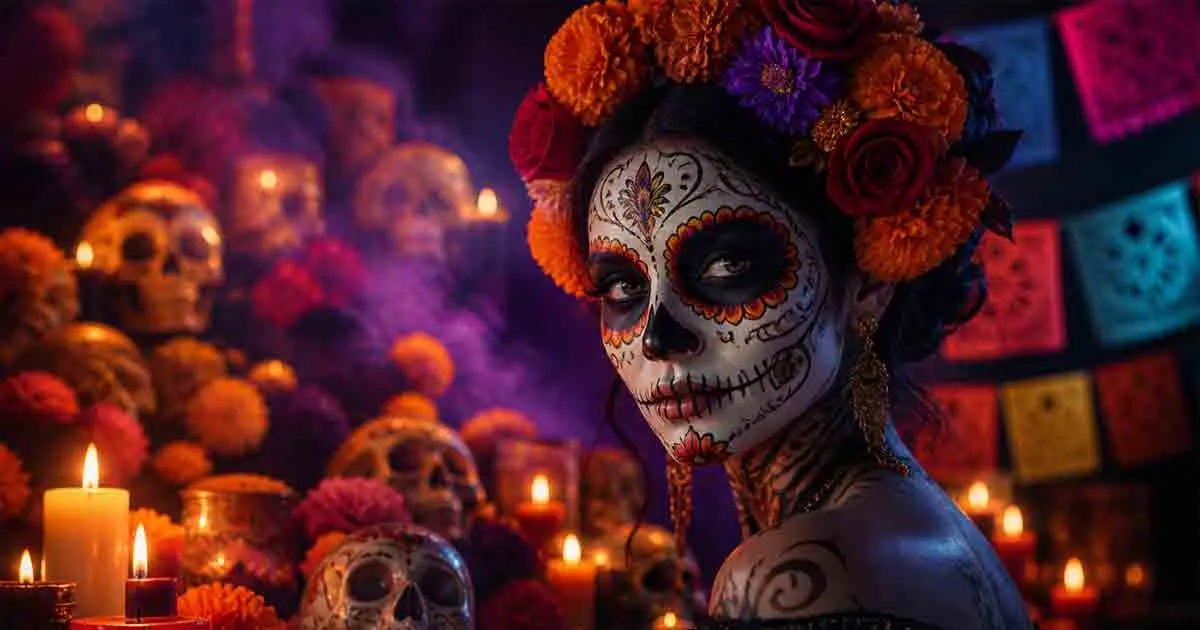
The Day of the Dead art is a visual tradition that is based on the belief that death is not an end but a continuation of life. Dia de los Muertos creates some of the most unique art in the world: sugar skulls adorned with colored icing, elegant skeleton figures dressed in Victorian clothing, tissue paper cut into elaborate lace patterns, and altars built out of marigolds, photographs, and candlelight. The art is a celebration and devotion a bridge between the living and the dead. To appreciate these forms of art, one has to comprehend the culture that they represent.
Key Takeaways
- According to the Mexican Museum, Day of the Dead artwork (Dia de los Muertos) is based on a 3,000-year-old artistic tradition of Mesoamerica.
- The most well-known forms of art are sugar skulls (calaveras), La Catrina figures, papel picado, ofrenda altars, and amate paper paintings.
- La Catrina iconic image was produced by Mexican printmaker Jose Guadalupe Posada (18521913) as a social and political satire.
- The Day of the Dead art has bright oranges, yellows, pinks, and blues to show the vibrancy of life and not the darkness of death.
- Dia de los Muertos was listed by UNESCO in 2008 on the Representative List of the Intangible Cultural Heritage of Humanity.
- Day of the Dead art entered into the public spaces and galleries through the Chicano art movement in the United States, spearheaded by Self Help Graphics and Art in East Los Angeles since 1973.
Historical origins of Day of the Dead Art
Observances of the Day of the Dead have their documented origins in pre-Hispanic Mesoamerica, with the Mexican Museum placing their ritual antecedents at over 3,000 years ago among the Olmecs, Toltecs, Mixtecs, Zapotecs, Maya and Aztec peoples. To these civilizations, death was seen as a natural phase in a bigger cycle and not an end. Their rituals to honor their dead, such as offering food, flowers and objects were captured in murals, painted pottery and stone monuments.
Catholic traditions such as All Saints’ Day and All Souls’ Day were overlaid on these native practices when Spanish colonizers arrived in the 16th century. This outcome, over a number of centuries, was a mixed tradition that preserved its indigenous nature but assumed the dates of the Catholic liturgical calendar. Wikipedia says that in 2008, UNESCO inscribed the tradition on its Representative List of the Intangible Cultural Heritage of Humanity.
The artistic vocabulary of the contemporary Day of the Dead, skulls, skeletons, marigolds and altars, is based on this long synthesis of indigenous and European traditions, influenced further by the social activism of Mexican and Chicano artists in the 20th century.
The key Art Forms of Dia de los Muertos
Sugar Skulls (Calaveras de Azúcar)
One of the most familiar symbols of Day of the Dead artwork are sugar skulls. They are made by mixing granulated sugar and meringue powder, then shaped into skulls and then painted in bright patterns, using colored icing, tin foil, and sequins. The decoration of either skull indicates the liveliness and character of the one being honored, not the sadness of their death.
The skulls are offered as offerings to the returning dead or as a gift with the name of the recipient written across the forehead. Their graphic language, vivid, lavish, and festive, established most of the color palette that defines Day of the Dead art more generally.
La Catrina: The Gracious Lady of Skeleton
There is no character in the artwork of Day of the Dead that is more easily identifiable than La Catrina. The Catrina image was painted by Mexican printmaker and lithographer Jose Guadalupe Posada in the mid-to-late 1800s. The original figure, which was created by Posada was a political satire of a female skeleton wearing the plumed European hat popular among the elite in Mexico, a sharp reminder that death makes all the social classes meaningless.
This figure was subsequently called La Catrina and painted into the famous 1947 mural, also titled Sueño de una Tarde Dominical en la Alameda Central, painted by Diego Rivera, who put her in the same composition with other figures in Mexican history and culture. The first three-dimensional Catrina sculpture was made in clay in the 1980s, by Juan Torres in the town of Capula, Michoacan, a town known for the production of pottery since pre-Hispanic times. It was there that the Catrina spread into wood, papier-mâche, plaster, tin, and even bread dough, becoming one of the most widely-produced and internationally-recognized examples of Mexican artistry.
In modern times, people paint their faces with Catrina figures during the celebration of the Day of the Dead, which is done in San Miguel de Allende, where thousands of Catrina figures were paraded through the streets during the festival.
Papel Picado
Papel picado, or perforated paper, is a traditional Mexican art form that existed prior to the Spanish colonization. The World History Encyclopedia states that it was initially an art form of the Aztecs. The patterns, pictures, or scenes are cut by skilled artisans into up to 50 sheets of tissue paper at a time. The imagery that is created about Day of the Dead usually incorporates ofrendas, religious objects, and skeletons or skulls that are depicted in different activities.
During the festival, the colorful paper flags are hung across altars, streets, and other public areas. Their fragility is not accidental: the lightness of the paper symbolizes the fragility of life itself. Meanwhile, their color and detail symbolize the beauty that life has.
Ofrenda Altars
The main artifact of Day of the Dead celebration and among the most intricate forms of art is the ofrenda, or alter. The altars are built with two levels to symbolize heaven and earth, three levels to include purgatory or seven levels to represent the steps to reach heaven.
All the items in the altar have symbolic significance. Water has been added to cool the thirst of spirits coming back. The candles are lit to show the spirits the way home. Food, especially the favorite foods of the deceased, are offered as food and comfort. Placed in the paths between the cemetery and the home, the strong fragrance of the marigolds is believed to help in guiding the souls of the dead back to the living. The photographs of the deceased are put in the center and therefore the person being honored is the center of the composition.
All the altars are unique and handcrafted, which reflects not only the personality of the person being honored but also the aesthetic sense of the family that made it.
Amate Paper Paintings
Amate paper painting has a unique niche among the regional forms of Day of the Dead art. Nicolas de Jesús, a Nahuatl painter, born in Guerrero, is known to have made etchings and amate paper paintings of Day of the Dead as it is practiced in indigenous communities. His works, according to mexican-folk-art-guide.com, combine local and universal elements, everyday scenes with the symbolism of his ancestors.
Even the Amate paper is made of the bark of the wild fig tree, which was used in pre-Columbian Mexico way before the arrival of the Spaniards. The amate paintings are generally bright in color, flat in perspective, and direct in their imagery, features which are typical of folk art tradition of which they are a part.
Tapetes de Aserrín (Sawdust Carpets)
One of the more ephemeral and labor-intensive Day of the Dead art forms is the tapete de aserrín, or sawdust carpet. As traveler Becky Wandell has seen in central Mexico: these carpets are designed by artisans right in the street using entirely natural materials like dyed wood shavings, salt, black, red and white beans, lentils, corn, and flower petals. The carpets are only two-night-old and lead the spirits through the community and are swept away by the morning on November 3rd.
This is not incidental to this temporary nature. Similar to the impermanence of the sand mandalas of Tibetan Buddhist tradition, the impermanence of tapetes de aserrin is also reflected in a philosophical approach to the impermanence and the importance of creating something beautiful exactly because it will not last.
Color Language of Day of the Dead Art
Day of the Dead artwork has a unique and purposeful palette. The visual language of the tradition is dominated by bright oranges, yellows, pinks and blues, the visual language of the tradition expresses the vitality and beauty of life rather than mourning or darkness.
| Color | Symbolic Meaning |
| Orange and yellow | Marigolds, sunlight, guiding spirits home |
| White | Purity and hope |
| Purple | Grief and mourning |
| Pink | Celebration and festivity |
| Red | The blood of life |
| Black | The Aztec underworld |
This use of color, which is deliberate and has meaning, is one of the most consistent elements of all forms of Day of the Dead artwork, whether it is the smallest sugar skull or the most elaborate altar.
The Birth of Modern Day of the Dead Art and the work of Jose Guadalupe Posada
No other person has influenced the artwork of Day of the Dead more than Jose Guadalupe Posada (18521913). Posada was a lithographer, engraver and printmaker who created thousands of illustrations to satirize the political leaders and social elites of his era. His calaveras, or skeleton figures that he drew, according to the Smithsonian American Art Museum, was a reminder that death levels the playing field and that all people, whether rich or poor, are equal in the eyes of death.
His impact was so widespread even after his own death. The stylized skeletons, the elaborate clothing, the blend of humor and reverence all bear the mark of the work of Posada. Modern artists who practice in the traditions of Day of the Dead still practice his imagery, as both a tribute and a living tradition.
The fact that the visual language of one artist can have an impact on a whole cultural tradition over the generations is a phenomenon that rings very deafeningly in the study of art history. It is also a question that runs through the work that is being discussed in depth on the Shani Levni art style page where the relationship between the personal vision of an artist and the wider cultural context in which they are working is explored in the same depth.
Day of the Dead and Chicano Art Movement in the United States
The inclusion of Day of the Dead art in the United States can be greatly attributed to the intentional efforts of Chicano artists and activists in the 1970s. The Smithsonian American Art Museum states that one of the earliest modern public celebrations was organized in East Los Angeles in 1973 by Self Help Graphics and Art, the oldest Chicanx art center that is still in existence. They aimed at reviving native traditions to the holiday and to use it as a means of cultural and political awareness among the people of Mexican origin.
Day of the Dead was introduced through their community-based events and as a political message by their public events, which ended at cemeteries with altars honoring those killed by gang violence. Notable Chicanx artists who contributed to these early celebrations include Ester Hernandez, Carlos Almaraz, Judith Baca, and the ASCO collective members Harry Gamboa, Gronk, Willie Herrón, and Patssi Valdez.
The earliest known activities of Day of the Dead occurred in the early 1970s in San Francisco. The first Day of the Dead altar exhibition was organized by René Yañez and Ralph Maradiaga at La Galería de La Raza. As the Mexican Museum notes, today, the Day of the Dead has been perceived as an urban artistic movement that has united communities throughout the United States.
This application of community art as a tool to establish community and maintain cultural identity is a theme that directly relates to the work that was discussed in the guide to The Root Collective where artistic practice is used as a means of community cohesion and preservation of shared memory.
Day of the Dead Art outside Mexico
The art of Day of the Dead has reached much further than Mexico. It is observed in Bolivia, Ecuador, Peru, Guatemala, and Haiti, all with regional differences in artistic practice. It has been integrated into popular culture in the United States, through museum exhibitions, public art installations, community events, and commercial production.
The international distribution of the Day of the Dead imagery begs the valid questions of cultural context and authenticity. Not every product that is decorated with the aesthetics of the tradition reflects deeper meanings of the tradition. The guide to Mexican folk art observes that there are now mass-produced trinkets alongside the authentic artisan pieces and that these trinkets are not necessarily representative of authentic traditions, but they do indicate that the celebration has a global reverberation.
To those who are collectors, teachers, or artists of Day of the Dead artwork, the issue of authentic craft versus commercial reproduction is of concern. The most significant works are those that are created as a part of the tradition itself, by craftsmen whose practice relates to the living cultural community the art is a part of.
The issue of how the traditions of art can retain their integrity when they cross the borders of the countries and find broader audiences is one the literary analysis on the Painting Swimming Pool with Epoxy Paint guide touches on in a different key, where the careful, material-based thinking of traditional craft is shown to produce more durable results than shortcuts. The same can be said about cultural art traditions: integrity of process is what makes the work last over time.
Production of Day of the Dead Artwork: Traditional and Contemporary
Traditional Craft Approaches
The most popular traditional Day of the Dead art projects, according to miguelcamarena.com, include:
- Decoration of sugar skulls: Calaveras are moulded and hand-painted with colored icing, foil and sequins to commemorate particular individuals.
- Construction of ofrendas: Constructing a multi-level altar with photographs, marigolds, candles, food offerings, and papel picado.
- Creation of a Catrina: Sculpting or painting a Catrina figure in vibrant colors, with traditional decorative elements, whether in clay, papier-mache or on canvas.
- Papel picado cutting: A cutting technique using tissue paper and small scissors or a craft knife to cut elaborate patterns, usually of skeletons, flowers, and geometric patterns.
- Paper maché calavera sculpture: Construction and painting of three dimensional skeleton figures in poses of their preference, often with the deceased in activities they loved in life.
Contemporary Reinterpretations
Modern artists who work within and with traditions of Day of the Dead include artists who work within the specific regional folk art practices and artists who incorporate the imagery of Day of the Dead into fine art, street art, printmaking, and digital illustration. The visual language of the tradition, its vivid colors, its lavish detail, its mixture of humour and mortality, are easily translated across forms and media.
The richness and sincerity of the visual self-expression that defines the finest Day of the Dead art is something explored through a different artistic prism on the Shani Levni exhibitions page, in which the connection between the personal history of an artist and the work that they create is a key theme.
Conclusion
The art of the Day of the Dead is among the most rich and historically stratified visual tradition in the world. Its art forms, the sugar skull to the tapete de aserrin, carry with them thousands of years of accrued meaning about the relationship between the living and the dead, between memory and loss, and between individual lives and the communities that remember them.
The reason why its main idea, to celebrate the dead with beauty, humor, and sincerity, has not only survived the colonization, cultural transformation, and global commercialization, but has also been as relevant today as it was three thousand years ago. To artists, educators, collectors and anyone who is attracted to the aesthetic language of this tradition, working with Day of the Dead art would mean working with one of the most sincere and persistent efforts of humankind to make something beautiful in the face of mortality.
To continue writing about art, culture, and creative traditions, see the entire scope of content at Shani Levni.
Frequently Asked Questions
What is the Day of the Dead artwork?
Dia de los Muertos artwork Day of the Dead art Day of the Dead artwork refer to the visual art forms associated with Dia de los Muertos, the Mexican holiday celebrated on November 1 and 2. It contains sugar skulls, La Catrina figures, papel picado, ofrenda altars, amate paper paintings, tapetes de aserrin, and a large variety of folk art objects. The art is inspired by the 3,000-year-old Mesoamerican tradition mixed with the Catholic influence that was brought by the Spanish colonization.
Who painted La Catrina?
La Catrina is a Mexican print illustration by Mexican printmaker Jose Guadalupe Posada (18521913). His original character, named La Calavera Garbancera, was a political satire in which the character is a skeleton wearing the trendy European hat of the upper classes in Mexico. The figure was later painted into a famous 1947 mural by Diego Rivera, where she is called La Catrina and established herself as a significant part of Mexican cultural identity.
Which colors do we use in the artwork of the Day of the Dead?
Day of the Dead artworks are also typified by vivid, colorful hues: orange and yellow (symbolizing marigolds and the sun), pink (party), red (life), white (purity), purple (death), and black (the underworld). The colors are used to show the vibrancy of life as opposed to the gloominess of death, which is why the Day of the Dead artworks look festive and celebratory as opposed to gloomy.
What is a sugar skull and what does it mean?
A sugar skull (calavera de azucar) is a decorative and occasionally edible skull made of granulated sugar and meringue powder, decorated with colored icing, foil and sequins. Each skull is dedicated to a certain person that has passed away and the name of the person is often written across the forehead. The decoration is associated with the character and energy of a given individual instead of lamenting the loss of that individual.
What is papel picado and why is it used in Day of the Dead art?
Papel picado is a type of tissue paper that is cut into elaborate designs by hand and used as decoration during Day of the Dead festivities. Its frailty is a symbol of frailty of life. The art form is older than the colonization of Spain and it was initially practiced by the Aztecs. In the case of Day of the Dead, the patterns of papel picado usually feature images of skeletons, flowers, religious symbols and ofrendas.
Do the Day of the Dead artworks resemble the Halloween artworks?
No. Day of the Dead and Halloween have certain visual elements, especially skulls and skeletons, but they belong to the different cultural traditions, with different meanings. The imagery of Halloween is inclined to focus on horror and threatening nature of death. The artwork of Day of the Dead is based on the celebration, memory, and the idea that the dead come back to see the living. The art is not frightening but joyful and colorful.
What impact did Chicano artists have on the Day of the Dead art in the United States?
Chicano artists, especially those who had been part of Self Help Graphics and Art in East Los Angeles since 1973, intentionally revived indigenous traditions to Day of the Dead celebrations and brought the holiday into the mainstream, including museums, galleries, and cemeteries. Their work changed Day of the Dead into a family celebration into a cultural and political protest. Artists such as Ester Hernandez, Carlos Almaraz and Judith Baca helped form the shape that Day of the Dead public art has today in the United States.